
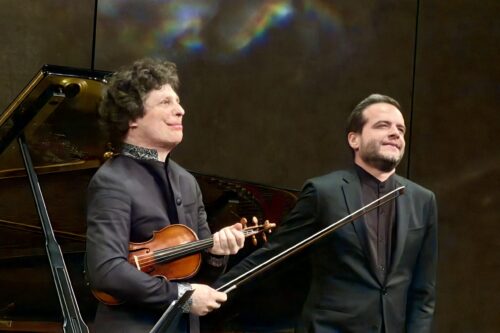
 United States Various: Augustin Hadelich (violin), Francesco Piemontesi (piano). San Francisco Performances, Herbst Hall, San Francisco, 20.3.2026. (HS)
De Grigny (arr. Piemontesi) – ‘Récit du chant de l’hymne précédent’
Debussy – Sonata for Violin and Piano in G minor
Rameau (arr. Piemontesi) – Pièces de clavecin en concert: Second Concert in G Major, ‘La Boucon’
Poulenc – Sonata for Violin and Piano ‘à la mémoire de Federico García Lorca’
Kurtág – Tre Pezzi, Op.14e
Franck – Sonata for Violin and Piano in A major
Encore: Poulenc – ‘C’
A recital by violinist Augustin Hadelich is not just a run-through of fine music by an especially gifted player. It is eye-opening, both for its virtuosity and for its revelations. It makes a point. It focuses on aspects of music, either familiar or rare, that we may not have noticed before. This thrilling recital by Hadelich and pianist Francesco Piemontesi demonstrated how attention to detail can mesh with a sense of form and structure to make magic.
The program of three great French violin sonatas preceded each one with short pieces that could segue seamlessly and create a revealing atmosphere to frame the sonatas. First up was a highly ornamented 17th-century church interlude by Nicolas de Grigny, the all-but-forgotten French organ composer. Piemontesi’s arrangement emphasized a gentle flow through all the trills and flourishes, contrasting and spotlighting the hazy, uncertain opening measures of Claude Debussy’s Sonata in G minor.
Written shortly before Debussy’s untimely death in 1918, the sonata bobs and weaves through a range of moods. Hadelich and Piemontesi brought a thoughtful structure to the kaleidoscopic music with the same uncanny sense of flow. Between Hadelich’s clarity and the pianist’s subtly applied gradations of dynamics, the piece blossomed into superb music-making.
Another deft Piemontesi arrangement of a Baroque curiosity preceded Francis Poulenc’s Sonata for Violin and Piano ‘à la mémoire de Federico García Lorca’. Hadelich spun out the lyric melody of Jean-Philippe Rameau’s brief but heartfelt ode to a talented young harpsichord student, Anne-Jane Boucon, with a sweetness that glided smoothly into the gentle opening measures of the Poulenc sonata.
Poulenc’s anger at the execution of the Spanish poet at the hands of fascists in the Spanish Civil War inspired the sonata, but the opening began gently before it gathered its potent energy. Once the pace revved up, both the violinist and pianist exploited every opportunity for virtuosity. The Allegro first movement reflected the fiery brilliance of Lorca’s verses. The slower Intermezzo, with its guitar-like pizzicato phrases, offered the balm of sunny Spain. Only the finale, with a musical depiction of gunshots and the ebbing away of Lorca’s life at the end, fashioned a gritty mood that was all the more shocking for the upbeat music that came before.
After intermission three spare but evocative pieces by the quirky Hungarian composer György Kurtág, played with straight-faced deadpan, introduced Cesar Franck’s maximalist, almost symphonic, Sonata in A major. Kurtag’s offbeat melodies traced an up-and-down-and-back-again shape that would prove to be strikingly similar to the idée fixe that Franck employed to tie together the movements of his sonata.
Thus, the quiet fragmented chords that begin the Franck sonata seemed to emerge from Kurtág’s spare music. And then, it blossomed into a thrilling range of sonorities and momentum-intense pacing. A favorite moment for me was the third movement, which created a mini-fantasy around the up-and-around theme that recurred in a different guise in each of the four movements. Hadelich seemed enchanted by the tune and let the variations spin freely
That led to the richness and relentless intensity of the finale, reminding me more of a concerto than a sonata. Hadelich and Piemontesi rode the up-and-around theme – the basis for a sort of canon in this movement – into a propulsive, ever-expanding arc to a big finish.
The sole encore looked back to Poulenc with a Piemontesi arrangement of ‘C’, a chanson that mirrored the moderate pace, broken chords and simple tunes which began several of the evening’s highlights.
Harvey Steiman