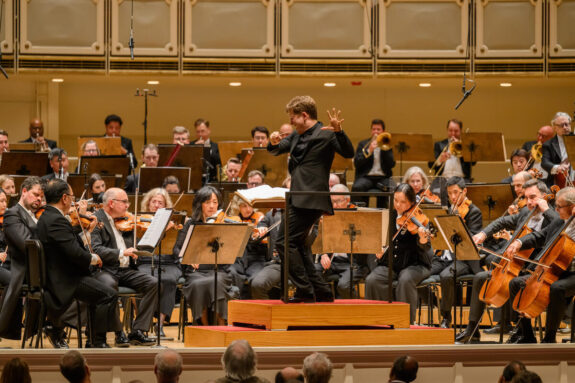
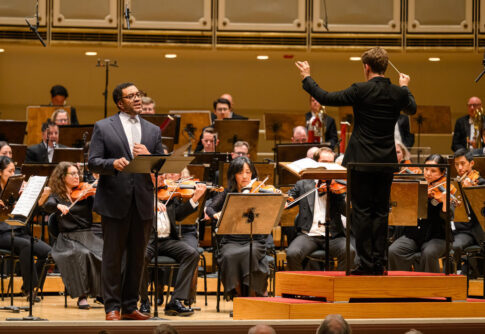
 United States Various: Harry Lennix (narrator), Chicago Symphony Orchestra / Joshua Weilerstein (conductor). Orchestra Hall, Chicago, 18.6.2026. (ZC)
Jessie Montgomery – Banner
Martinů – The Rock
Copland – Lincoln Portrait
Ives – Three Places in New England
Duke Ellington – Harlem
Throughout June, the Chicago Symphony Orchestra has been celebrating the nation’s 250th birthday with American music. Current events and today’s political climate make for an unusual backdrop to the survey. This is especially true for the program performed on Thursday evening which at times painted an idyllic vision of the American idea – celebrating one of its greatest leaders and exploring one immigrant’s view of the nation that gave him refuge.
Among my friends, the CSO’s month-long festival has been a point of friendly debate. Some feel the programming is centered too narrowly on a handful of familiar voices, representing only a small slice of American classical music. In calling for greater diversity, they point to the Grant Park Music Festival as a counterexample – an organization that seems always ready to explore the hidden nooks of the American canon. These are valid arguments. Yet what the CSO assembled feels more closely aligned with the orchestra’s own history – not to mention the city’s and the state’s – through its connections to jazz, the Central European immigrant experience and the Great Emancipator, Abraham Lincoln.
The final concert of the series was led by Joshua Weilerstein, who helmed a program that jumped quickly through time, history and musical vernacular. Because this concert effectively closed out the subscription season, it felt somewhat anticlimactic – a quiet end to both the season and the American survey. Placed at the start of the month, the same program would have made an intriguing opening, serving to frame the rest of the survey and leading toward what could have been a rousing conclusion with Wynton Marsalis and Marin Alsop. The difficulty of scheduling world-class artists likely made a more persuasive ordering impossible.
Five works by five distinct composers filled the evening. The concert opened with Jessie Montgomery’s rhapsodic Banner and closed with Harlem, Duke Ellington’s large-scale symphonic jazz work. In between came Aaron Copland’s Lincoln Portrait, Bohuslav Martinů’s The Rock and Charles Ives’s Three Places in New England. Collectively, this was as earnest and noble a program as one could desire to exalt America.
Copland’s Lincoln Portrait anchored the evening’s populist spirit. The CSO boasts a storied history with this piece – past narrators have ranged from the most recent Illinoisan to occupy the White House, Barack Obama, to Copland himself. For this occasion, acclaimed actor Harry Lennix joined the orchestra. Lincoln lived in Illinois, represented the state in Congress and set off from here to serve as President, making the piece feel like part of the state’s history. Lennix was occasionally blurry in sound, perhaps due to the hall’s amplification, but he delivered the text with deep theatrical passion, the orchestra swelling and receding behind him on cue.
Two of the other works shared a related impulse. Montgomery’s Banner is not a straightforward arrangement of The Star-Spangled Banner but rather a collage of fragments that weaves in other cultural anthems and folk songs to ask what a national anthem can mean in a diverse 21st-century culture. Ives’s Three Places in New England operates similarly – bits of old tunes float in and out of impressionistic textures, the piece functioning like a musical ‘Magic Eye’ poster. Stare long enough and the whole picture comes into focus.
The performance of the Ives had real peaks and its final movement, ‘The Housatonic at Stockbridge’, was a triumph. Weilerstein and the CSO captured the lifting haze over the river before the current culminated in an unsettling, powerful surge. ‘Putnam’s Camp’, the middle movement, would have benefited from more textural clarity, though the mashup of marching bands remained thrilling.
It was Ellington’s Harlem that provided the program’s most visceral pleasure – a bustling, serious portrait of the neighborhood whose high-octane demands suited the CSO’s virtuosity. Unlike a previous festival performance featuring Marsalis and his jazz orchestra, this one put the CSO’s musicians front and center and oozed a muscular character as a result.
Earlier Martinů’s The Rock felt out of place. The logic of its inclusion is understandable – we are a nation of immigrants and Martinů and the wave of composers who escaped Europe during the Second World War contributed immensely to our musical fabric. But despite Weilerstein’s passionate verbal defense during a stage change, the piece never quite shed the feeling of an historical aside.
No matter. The performance succeeded because it was presented with earnestness and optimism, and that is something we need right now – both as a city and as a nation. Weilerstein conducted as a true believer in this music, and the program embodied the idea of art that lifts us up while carrying our highest ideals.
Zach Carstensen
Featured Image: Conductor Joshua Weilerstein and the Chicago Symphony Orchestra in Ellington’s Harlem © Amy Aiello