 United Kingdom Saint-Saëns, Poulenc, Boulanger: Anna Lapwood (organ), Bournemouth Symphony Orchestra / Chloé van Soeterstède (conductor). Bristol Beacon, 17.6.2026. (CK)
Saint-Saëns – Phaeton; Symphony No.3, ‘Organ’
Poulenc – Organ Concerto
Lili Boulanger – D’un Matin de Printemps
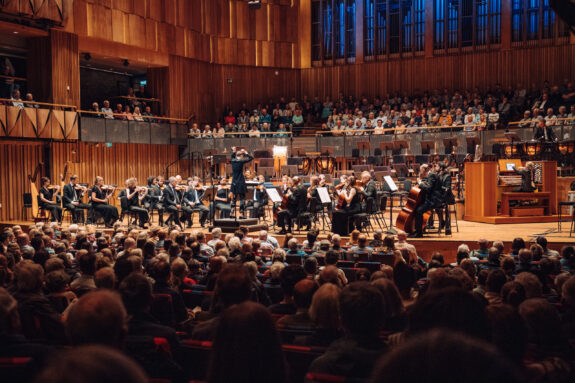
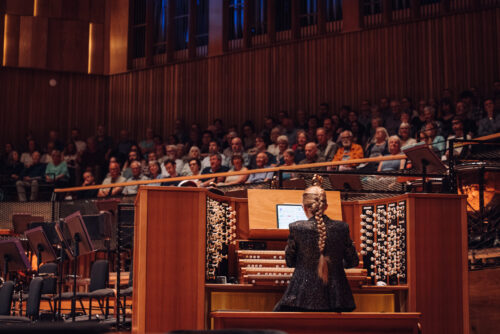
Bristol Beacon was sold out when Anna Lapwood inaugurated the hall’s Harrison and Harrison organ, after a seven-year restoration, with a recital in January: and it was sold out again for this concert in which she went head-to-head with the Bournemouth Symphony Orchestra in not one but two great organ concertos. With the organ’s mobile console parked amongst the orchestra and angled so that she could see the conductor (no need for mirrors) and we could watch her play, this was no ordinary performance. I confess I have never imagined an organist as an elfin figure in a sparkling outfit, full of energy and lightness, who skips onto the stage with a cheery wave that included us all; nor one who is so naturally and physically wedded to her instrument (Chi-chi Nwanoku and her double bass come to mind).
Poulenc’s Organ Concerto is no barnstormer: scored for organ, reduced strings and timpani, it reflects Poulenc’s study of the Baroque composers whilst assuming a unique and independent form and style of its own. Its seven continuous sections feature bold contrasts, with music of brassy grandeur and even violence: but it was the quieter sections that hit home, beguiling us with the luminous clarity of the organ’s reed stops and the beauty of its sound. Lapwood, sensitively accompanied by the BSO strings and a timpanist who defined rhythms with great precision, took us on a journey through the work that lingers in the memory, refusing to be obliterated by the splendours of Saint-Saëns that brought the concert to a glorious close.
Getting ahead of myself. The concert had opened with Saint-Saëns on a smaller but no less grandiose scale: his symphonic poem Phaeton, which deserves to be as well-known as his Danse Macabre. It concerns the eponymous son of Helios the sun god, whose hubristic request to drive the sun-chariot across the sky for a day results in disaster – not least for Phaeton himself, killed by a wrathful Zeus’s thunderbolt. The work’s eight minutes manage to contain music that delightfully suggests flight (I was even reminded of the third part of John Adams’s Harmonielehre), a bold brass theme, rippling harps and a thunderous catastrophe whose multiple timpani suggest the example of Saint-Saëns’s great predecessor Berlioz.
Following the Poulenc Concerto Lapwood explained that its reduced forces meant that she was unable to use the full power of the organ: well-known for disregarding musical boundaries, she proposed to show it off by playing an extract from Hans Zimmer’s music for the film Interstellar. As she said – more than once – ‘This is no time for caution’. With caution thrown to the winds, she duly raised the roof.
After the interval van Soeterstède’s performance with the BSO of Lili Boulanger’s D’un Matin de Printemps made a greater impression on me than previous performances, and it made me regret afresh – as also in the case of the Czech Vítĕzslava Kaprálová – that we are deprived of so much music by her tragically early death. This brief piece is full of fresh, vernal sounds, scored with a wonderful eye for detail: a delicate, floating web, with harp, celeste, and even the percussion – a side drum and suspended cymbal gently tapped – light as thistledown; yet it is music full of character. Van Soeterstède and the orchestra made us listen to everything, drawing us into the music’s brief but entrancing imaginary world.
And so we arrived at Saint-Saëns’s Organ Symphony: a performance, in van Soeterstède’s hands, to remind us what a fine, and finely wrought, work it is – how much more there is to it than its justly famous finale. She made it more than usually clear that the theme that is to achieve its final form in the finale pervades the whole work. Very tall and very slim, she uses the length of her arms and the flexibility of her knees to communicate precisely and electrically with the orchestra, to highlight detail without sacrificing tension. Every movement made its mark: the Adagio easily kept its head above the emotional morass into which it can descend, and the Scherzo had an almost Tchaikovskian drive and intensity.
The organ, of course, was splendid, yet the sounds that remain in my mind are the gentle ones underpinning the Adagio: the organ’s entry in that movement was ineffable, a vibration felt in the body rather than heard by the ear. The chord that launches the finale was thrilling, and so were the fireworks that followed – exultant brass, sparkling four-hand piano, percussion mightily handled (especially by the herculean timpanist and an almost airborne cymbals player). As we neared the end there was a sense of abandonment in the playing – ‘they were on fire’, my companion said – that van Soeterstède seemed able to foment whilst also securing razor-sharp precision. It was a remarkable display by her, by the orchestra and by Anna Lapwood: the audience cheered it to the rafters.
Chris Kettle
Featured Image: Organist Anna Lapwood, conductor Chloé van Soeterstède and the BSO © Soul Media/Jessie Myers