 United Kingdom Three Choirs Festival [1] – Higgins, Elgar, Walton: David Stout (baritone), Three Choirs Festival Chorus, Philharmonia Orchestra / Adrian Partington (conductor). Gloucester Cathedral, 25.7.2026. (JQ)
Gavin Higgins – Fanfare Americana (UK premiere)
Elgar – Symphony No.1 in A-flat major, Op.55
Walton – Belshazzar’s Feast
Gavin Higgins is the Three Choirs Festival’s inaugural Associate Composer; his tenure will last for three years and this is his first festival in the role. It was fitting, then, that the first evening concert of the 2026 Festival should open with the UK premiere of his recent Fanfare Americana. This isn’t the first time I have heard his music at a Three Choirs concert. In 2023 I admired his cantata The Faerie Bride (2021) and when that excellent performance was issued on CD, I was even more impressed with his hugely imaginative Horn Concerto which formed part of the same set (review here).
We heard the UK premiere of a short orchestral work, lasting about six minutes, which Higgins composed for the Amarillo Symphony Orchestra. I have not been able to establish the date of the composition, but I am sure it is a fairly recent work; it was written to mark the twentieth anniversary of the Globe-News Center for the Performing Arts in the Texas city of Amarillo. It is scored for a conventional-sized orchestra (the four optional Wagner tubas were not deployed this evening!) including a generous amount of percussion; the latter were used to excellent effect. The music is full of energy and colour and the scoring is resourceful and imaginative. In this performance, though the strings were kept very busy, the woodwind, brass and percussion were in the ascendancy; perhaps that was due to the resonant acoustic. At times, I was put strongly in mind of the orchestral music of John Adams, a comment I mean as a sincere compliment. The fizzing performance that Adrian Partington and the Philharmonia gave got the concert off to an exuberant start. Later in the week, Higgins’s new settings of the Magnificat and Nunc dimittis will be unveiled at the service of Choral Evensong which will be broadcast live on BBC Radio 3. The 2027 Festival programme will include the first performance of Higgins’s cantata His Salt Skin. The relationship between Gavin Higgins and Three Choirs looks likely to be very rewarding.
Elgar’s First Symphony was an enormous and immediate success, achieving over 100 performances after its premiere in 1908. The composer’s music has been a cornerstone of the Three Choirs repertoire for over 125 years but I am not sure that the First Symphony has featured in any previous programmes; the authoritative book, The Three Choirs Festival: A History by the late Anthony Boden and Paul Hedley has no reference to the work in the index. Is it possible that the performance was the Three Choirs debut for this English symphonic masterpiece? If so, Partington and the Philharmonia ensured that the long wait to hear it was worthwhile.
The symphony opens with an extended motto theme, marked Andante, nobilmente e semplice. This generous theme will permeate the entire work. Tonight, it was unfolded precisely as Elgar asked, with simple nobility. The Allegro which follows abruptly, in the surprising, remote key of D minor, contains a great deal of turbulent music. Partington ensured that this music surged forward with great urgency. Initially, I wondered if, in this resonant acoustic, the swift tempo might be a touch risky, with detail blurred. However, this conductor understands the Gloucester Cathedral acoustic completely; he and his skilled musicians ensured that lots of inner detail was clearly audible to me, even though my seat was about halfway down the nave. As the movement unfolded with blistering urgency I was put in mind of two particular recordings of the work: the celebrated one by Elgar himself (1930) and also the one by Sir Georg Solti (1972) who, it is known, studied Elgar’s recording while learning the work. Though I have emphasised the energy of the performance I mustn’t give the impression that all was hustle and bustle; there are many episodes in which Elgar relaxes into a gentler mood; these sections were delivered with great finesse, not least as the movement drew to a tranquil close. A Seen and Heard colleague has previously called out audience members who disrupt performances, aptly christening them as the ‘bronchial terrorists’. Sadly, one of their number had infiltrated the cathedral this evening and delivered an explosive sneeze just as the movement was ending. What a pity that this inconsiderate person marred the atmosphere that conductor and orchestra had worked so hard to achieve!
The Allegro molto scherzo was fast and fiery but the contrasting trio section was light-footed and delicate, which is just as it should be. The seamless transition to the slow movement was most atmospheric. What a miracle of composition Elgar achieves in this Adagio; the broad, noble melody on which the movement is founded is nothing less than a note-for-note restatement of the scurrying string material heard at the start of the scherzo; now it is transformed into a glorious and lyrical theme. The performance of this movement which we heard was wonderful. Partington paced the music in an ideal fashion and the Philharmonia responded to his direction with glowing, expressive playing. I can pay the musicians no greater compliment than to say that I was so caught up in what I was hearing that I was unaware of a genuine medical emergency involving a member of the audience. (I understand that the incident was dealt with most discreetly and efficiently and in such a way that disruption to the performance was minimal; we can only wish the audience member concerned a speedy recovery.) This deeply eloquent account of Elgar’s slow movement was the highlight of the evening for me. Only gradually did Partington and the Philharmonia break the spell of the Adagio as they played the Lento introduction to the finale. Once the main Allegro was launched, the music was invested with tremendous energy. Partington set an electrifying pace and, to be honest, I thought the tempo was on the margin of being too hectic. However, the conductor stayed on the ‘right side’ of that margin and generated terrific momentum. One benefit of this was that when Elgar abruptly applies the brakes and reminds us, at a slower speed, of the motto theme, the contrast with the preceding music was strongly made. There follows a miraculous episode where a broadly paced variant of the motto is played by the strings, accompanied by rippling harps; this sublime passage was beautifully delivered. Thereafter, Elgar picks up the pace again and the way Partington and the Philharmonia played the music was compelling. Eventually, the motto theme returns in glory.
In some fifty minutes of music Elgar has taken the listener from the gentle first statement of the theme, through many manifestations of the melody, to its glorious fulfilment on full orchestra; what a symphonic achievement this is! Partington and the Philharmonia brought the symphony home in triumph. I have heard a fair few live accounts of Elgar’s First over the years; this one was up with the very best.
You have to hand it to the members of the Festival Chorus. Earlier in the day, they had joined with the various choirs of Gloucester Cathedral to make a memorable musical contribution to the Third Choirs Festival’s Opening Service. The music we heard included Walton’s magnificent Coronation Te Deum in a splendid performance which whetted my appetite for Belshazzar’s Feast, and the punchy, exciting anthem by David Bednall, Sing Praises to God. The latter had been commissioned for a service of Festal Evensong at which the cathedral’s new organ was formally dedicated earlier in July. I was delighted to have an early opportunity to hear it again. Presumably, at some time later that day, the Festival Chorus would have taken part in a rehearsal of Belshazzar’s Feast with the Philharmonia and now they took to the stage to perform the work as the climax to what must have been a tiring day.
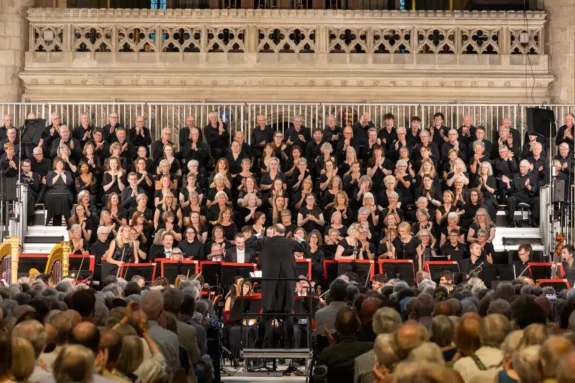
Let it be said at once that there was absolutely no trace of fatigue in the way the Festival Chorus approached the music. I had wondered if the resonant cathedral acoustic might blunt the incisive passages of music in which Belshazzar’s Feast abounds but any such fears proved groundless. I heard an abundance of choral and orchestral detail. In addition, the words came across very clearly. Perhaps it helped that I know the words well, but actually, I think the choir’s excellent diction was the principal factor. Something else delighted me. Belshazzar’s Feast is thrillingly, even riotously scored and the Philharmonia did not hold back; they really delivered the goods. However, rarely, if ever, did they swamp the singers. The players’ collective skill and clear direction from the rostrum will have been important in that, but I suspect another factor may be the new layout. In previous years the orchestra has been placed on a platform, three or four feet high. This year, the strings have been seated at floor level with the woodwind and brass on risers behind them. This arrangement not only gives the players much more room but also must surely help with the balance between choir and orchestra.
We heard a thrilling, energised performance. The tenors and basses set the tone at once, impressively declaiming Isaiah’s ominous prophecy. Thereafter, the choir’s lament was sung with great intensity. Later in the work, both the description of the Feast and what I might term the parade of the false gods were delivered incisively and in a punchy fashion. The Festival Chorus had the power and enthusiasm that Walton frequently demands but they also showed that they were capable of no little sensitivity at times; the best example of this came near the end with the delicate, reflective episode for semi-chorus (‘The trumpeters and pipers are silent’); here, the singing was refined.
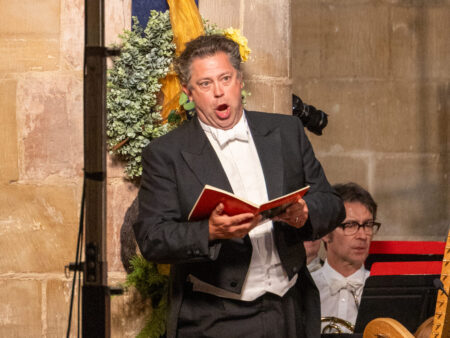
The important baritone solos were entrusted to David Stout. He was ideally suited to the music. Because his interjections are brief a pragmatic decision was taken that he should deliver his solos from the extreme left of the platform; this worked very well and his voice carried with ringing conviction down the nave. He was impassioned in his first solo (‘If I forget thee’) and delivered the famous ‘shopping list’ solo with evident relish. His narration of Belshazzar’s demise was compellingly sung and by a neat coincidence, as he related the fate of the king, Walton’s creepy orchestration was enhanced by doom-laden tolling as the cathedral’s bells struck ten o’clock.
The Philharmonia played Walton’s imaginative, incident-packed score superbly – and the off-stage brass duly made their impact. Adrian Partington’s conducting energised all the players and singers; under his leadership the performance had all the gripping, vivid drama one could desire.
The concert attracted a full house and judging by the audience reaction to each piece, I feel sure everyone felt that they had more than got their money’s worth. The 298th Three Choirs Festival is off to a thrilling start.
John Quinn
Featured Image: Adrian Partington conducts baritone David Stout, the Three Choirs Festival Chorus and the Philharmonia Orchestra © TCF/James O’Driscoll
Thanks for your detailed reviews of this year’s Three Choirs Festival. Indeed it was an exceptional year.
However Elgar’s First Symphony has certainly been performed before. 20.8.2003, RPO, Vernon Handley, Hereford, and 5.8.2007, Philharmonia, Martyn Brabbins, Gloucester. I was there!