 Germany Puccini, La bohème: Soloists, Children’s chorus and Chorus of Theater Krefeld Mönchengladbach. Niederrheinische Sinfoniker / Mihkel Kütson (conductor). Theater Krefeld, 19.7.2026. (DM-D)
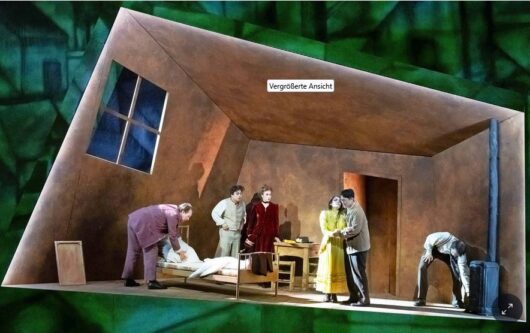
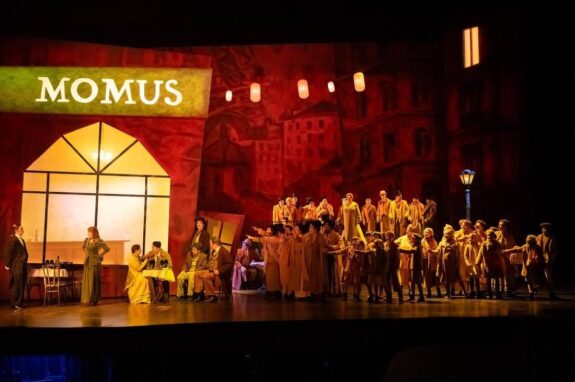
Dennis Krauss (b.1991) has been making a name for himself in the opera world, predominantly in Germany in the last few years and culminating, in 2025, in the Faust prize for opera direction and the 14th European prize for opera direction (EOP). For some of his productions he also designs the set and costumes. For this production of La bohème, he directed and designed the set. The action took place around the time the opera was premiered, i.e., the turn of the 19th to the 20th century, and the set was inspired by Cubism and Pointillism. For the first and last scenes, the Bohemians’ attic was represented by a distorted box frame on the stage with not a single right angle. Its effect was multi-layered: the irregular shape invited particular attention to and analysis of the space in relation to expectations of ordinary room shapes, and the characters were visually foregrounded within this environment. It was then striking to note how the characters moved around that unusual space as if it were not unusual, walking the stark slopes of the floor as if they did not exist and sitting on lopsided chairs as if they were straight. The box frame was surrounded by projections of cubist shapes, which were lit in different colours to support the moods conveyed by plot and score. For the second scene, Café Momus was signalled through a large sign on the left of the stage, with the rest an open space in front of a backdrop of Paris housefronts painted Cubist-style. The crowds of that scene were particularly well choreographed. The third scene took place outside the Cabaret where Musetta and Marcello were working, with the building squeezed onto the far right of the stage, allowing a large, open space for the scene’s action in front of a vast backdrop of a cubist sky in shades of blue.
Overall, the set made sense, was impressive and, most importantly, beautiful. The period costumes by Raphaela Rose suggested the simplicity of the characters, implying poverty, but the costumes did not render the characters destitute paupers, as in Les Misérables. The contexts of set and costumes enabled an intense density of Personenregie. Here, the overarching principle was that despite their realistic insight into the reality of their lives, the characters chose to make the most of it and to be as happy as possible. The production cleverly foregrounded the full extent to which Rodolfo realised, in the very moment he first saw Mimì, how desperately ill she was (with the mature implication that he realised from the start that there was in fact no hope of lasting happiness here). The relationship was developed further along those lines, with Mimì shown to be aware of her hopeless situation when she overheard Rodolfo and Marcello talking about her critical state of health in the third scene, it did not come as a surprise for her, as in many productions, but as confirmation of what she had sensed herself. Such consistent attention to detail is rare and a major achievement.
Musically, the production was on a similarly high level. General music director Mikhel Kütson conducted with much attention to detail in terms of tempi and volume within the overarching flow. Woongyi Lee sang Rodolfo with passion and ardour, maintaining a strong musical line and making sure to express the whole range of Rodolfo’s emotions, rather than limiting his portrayal to some vague notion of a romantic operatic hero. The voice was radiant and gentle, as needed, and rose to the higher range with ease. Sofia Poulopoulou sang Mimì with just the right combination of panache, expressing fully the character’s fragility, and emotions of love, happiness and deepest sadness at her fate. Her voice is in full bloom, rich enough for Puccini’s arcs, while also flexible and mellow. She was announced before curtain-up as suffering from indisposition that might affect her voice but her singing was in fact excellent, and if what we heard was indeed in any way a diminished achievement, I can hardly imagine what her voice may be like in this role without that indisposition.
Sophie Witte was equally excellent as Musetta, emphasising that her character’s good, gentle core was the source of the exuberance that could get on Marcello’s nerves, occasionally, and also rather playfully. Her voice contrasted well with that of Poulopoulou, and in Musetta’s Waltz, her breath control allowed her to foreground the high B with particular relish. Rafael Bruck sang Marcello with a burnished baritone, with open honesty as this character’s main feature. Jeconiah Retulla (currently a member of the company’s opera studio) was enthusiastic as Schaunard, and Matthias Wippich was convincing as the more mature Colline. Hayk Deinyan Thomas Peter, Markus Heinrich and Bondo Gogia contributed strong portrayals of their respective characters.
Daniel Meyer-Dinkgräfe
Featured Image: Cast and chorus in the Café Momus © Matthias Stutte
Production:
Director and Set design – Dennis Krauss
Costumes – Raphaela Rose
Choreography – Luca Villa
Chorus director – Michael Preiser
Children’s chorus directors – Narie-Kristin Steiner, Ricardo Navas
Dramaturgy – Ulrike Aistleitner
Cast:
Mimì – Sofia Poulopoulou
Musetta – Sophie Witte
Rodolfo – Woongyi Lee
Marcello – Rafael Bruck
Schaunard – Jeconiah Retulla
Colline – Matthias Wippich
Benoît – Hayk Deinyan
Alcindoro – Thomas Peter
Parpignol – Markus Heinrich
Sergeant – Bondo Gogia