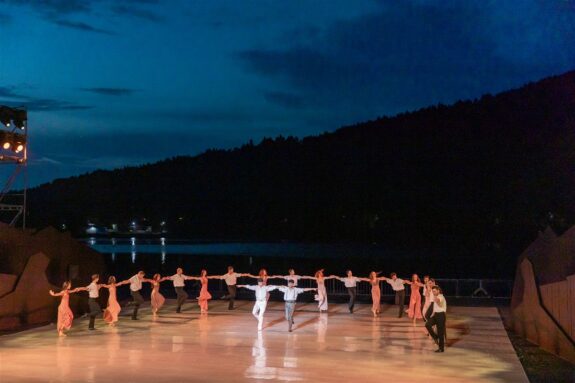
 Bulgaria Theodorakis, Zorba the Greek: Soloists, Corps de ballet of Sofia Opera and Ballet. ‘Muses on the Water’, Pancherovo Lake, Sofia, 16.7.2026. (GT)
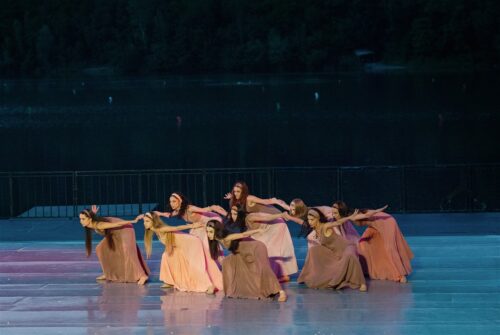
Nikos Kazantzakis’s novel, The Life and Times of Alexis Zorbas, became a bestseller in postwar Greece through its story of a young Greek intellectual who broadens his horizons by befriending the extrovert, Alexis Zorba. The key to the amazing success of the novel and its offshoots is the embrace of uplifting ideals, raw passion, and spontaneity. It was an ideal subject for the Greek Cypriot filmmaker Michael Cacoyannis, who wrote the screenplay, produced and edited as well as casting. The 1964 film earned three Academy Awards and another four nominations. It was also adapted into a stage musical and a BBC TV play. One of the biggest hits for the film’s success was Theodorakis’s score. Remarkably, it was not awarded the best film score; nevertheless, its colourful harmonies led to the 1968 Broadway musical, which was nominated for a Tony Award, enjoyed 305 performances, and was revived for another 362 shows in 1983.
The Greek composer Mikis Theodorakis (1925-2021) is largely known today for his music to Zorba the Greek. However, the cinema proved a productive area for his creativity, for he also wrote award-winning scores for Z and Serpico and another sixty films. He wrote well over 1,000 works, including operas, ballets, symphonies, concertos, chamber music, cantatas, theatre music and song cycles, many of which were inspired by his country’s history and culture. Theodorakis was also prolific in writing poetry, autobiography, and political books. Sadly, he suffered for most of his life and was imprisoned by the Germans during the occupation and by the Greek junta and was politically active during his years in exile and following the end of the junta in 1974.
A common theme is his use of Cretan folk tradition with a blend of 20th-century modernism. His scores are rich in their colourful orchestration, and perhaps no other work better epitomizes his creativity than this two-act ballet, based on the film score. As the composer wrote, ‘Zorba is an archetype of the primary man, bound to everything beautiful and ugly in life. Inherent to him is the sense for wonders which are on our way to losing, adapting ourselves to today’s world, habits, acquisitions and comfort.’
Zorba’s Dance, in its slow-to-fast rhythmic theme, is at the heart of the ballet (performed to pre-recorded music), yet there are many captivating sections such as the sensuous belly dance of the Dance of Tsifteteli, then a fast-moving celebratory Bacchic Dance; the Dance of Love, with its lyrical, dramatic theme; then the Hassapiko Dance from a traditional Greek butcher’s dance, with sharp synchronised footwork. The Evin/Evan dance is heartwarming and lyrical, remaining long in one’s memory afterwards. At the close is the Death of Hortensia with its tragically repetitive melodic theme.
Distinct in Lorca Massine’s choreography are the arm and body movements as if pleading for understanding or compassion. The music carefully accompanies those movements and makes the drama more understandable than in classic dance forms. The famous Zorba’s Dance is based on the Hasapiko, which is a slow yet dramatic dance in which the dancers form a line, or semi-circle, with their arms joining, and becomes increasingly faster and moves into the phase called the Pidikhtos, which becomes frantic and joyful. Of the nineteen dances, one of the most striking was that between Zorba, John and Hortense in its dramatic and impassioned dancing; other outstanding sections were the Arabic dances in the first act, while the extended Death of Hortensia was intensely performed.
Theodorakis’s use of traditional Greek instruments such as the bouzouki and large chorus provided a colourful musical backdrop to the whole evening, with the bouzouki providing the backdrop to the rhythmic Zorba’s Dance. The choral singing gave a distinctly Cretan colour, added to by solo male and female songs. The Return of Zorba reminded me of a theme from a film score by Prokofiev, but Theodorakis’s score is original and exceptionally dramatic, with Massine’s choreography superbly fitting for this ballet, which touches the most heartrending and impassioned human emotions and feelings.
Of the dancers, Vincenzo Caruana’s superb portrayal of John with his impressive leaps and immaculate dancing was one of the highlights; the dancing with Nikola Hadjitanev as Zorba was another highlight of the whole evening in Zorba’s Dance. Another star was Marta Petkova as the widow Marina, whose love for John was at the heart of the ballet. The characterisation of Hortensia by Charlotte Berard was another masterly performance in her love for Zorba and then her tragic death at the end. Of the other male dancers, Nikola Hadjitanev’s Zorba was an outstanding portrayal, as was the Manolios of Georgi Banchev, especially with his incredibly high leaps. The corps de ballet was exceptional, especially the ballerinas, evoking the plight of the Cretan villagers countered by the contrasting love dances and the exoticism of the Arabic dances as evidence of the Sofia Ballet’s world-class standards.
The setting of the Pancherovo Lake gave the ‘Muses on the Lake’ festival a wonderful backdrop for this action-filled ballet. There is probably no better way of sending the audience away happy than performing Zorba’s Dance at the finale, and so it proved, with the dance being repeated three times, so that everyone went home in an uplifed and positive mood.
Gregor Tassie
Featured Image: Sofia Ballet’s Zorba the Greek
Production:
Libretto and Choreography – Lorca Massine
Assistant Choreographer – Elisa Arnone
Set designer – Valentin Topencharov
Costume designer – Tsvetanka Petkova-Stoyanova
Cast:
Zorba – Nikola Hadjitanev
John – Vincenzo Caruana
Marina – Marta Petkova
Manolios – Georgi Banchev
Madame Hortense – Charlotte Berard