
 United Kingdom Various: Welsh Chamber Orchestra / Anthony Hose (conductor). St Elli’s Church, Llanelli, 25.7.2026. (PC)
Handel – Arrival of the Queen of Sheba
Sarah Frances Jenkins – The Path to Dinas Emrys
Haydn – Symphony No.22 in E flat, ‘The Philosopher’
Morfydd Owen – Threnody for the Passing of Branwen
Mozart – Symphony No.41, K.551, ‘Jupiter’
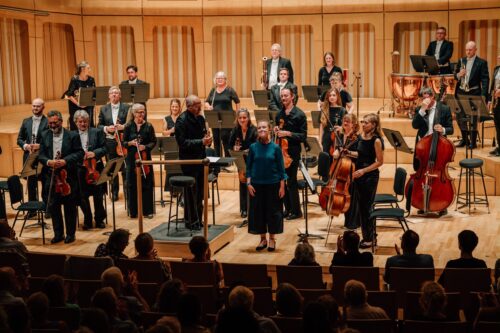
The final concert in the Welsh Chamber Orchestra’s fortieth anniversary summer tour took place in St Elli’s Church, Llanelli on 25 July, conducted by their founder and artistic director, Anthony Hose. The satisfyingly diverse programme balanced two 18th-century classical symphonies and a well-known 18th-century sinfonia with an elegiac, early 20th-century work for strings and a picturesque, very recent piece written especially for the orchestra.
An ideally paced account of Handel’s Arrival of the Queen of Sheba, for two oboe and strings provided a perfect curtain-raiser. While allowing every gracefully turned phrase enough space to register, Anthony Hose and his players imbued the music with a palpable sense of bustling readiness and expectation.
Chamber orchestral forces consisting of a single flute, oboes, bassoons, horns and trumpets in pairs, timpani and strings then assembled for a performance of a new piece by Sarah Frances Jenkins, commissioned by the orchestra to mark their fortieth year and premiered by them at The Welfare, Ystradgynlais in June of this year. This composer already has several evocative scores to her credit, including the orchestral work And the Sun Stood Still (2018), inspired by the winter solstice; Gaia, for piano trio and clarinet, a celebration of the fragile beauty of the earth, first performed at the 2023 Corbridge Chamber Music Festival, and The Lonely Tree of Lyn Padarn, for violin, horn and piano, depicting a solitary birch and its environment near Llanberis, which was premiered at the 2023 Presteigne Festival.
Her latest piece to take the natural world as a creative spur, The Path to Dinas Emrys conjures up the beautiful trail past waterfalls and oak woodland leading up to the ancient hillfort in Snowdonia of the title. The piece began spaciously and hazily, with hushed, gently rocking string figures underlying more sharply defined upper woodwind lines. A broad tempo was maintained during this opening section, ensuring the enchanting atmosphere of the work was firmly established and allowing the music’s main motifs to be grasped and retained by listeners. Initiated by staccato strings, a contrastingly animated central section soon gained momentum and built to a noble climax, punctuated by timpani, as an imposing summit was reached. Presently, the sustained music of the opening section returned, and the music ended softly and expansively, casting a final breath of wonder before fading into stillness. With an economy of gesture and a sureness of touch, Sarah Frances Jenkins’s new work summoned elusive but abiding impressions of folkloric mysticism and scenic vistas, all faithfully and poetically rendered by the musicians for whom the score was created.
There followed an impressively purposeful reading of Haydn’s Symphony No.22 in E-flat, ‘The Philosopher’, in which a reflective but firmly treading Adagio was followed by a fast and furious Presto, a robust minuet, crowned by heroic horn playing in the Trio section and a dashing finale. The wit and elegance of Haydn’s writing was deftly conveyed and the richness of his orchestral timbres warmly presented.
After the interval, the strings of the orchestra gave an eloquent performance of Morfydd Owen’s Threnody for the Passing of Branwen, written in 1916 for a stage work, as the programme notes put it, ‘almost certainly inspired by an episode in the Mabinogion in which the Princess Branwen dies of a broken heart’. Prior to the performance, Anthony Hose revealed that he had been given a copy of the score of this work thirty years ago by Heward Rees, then Director of the Welsh Music Information Centre. The conductor was instantly taken with the piece, and it has featured in in several of his concerts since then. His poised, yet flexible rendition of the work, expressively unfolded by the WCO strings, was enhanced by a scrupulous observance of the music’s wide dynamic range and an ability to sustain a broad tempo convincingly. The reading was audibly the product of a close familiarity with, and deep affection for, this brief and affecting score.
Mozart’s Symphony No.41, ‘Jupiter’, with which the concert ended, received one of the finest performances of any piece of music I have heard in my thirty years of reviewing. Not owing to any interpretative quirks or undue accentuation of instrumental colouring, but because this riveting and utterly persuasive account was played with clarity, understanding and, above all, love. Tempos were sufficiently steady to permit every detail of the writing to tell, particularly beneficial in the contrapuntal miracle of the finale. Exposition repeats were observed in the outer movements, creating a satisfying balance of weight. Phrasing was elegant without being fussy and climaxes were unerringly placed and delivered at white heat. Allowing listeners to hear precisely what Mozart wrote, Anthony Hose and the WCO presented this intricate and radiant work afresh. The ensuing extended applause and standing ovation was entirely justified. Any record label would do well to gather these musicians in a studio to set down their distinctive interpretations of the music of the man whom Hose called, in a short preliminary address, ‘the greatest of composers’.
Paul Conway