 United Kingdom Three Choirs Festival [2] – ‘From the Forest of Dean to the Appalachians’: Roderick Williams (baritone), Iain Burnside (piano). Gloucester Cathedral, 26.7.2026. (JQ)
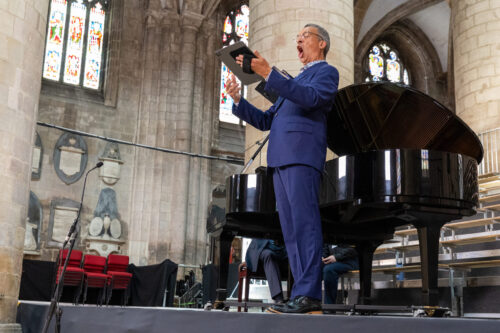
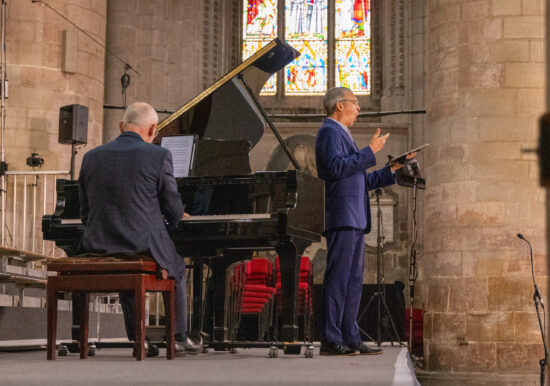
What a contrast from the previous evening (review here) when the concert platform in Gloucester Cathedral had been full to overflowing for a concert which culminated in Walton’s Belshazzar’s Feast. This afternoon, just two artists occupied the performance space. It is a measure of the extent to which a song recital by Roderick Williams is a hot ticket at Three Choirs – or indeed anywhere else – that this recital was presented not in the more intimate surroundings of a hall or one of Gloucester’s smaller churches but in the cathedral itself. The use of the large venue was amply justified; Williams and Burnside performed to a substantial audience.
The recital, which was performed without an interval, was divided into three parts; the central panel of the programme was Six Songs to Poems by the Dymock Poets by Douglas Weiland (b.1954). Taking his cue from Welland’s use of the Dymock poets, Williams first offered a group of six songs by a variety of composers, all of which set words by the Dymock poets. This informal group of six, including Rupert Brooke, Robert Frost and Edward Thomas, all lived and worked around the Gloucestershire village of Dymock (near the border with Herefordshire) between about 1911 and 1914.
Williams began with ‘The Mill-Water’ from the collection entitled Looking Back by Ina Boyle. She was an Irish composer who studied with Vaughan Williams before the Second World War – remarkably, she used to travel all the way from Ireland to London specifically to have her lessons. I became aware of Boyle’s songs just a few years ago when I greatly enjoyed a CD of her songs, which included this one (review here). ‘The Mill-Water’ sets a poem by Edward Thomas. It was a treat to hear the song live. The vocal part consists of long lyrical lines – Williams caressed the words – over a rippling piano part. The two songs by Ivor Gurney are much better known, as is the one by John Ireland; all three received splendid performances. I especially appreciated the effortless expression with which Williams delivered Gurney’s Lights Out. In the songs by Elaine Hugh-Jones and Howells it was very noticeable that Williams took great care to communicate the words he was singing; in the case of the Howells his delivery was wittily pointed.
At the heart of Roderick Williams’s programme was Douglas Weiland’s Six Songs to Poems by the Dymock Poets. I have to admit that until today I was unaware of this composer or his music. I learned from Andrew Burn’s programme note that Welland was born in Malvern, Worcestershire and that the set of songs we heard today constitute part of a triptych, the composer’s Opp 67, 68 and 69, all of which set poems by the Dymock poets. The date of composition was not included in the programme but a bit of internet research leads me to think that the songs were written in or just before 2023. Welland has said this: ‘Whilst, strictly speaking, the set of songs called Dymock [Op.69] is the only one of the three [which is] a ‘cycle’ – the musical material enough of a common bond – the three sets could be thought of as linked together throughout by an intimacy of purpose: the poems, the remarkable yet brief friendship between the two great poets Edward Thomas and Robert Frost, (both “members” of the Dymock group) and the moving relationship between Edward and his wife, Helen.’ The composer has also written that ‘These three sets of songs are fashioned, one could say, in large part from two genres: Schubert’s lieder and 20th-century English Song’. In the Op.69 cycle, Welland sets one poem by each of the six Dymock poems.
On a first hearing, I found much to admire in these songs. The second song, ‘Blackbird’ has words by John Drinkwater. It is an acutely observed response to the poem; furthermore, the music is witty, not least at the very end where the piano postlude, high in the treble register, allows us to enjoy the blackbird’s song. The third song, ‘The Cliffs’ (Wilfrid Wilson Gibson), is, I think, the longest; it also struck me, on first acquaintance, as the one which contains the most complex and exploratory music in the cycle. Arguably, Welland’s finest achievement in this cycle is his setting of Rupert Brooke’s celebrated poem, ‘The Soldier’ (‘If I should die, think only this of me…’) Brooke’s elegy for England found a noble and expressive response in Welland’s music; Williams communicated both words and music marvellously. The final song, ‘The Pasture’ by Robert Frost seemed to me to bring the cycle back full circle since the music, with its rippling piano part and lyrical vocal line, appeared to revisit in spirit – and possibly in exact notation – the music which we had heard in the opening song ‘Thaw’ by Edward Thomas. I thought Welland’s songs were most interesting and I should like to hear them again. The composer, who was present and warmly received, could scarcely have wished for finer advocates than Roderick Williams and Iain Burnside.
Robert Frost, though American, lived for some years in the UK, during which time his friendship with Edward Thomas drew him into the orbit of the Dymock poets. Frost’s American nationality gave Williams the impetus to devote the third panel of his programme to settings of American poetry by British composers.
The songs of Sir Arthur Bliss are too little known; I have in my collection the CD set of his complete songs which Hyperion issued as long ago as 2000, but I can’t honestly claim that I really know the songs. To be honest, I cannot recall attending a live performance of any Bliss songs prior to today. The Seven American Poems were composed in 1940 when Bliss was living in the USA, where he had been stranded on the outbreak of war. He was torn between his desire to return home and ‘do his bit’ and his reluctance to endanger – or be parted from – his wife and family by so doing. From the set, Williams and Burnside selected three: ‘Gone, gone again is Summer’ and ‘Siege’ are settings of poems by Edna St Vincent Millay, while the text for ‘Little Elegy’ was furnished by Elinor Wylie. ‘Gone, gone again is Summer’ and ‘Little Elegy’ were both excellent examples of the romantic vein in Bliss’s music. I enjoyed both of them; the latter was sung with particular warmth and feeling. By contrast, the music to which Bliss set ‘Siege’ was, as befits Millay’s bitter words, very spiky, especially in the piano writing; indeed, as I listened, I thought that this particular song sounded like some of the rebellious music that Bliss wrote in the 1920s.
The second living composer on Williams’s programme was Rhian Samuel. I was more than a little intrigued to read in Andrew Burn’s notes that Of Swans, Snails and Geese was originally composed in 1991 for Red Byrd; the composer told us that the work was conceived for ‘a fairly obscure line-up of four solo singers and three electric guitars’. The version we heard today was a 2025 revision of the songs for baritone and piano, written with Williams in mind. The three songs set words by the American poet May Sarton (1912-1995). I am afraid that these songs did little for me. I don’t think I was helped by the words, which I find very difficult to comprehend. Samuel’s music received expert and highly committed advocacy from Williams and Burnside, but the songs were not at all to my taste. It is only fair to record, though, that mine may have been a minority view. The second and third songs occasioned audible chuckles from the audience – though that could have been prompted by Williams’s communicative performances – and the composer was warmly received when she was called forward to take a bow at the end.
To conclude the recital Williams had selected two of Vaughan Williams’s set of Folk Songs from the Southern Appalachian Mountains. These are taken from a collection of nine song arrangements for voice and piano which VW made in around 1938, though they lay unpublished until 1967. The complete set was included in Vol.2 of the recent and invaluable complete survey of VW’s folksong settings on Albion Records; Roderick Williams was one of the three singers involved in that project (review here). The songs were discovered by the intrepid folksong collectors Cecil Sharp and Maud Karpeles during trips that they made to the Eastern USA between 1916 and 1918. It might be argued that the two songs which Williams chose to perform are not among VW’s finest folksong arrangements, but that is not the point; he selected them for another reason. Both are examples of what he termed ‘cumulative number songs’ – rather along the lines of ‘Green grow the rushes, O’; as such, they presented ideal opportunities for him to involve all of us in some humorous audience participation. The songs were a fun conclusion to the recital.
This recital was a typical Roderick Williams recital in so many ways. The programme – and the ordering of the items – had been chosen with great care and discernment; the selection included some familiar repertoire but also offered the audience the chance to explore less well-known pieces. The execution of the programme was impeccable; Williams was in very fine voice indeed. Not only was the singing marvellous but also Williams, as he always does in my experience, had an instinctive rapport with his pianist; on this occasion, Iain Burnnside, whose contribution was skilful and insightful from start to finish. As if this were not enough, Williams displayed his habitual concern for the words of each song, communicating both text and music very directly to the audience but without the slightest hint of histrionics. As the icing on the cake, he introduced the groups of songs in an engaging and witty manner. Through these performative skills, Williams and Burnside drew us into all the songs and brought them alive for us.
This was a memorable recital of songs by British composers.
John Quinn
Featured Image: Pianist Iain Burnside and baritone Roderick Williams © TCF/Dale Hodgetts
Ina Boyle – ‘The Mill-Water’ (from Looking Back)
Gurney – Black Stitchel; Lights Out
Ireland – Blow out, you Bugles
Elaine Hugh-Jones – A Dream
Howells – Girl’s Song
Douglas Weiland – Six Songs to Poems by the Dymock Poets, Op.69
Bliss – ‘Gone, gone again is Summer’; ‘Little Elegy’; ‘Siege’ (from Seven American Poems)
Rhian Samuel – ‘The Memory of Swans’; ‘Eine Kleine Snailmusik’; ‘Franz, A Goose’ (Of Swans, Snails and Geese – version premiere)
Vaughan Williams – ‘The Tree in the Wood ‘and ‘The Twelve Apostles’ from Folk Songs from the Southern Appalachian Mountains