 United States Tanglewood 2026 [2] – Mozart, Tchaikovsky: Augustin Hadelich (violin), Paul Lewis (piano), Boston Symphony Orchestra / Andris Nelsons (conductor). Koussevitzky Music Shed, Lenox, 24 & 25.7.2026. (ES-S)
24.7
Mozart – Violin Concerto No.5 in A major, K.219, ‘Turkish’
Tchaikovsky – Symphony No.3 in D major, Op.29, ‘Polish’
25.7
Mozart – Piano Concerto No.27 in B-flat major, K.595
Tchaikovsky – Symphony No.4 in F minor, Op.36
Across a full Tanglewood weekend, Andris Nelsons and the Boston Symphony Orchestra paired three Mozart concertos with Tchaikovsky’s Third, Fourth and Fifth Symphonies. The idea had a clear historical basis: in an 1886 diary entry, Tchaikovsky called Mozart ‘the highest, the culminating point which beauty has reached in the sphere of music’. The programs invited comparison between two sharply different musical temperaments and brought into focus their shared attraction to dance, theatrical contrast and sudden shifts of character.
The Mozart concertos heard across the weekend revealed markedly different expressive worlds. The Fifth Violin Concerto is animated by abrupt changes of tempo and texture. After the orchestra’s brisk exposition, the solo violin enters with an unexpected Adagio; the brief interruption soon yields to a new, faster-moving theme. The finale creates a comparable disruption: a poised minuet gives way to the sharply accented episode that supplied the concerto’s ‘Turkish’ nickname, before Mozart restores its opening elegance with characteristic nonchalance. In the Piano Concerto No.27, heard the following night, instability lies much further beneath the surface, with shifts of mood within an outwardly serene design conveyed through chromatic excursions into remote keys and subtle flexibility of phrase and form.
The solo instrument often assumes the role of an operatic voice in Mozart and both works brought that quality into focus. The Adagio interjection in the Violin Concerto unfolds in a long, suspended line recalling the serene lyricism of ‘Soave sia il vento’ from Così fan tutte. In the Piano Concerto, the analogy is subtler but equally persuasive: the piano line often has a vocal contour and the woodwinds answer in similarly songful phrases.
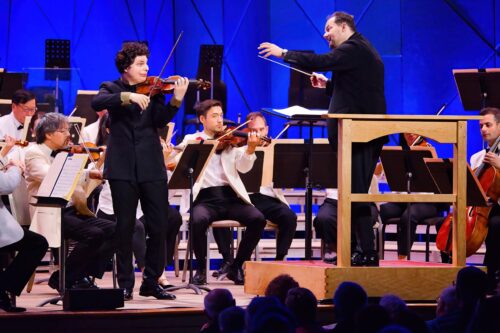
In his rendition of the Fifth Violin Concerto, Hadelich combined Classical elegance with a keen sense of drama. His focused, supple sound was matched by incisive rhythmic definition, and his exchanges with the reduced-size orchestra had the ease and delicacy of chamber music. Nelsons kept the textures light and transparent while giving Mozart’s abrupt contrasts sufficient weight. Hadelich sustained the central Adagio’s cantabile phrases with unaffected simplicity; in the finale, he moved between courtly grace and percussive energy with immaculate control.
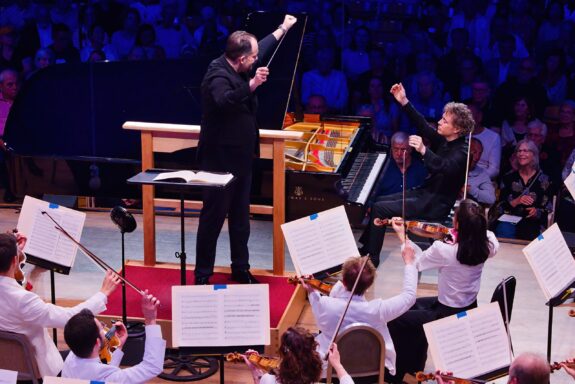
A distinguished Schubertian, pianist Paul Lewis was especially attuned to the elusive character of K.595, approaching it with austere clarity and restrained lyricism. His finely graded touch brought out the concerto’s harmonic and formal shifts without disturbing the larger continuity; transitions seemed to arise almost imperceptibly from what preceded them. The Larghetto was deeply affecting in its simplicity. In the finale, the pianist gave each return of the rondo theme a distinct character through finely varied articulation, tonal color and phrase shaping while preserving an undercurrent of wistfulness. Nelsons created a spacious orchestral frame, encouraging the woodwinds to respond to the soloist as equal partners.
Saturday morning’s rehearsal for the Sunday program offered a glimpse of a third Mozartian voice in Himari’s account of the youthful First Violin Concerto. Since I did not attend the concert itself, the impression necessarily remains provisional, but her freshness, technical assurance and directness of expression were remarkable.
What remained contained within Mozart’s more compact structures assumed a far broader scale in Tchaikovsky’s richly orchestrated, emotionally charged idiom. The Symphony No.3 unfolds across an unusual five movements, alternating weightier symphonic argument with lighter episodes that foreshadow the world of his ballets. The Fourth, written only two years later, concentrates those conflicts more forcefully, binding the work together through the recurring fanfare traditionally associated with fate. Heard on successive evenings, the two works made Tchaikovsky’s rapid development as a symphonist evident, tracing a progression from episodic contrast to a more concentrated drama shaped by recurrence, disruption and emotional pressure.
Nelsons sought to give the Third a coherence that the score itself does not fully possess. The somber introduction to the first movement had weight without heaviness, and the transition into the Allegro generated strong momentum. The BSO’s brass sounded powerful but disciplined, and the strings brought a warm, blended sonority to Tchaikovsky’s expansive melodies. The three central movements were clearly differentiated. The Alla tedesca retained a light, graceful lilt; in the Andante elegiaco, the plaintive exchange between bassoon and horn gave way to lyrical material taken up by the violins with particular nobility. In the Scherzo, strings and woodwinds dispatched the rolling, sylph-like sixteenth-note scales with delicacy and precision. In the Finale, Nelsons maintained momentum across the polonaise rhythms, contrapuntal writing and ceremonial brilliance, though the movement’s episodic construction remained apparent.
The Symphony No.4 marked a decisive change in Tchaikovsky’s symphonic language. Nelsons launched the opening fanfare with monumental breadth, establishing it as an implacable presence. The principal 9/8 theme had a flowing waltz character with the lyrical passages offering temporary refuge from the surrounding tension. The first movement’s repeated surges and reversals can pose the work’s greatest structural challenge, but Nelsons sustained the long span with impressive control and the orchestra responded with finely balanced power. The brass remained disciplined at the largest climaxes while the strings brought polished warmth to Tchaikovsky’s arching phrases and displayed the same striking unity that characterized their playing throughout these performances.
In the Andantino, John Ferrillo’s opening oboe solo established an atmosphere of reflective melancholy. The melody was then taken up by the strings with supple phrasing and tonal richness. Nelsons kept the music moving, ensuring that the movement functioned not merely as a lyrical interlude but as a stage in the symphony’s larger psychological trajectory. The pizzicato Scherzo brought a different kind of orchestral virtuosity, capturing its weightless, capricious spirit. The strings played with crispness and lightness and the successive wind and brass episodes were vividly contrasted.
In the finale, the Russian folk song ‘In the Field Stood a Birch Tree’ was swept into an increasingly feverish celebration. However familiar the symphony may be, the abrupt return of the fate motif still came as a shock. The closing pages sounded at once triumphant and manic.
Edward Sava-Segal
Featured Image: Andris Nelsons conducts Mozart’s Piano Concerto No.27 with Paul Lewis © Hillary Scott