
 United Kingdom Beethoven, Zemlinsky: Bomsori Kim (violin), Miah Persson (soprano), James Atkinson (baritone), BBC Scottish Symphony Orchestra / Ryan Wigglesworth (conductor). City Halls, Glasgow, 24.9.2026. (GT)
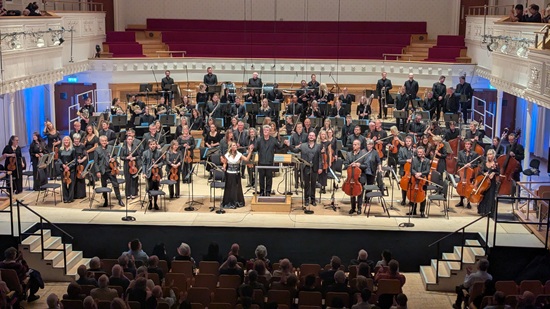
Beethoven – Violin Concerto in D major, Op.61
Zemlinsky – Lyric Symphony, Op.18
This concert in the Thursday Night Series opens a season-long commemoration of Beethoven’s death in 1827. The celebration is a unique collaboration with Scotland’s orchestras: the Scottish Chamber Orchestra and the Royal Scottish National Orchestra, exploring all nine symphonies, the concertos, and other works, and Scottish Opera will stage Fidelio next spring. As always, the programmes of this orchestra introduce audiences to music unfamiliar yet there are connections with Beethoven, here mostly in that Alexander Zemlinsky epitomised the Vienna of a different world yet his humanity was not distant from that of Beethoven.
The evening opened with one of the finest performances of the Beethoven Violin Concerto that I have heard in the concert hall. The main reason being the young Korean violinist Bomsori Kim who plays on the 1725 Guarneri del Gesu ‘ex-Moller’. Following the momentous strokes on the timpani, almost immediately her almost meditative playing was enhanced by a remarkable control of tone and colour. The silvery tones that she produced were quite astonishing in their effortless beauty and mastery – it all seemed as if this diminutive violinist was as if from a different planet, able to create magic on her instrument. She was accompanied superbly by the musicians and conductor Ryan Wigglesworth who listened closely to every note. Her first cadenza was quite remarkable achieving incredibly stunning sounds from the darkly hued tones to light almost golden voiced singing. Sometimes, one forgot about the orchestral playing, so much was one was drawn to her virtuosic artistry. It seemed as if her violin was singing this remarkable song of songs in the mood of peace and a glimpse of the humanity envisioned by Beethoven in 1806.
The hymn-like song of the second idea dominated the last passage of the Allegro ma non troppo, and Bomsori’s cadenza was as if a peaceful transfiguration was before us. The Larghetto was lyrical in the strings aided by the horns and the clarinets before the cadenza heralded the transition to the Rondo-Allegro and the lively theme from the soloist was joined by the orchestra in jubilant manner. Bomsori’s joyful runs on her violin were exquisite as the concerto ended on a glorious note. Of course, the performance could not end without an encore, and the Korean played Kreisler’s Schon Rösmarin finally satisfying the packed hall and her many compatriots present.
In his early years, the Viennese-born Zemlinsky gained the support of Brahms, and, like Mahler, had to ply his musical career by conducting; yet he wrote a huge number of works, from chamber pieces to orchestral and choral works and eight operas. Mahler conducted several of Zemlinsky’s symphonies, and his music earned the respect of Schoenberg, who was one of his students. Stravinsky said that Zemlinsky’s conducting of The Marriage of Figaro was ‘the most satisfying experience of my life’.
Zemlinsky’s composing suffered in comparison to his contemporaries; as a writer said, ‘for every good piece of his, there’s a better one by Mahler or Schoenberg.’ Mahler highly regarded Zemlinsky, although his friendship with Alma may have dissuaded him. Zemlinsky was nevertheless influenced by Mahler, and the Lyric Symphony recalls one of the song cycles: ‘In the Summer, I wrote something like the Das Lied von der Erde’. Zemlinsky’s composition, started in the summer of 1922, not only used texts from the Far East, but also the dialogue between male and female voices and similar strophic and symphonic structures. Zemlinsky used Rabindranath Tagore’s collection of love songs, The Gardener. As in Mahler’s song cycle, the love of the two protagonists is unfulfilled, but in musical expression, Zemlinsky advances beyond Mahler by abandoning sentiment and offering a farewell to the past, with longing and sadness. He suffered under the Nazis and spent the last years of his life as an exile in New York.
The orchestral score is full of luscious phrasing, with sharp bursts of exciting moments that thrill as much as any of Mahler’s or Richard Strauss’s finest works. Sensuality and colourfully sumptuous colours decorate the score, with the balance against the often-shrill songs from the baritone and the beautiful soprano marvellously created. There are many expressionist passages that could be by Berg or Strauss, and the climax is astonishingly beautiful.
The opening song ‘Ich bin friedlos’ was glorious, with the whole orchestra creating wonderfully sensual, luxurious melodies. In the opening song, the strident baritone of James Atkinson set the tone in ‘I am restless. I am athirst for faraway things’ before the transformation to the uplifting ‘O the keen call of thy flute!’ In the second song by the soprano Miah Persson, ‘Mutter, der junge Prinz’, the harmonies of the strings were more graceful and softly lyrical, with the gorgeous woodwind introducing ‘O mother, the young Prince is to pass by our door’. Here were unveiled the emotions of the two characters through the transitions between lyricism and high tension set against a foreboding sense of tragedy. Invoking the atmosphere was a reflective solo by the violin of Emre Engin, followed by a dialogue with the cello of Rudi de Groote that led to a beautiful heavenly passage from Persson in ‘Sprich zu mir, Geliebter’ (‘Speak to me, my love’). The mood was contrasted by the abrupt blast of excitement from the orchestra, and the mood of enlightenment was finally extinguished by a crash from the percussion harking of terrible times, and a sad solo from Engin’s violin heralding a song of great beauty from Atkinson in the final song, ‘Friede, mein Herz’ (‘Peace, my heart, let the time for parting be sweet’). Finally, the beautifully performed orchestral epilogue brought this piece to a mesmerising close as Ryan Wigglesworth slowly brought the final reflective bars of this outstanding work to its finale.
This concert marks a tremendous liftoff for the BBC Scottish Symphony Orchestra for their new season, and one looks forward to many more outstanding concerts here in the City Halls, Glasgow.
Gregor Tassie