
 United Kingdom Britten, War Requiem: Natalya Romania (soprano), Paul Appleby (tenor), Benjamin Appl (baritone), London Philharmonic Choir (chorus director: Madeleine Venner), London Symphony Chorus (chorus director: Mariana Rosas), Tiffin Boys’ Choir and Girls’ Choir (director: James Day). London Philharmonic Orchestra / Edward Gardner (conductor). Royal Festival Hall, London, 26.9.2026. (JR)
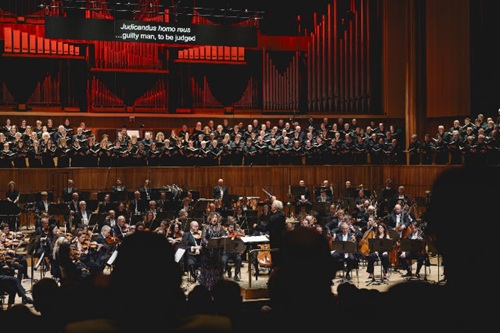
This was a luxury War Requiem in all ways: an orchestra in top form relishing a new season, two fine choruses and three first-class soloists, all in a perfect acoustic for this work. It reminded me how tricky the Royal Albert Hall acoustics were for the recently finished BBC Proms.
I must say that my heart sank when I learned, just a day before the performance, that one of my favourite tenors, Allan Clayton, was indisposed and his place would be taken by an American tenor Paul Appleby, I must admit a new name to me. I Googled and could not find he had sung a War Requiem before, though he is scheduled to sing it next year with the Vienna Radio Symphony Orchestra under the baton of Marin Alsop. I need not have worried – he was well up to the job, injecting sufficient meaning to the words (the moving and prescient poetry of Wilfred Owen) and a virile tenor voice to project round the hall. His final hushed ‘Dona nobis pacem’ was very moving.
Benjamin Appl was his German soldier counterpart, reminiscent in many ways of the late, great Dietrich Fischer-Dieskau (Appl says that Fischer-Dieskau was a ‘an invaluable and hugely informative influence’.). Appl was the more moving of the two soloists, especially when the seed of Europe is slaughtered one by one. Appl’s refined diction and perfect intonation were most impressive: only a few words gave away he isn’t a native English speaker, the vowel in ‘and’, the ‘th’ in ‘truth’ and the pronunciation of ‘sojourned’ (not an easy word). Welsh-Ukrainian soprano Natalya Romaniw gave us glittering top notes and enough volume to override the huge chorus and orchestra in the ‘Agnus Dei’: her ‘Lacrimosa’ most touching, the opening of ‘Sanctus’ chilling.
The London Philharmonic Chorus were augmented by many members of the London Symphony Chorus making well over 200 singers. The opening hushed ‘Requiem aeternam’ was perfectly executed, the ‘Dies irae’ thrilling as it must be, lusty in ‘Quam olim Abrahae’, weighty in ‘Pleni sunt coeli’, ghostly in the opening ‘Libera me’. The choir had plenty of breath, so that the final ’n’s in ‘Amen’ lingered audibly for as long as conductor Edward Gardner wanted. I guess Madeleine Venner, chorus director of the London Philharmonic Choir, took all the rehearsals, as Mariana Rosas (the London Symphony‘s chorus director) did not appear for the curtain call, ensuring the huge choir sang as one band.
The boys choir (in the distant past taken from Highgate School and Wandsworth Boys) have, for some time now, been eclipsed by the boys and girls from Tiffin School; they were faultless, placed right behind the upper balcony, perhaps not quite distant enough, especially if you were sitting in the balcony. It is always a conundrum for conductors to know where to place the chorus of angels, not too distant and not too loud. I have heard them (and sung it as a treble) behind the tall wooden screen at the side of the Festival Hall stage, on the stage of the Zurich Tonhalle (simply wrong) and in the Upper Gallery of the Albert Hall (perfect). Only a shame that they could not rush the boys and girls (I suspect nowadays mainly girls) down to the stage to receive their applause.
The orchestra and chamber orchestra (the latter packed with Principals) were in fine form; I highlight the flawless quartet of trumpets and the barrage of percussion. Richard Gowans relished his contribution on the huge Festival Hall organ, after a long wait; and his final flourish (is this ad lib or in the score?) Was very audible, which is often not the case.
Edward Gardner had the full measure and tempi of this masterpiece, and most generous to chorus and soloists with signals of entries. He will have been very well pleased by this splendid start to the LPO season, as were the packed-out Festival Hall audience. Gardner kept completely still at the end of the work, preventing premature applause: he made his point.
Sadly, current warmongers were not in obvious attendance to heed Britten’s pacifist warning.
John Rhodes