
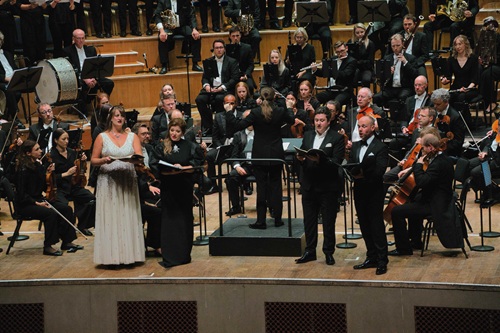
 United Kingdom Brahms, Britten, Beethoven: Senan Sheridan (piano), Eleanor Dennis (soprano), Carolyn Dobbin (mezzo-soprano), Kieran Carrel (tenor), Padraic Rowan (bass-baritone), National Youth Choir of Northern Ireland Senior Choir, Belfast Philharmonic Youth Chamber Choir, Belfast Philharmonic Choir, Methodist College Chapel Choir, Royal Belfast Academical Institution Choir Tenors and Basses, Belfast Royal Academy Chamber Choir, Ulster Orchestra / Anna Handler (conductor). Ulster Hall, Belfast, 25.9.2026. (RB)
Brahms – Academic Festival Overture, Op.80
Britten – Young Apollo, Op.16
Beethoven – Symphony No.9 in D minor ‘Choral’, Op.125
The Ulster Orchestra opened their 60th anniversary season under the baton of their new Chief Conductor, Anna Handler. The key work on the programme was Beethoven’s monumental Ninth Symphony which, since its first performance in 1824, has remained a potent symbol of unity, community and untrammelled joy. The ‘Ode to Joy’ theme in the final movement is the official anthem of the European Union. This year is the 50th anniversary of Benjamin Britten’s death, so to commemorate the concert also featured a performance of the composer’s Young Apollo.
The concert opened with Brahms’s Academic Festival Overture. The University of Breslau conferred an honorary degree on the great composer in 1880, and Brahms wrote the work as a tongue-in-cheek thank you to mark the occasion. It is based entirely on student drinking songs and by all accounts the Breslau students showed their appreciation by singing along during the first performance.
There was much to admire in this performance by Anna Handler and the Ulster Orchestra. The strings captured the deadpan humour in the stealthy march like opening setting the scene for the drinking songs to follow. The trumpets were impressive in the first of the drinking songs and the bassoons executed the light-hearted comedic effects to perfection in the third. Handler did an excellent job keeping the textures light and transparent, although I wondered if there was scope to bring more of the rich inner harmonies. Handler was highly attentive to the big dynamic shifts in the score, and she and the orchestra raised the roof in the final section of the piece.
Britten’s wrote Young Apollo in 1939 in response to a commission by the Canadian Broadcasting Corporation. It is a brilliant, high-energy work for piano, string quartet and string orchestra. The piano writing is highly virtuosic, and it is an unusually bright and extrovert work for Britten. It carries the final lines of Keats’s Hyperion as an epigraph, although it was inspired by Wulff Scherchen with whom Britten had a romantic relationship.
Northern Ireland’s Young Musician of the Year, Senan Sheridan, was the soloist. He did a terrific job navigating his way through Britten’s glittering virtuoso passagework. Handler ensured there was an excellent balance of sound and tight coordination between the strings, string quartet and soloist. The string quartet brought a sense of intimacy to the work and the concertino effects with the strings were well executed. The short reflective interlude was well-handled before the music surged once again in a dramatic sprint to the finish. Handler is a distinguished concert pianist as well as a conductor and she and Sheridan performed ‘The Fairy Garden’ from Ravel’s Mother Goose as an encore.
Beethoven’s Ninth Symphony is a groundbreaking culturally iconic piece. Any performance is a special occasion, so it was a great piece to mark the opening of the Ulster Orchestra’s 60th season. It was good to see home grown talent making their mark in this performance. Two of the soloists, Carolyn Dobbin and Padraic Rowan, are from Northern Ireland and Ireland respectively. Several youth choirs from schools in Belfast (including my own former school), and from across Northern Ireland, joined the Belfast Philharmonic Choir.
The first movement of this symphony is often the most difficult to bring off in concert and I had mixed feelings about this performance. The famous opening with its tremolos and falling fifths on the strings conjured up images of order springing from the void. Handler succeeded in investing the music with tragic weight and depth although occasionally the tempo was a little sluggish. The Ulster Orchestra did a reasonably good job capturing the struggle and conflict which runs through the movement, although there was scope for them to make more of the striking contrasts. A few of the entries in the contrapuntal development section could also have been clearer.
The scherzo second movement was taken at a cracking pace. Handler ensured the entries remained tightly coordinated as the theme bounced across different sections of the orchestra. The timpanist punctured the orchestral texture in the striking way Beethoven demands. The orchestra’s performance of the slow movement was gorgeous and a highlight of this performance. The opening was deeply expressive, and Handler’s pacing of the material was spot on; the movement had a wonderful sense of lyricism and flow. The strings were marvellous in weaving increasingly elaborate textures as the variations progressed while the horns brought warmth and lyricism to the orchestral textures.
Conductor, orchestra, chorus and the four soloists joined forces to produce a memorable finale. The baleful Schreckenfanfare which opened the movement sent a shockwave through the hall that demanded a resolution. The lower strings conveyed the speech-like recitative sections beautifully before the ‘Ode to Joy’ theme emerged as a ghostly whisper. The four soloists were impressive in their respective roles. Bass-baritone Padraic Rowan was very good indeed: he sang with a gorgeous, burnished tone and his diction was excellent. Tenor Kieran Carell also did well in the ‘Turkish March’ section, aided in no small part by the orchestra’s percussionists. He coped well with Beethoven’s very high and elaborate vocal line, although I would have liked a more focused sound. Soprano Eleanor Dennis and mezzo-soprano Carolyn Dobbin also acquitted themselves well.
The various choirs had clearly been very well drilled, and they successfully combined to create one massive, unified choir. The diction was excellent and they successfully cut through large orchestral forces. A lot of the vocal writing in this movement is exceptionally high and notoriously difficult. The massed choirs negotiated the technical demands with aplomb and the performance never flagged. In the middle of the movement, they combined with the orchestra to electrifying effect. Handler brought the choral and orchestral forces together one final time before driving the movement to its thrilling conclusion.
Superb playing and singing all round and an auspicious debut from Anna Handler in her Chief Conductor role. The performance was deservedly greeted with a standing ovation from the audience.
Robert Beattie