
 United States Various, ‘Ben Franklin in Paris’: Alan Choo (violin), Chloe Feder (violin), Apollo’s Fire / Jeannette Sorrell (conductor). First United Methodist Church, Akron, 15.10.2026. (MSJ)
Mozart – Overture & Dance from Les petits riens; Symphony No.31 in D major, ‘Paris,’ K.297
Dusuel – Contredanse ‘La Voltaire et La Franklin’
Rameau – Suites from Les Fêtes de l’Hymen et de l’Amour & Les Fêtes de l’Hébé (ed. Sorrell)
Bologne – Symphonie-Concertante No.2 in G major
Grétry – Suites from Zemire et Azor & Le Caravan du Caire (ed. Sorrell)
One could spend a lifetime trying to capture anything about the mysteries of music in words. One particular problem is distinguishing between the ‘feel’ of performances. Case in point: why is it that Jeannette Sorrell and Apollo’s Fire performing Mozart’s ‘Paris’ Symphony can feel so tremendously alive, while any number of other performances at the exact same tempos sound inert? It is not just the usage of historically-informed performance practices. I have heard some completely flat-lined period instrument performances of the work, while one of the best recordings I ever encountered was by Eugene Ormandy and the Philadelphia Orchestra. What is it that animated the piece in both Ormandy’s recording and Sorrell’s concert?
I think it comes down to thinking of the music in a linear yet elastic manner. An Apollo’s Fire concert never ticks by metronomically. Whether or not Sorrell or any individual players make expressive tweaks along the way, there is a sense that all the players are engaged with the music as a living line which they collaboratively spin out. They work at it until they are anticipating each other’s flexions. That is quite a distance from performances which perfunctorily tick away measures as if the metronome is a guillotine, chopping off phrases as they pass.
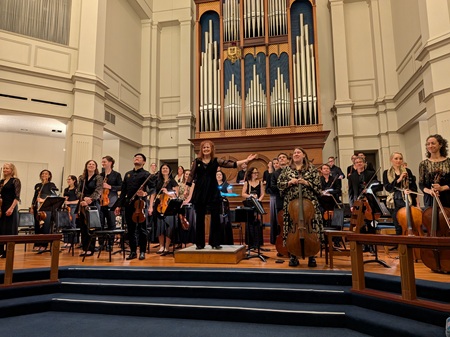
In this cleverly programmed ‘Ben Franklin in Paris’ concert that trademark sense of investment was present, even if slightly diluted by the size of the ensemble. On this occasion, it was a grand collection of nearly forty players who gave the music a rich and festive flavor. The extra forces, some perhaps encountering the ensemble for the first time, may become more engaged as they live with Apollo’s Fire through more performances, but they were already far beyond most groups. The orchestra is celebrating its thirty-fifth season this year, and this program started it with style.
The framing device of US diplomat Benjamin Franklin’s high-profile visits to Paris in the late 1770s gave a reference point for the music of the program: a concertante work by the highly popular violinist, composer and conductor Joseph Bologne, the Chevalier de Saint-Georges; colorful theater music from Jean-Philippe Rameau and André Grétry; and some works by an unknown and unsuccessful young composer named Wolfgang Mozart. Sorrell even went the extra distance and tracked down a dance by Dusuel specifically composed to depict a meeting that had taken place between Franklin and the philosopher Voltaire. The piece is so obscure that the composer’s first name isn’t even known for certain, but it depicts the aged and shaky (though still sharply witty) Voltaire with awkward leaps and tart dissonances, while Franklin is assured and charming, though repetitious, just like his constant diplomatic pleas for funding from the French government to support the American Revolution. The piece was hilarious, and the players relished its vivid pictures.
Violinists Alan Choo and Chloe Feder were paired in Bologne’s elegant double concerto. Despite having pronouncedly different tones, they blended gorgeously when playing sweet harmonies. Separately, Choo was bright-toned and brilliant while Feder tended toward a much more introspective and mysterious shading. This interplay of colors heightened the work’s lithe turns of phrase, as Sorrell guided it sure-handedly from the podium while still allowing the soloists room to explore.
Sorrell’s hand was also in the music editorially as she sifted through multiple theater works by Rameau and Grétry to assemble outstanding suites. Rameau’s wry genius was played for all its considerable worth, while the noisy but entertaining Grétry was deployed with panache as a light interlude, replete with period wind machine. As an aside, if you think that Mahler invented the ‘boom-chick’ rhythm of bass drum and rote in his first symphony, think again, for Grétry beat him to it here.
But, of course, the Mozart exists on a plane so far above the other works of this time that the people of Paris were unable to recognize the giant in formation, leaving Mozart to depart Paris in disappointment. Though only the overture to Mozart’s ballet Les Petits Riens (‘The Little Nothings’) was credited in the program, what Sorrell actually did was to append one of the dances from the ballet immediately following the quiet close of the overture, which made for a good concert ending. The music of the ballet is delightful, and one hopes they will perform the whole set at some future point, though it would be interesting to see how they might accomplish the logistics of the number which calls for an offstage ensemble echoing the onstage orchestra.
The ‘Paris’ Symphony was even more delightful, with grandeur and high energy countered with flexibility and gravity. Each rushing scale of the first movement was given its own contextual treatment by Sorrell, turning empty flash into thoughtful deployment of a local fashion that Mozart was using in hopes of appealing to his French audiences. The slow movement flowed elegantly while foreshadowing the later Mozart with passing shadows. The finale was a romp for the ensemble, relishing the fact that they can still make music dance, even when swelled to grand size.
Mark Sebastian Jordan