
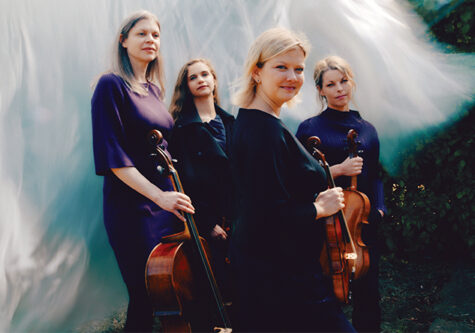
 United Kingdom Haydn, Beethoven: Chiaroscuro Quartet (Alina Ibragimova [violin], Charlotte Saluste-Bridoux [violin], Emilie Hörnland [viola], Luise Buchberger [cello]). Wigmore Hall, London, 14.10.2026. (CSa)
Haydn – String Quartet in G minor, Op.20 No.3; String Quartet in A, Op.20 No.6
Beethoven – String Quartet No.15 in A minor, Op.132
Edging towards its 21st birthday, the all-women Chiaroscuro Quartet, founded by violinist Alina Ibragimova and fellow students at the Royal College of Music under the guidance of the late Sir Roger Norrington, is dedicated to a distinctive performance sound and style. The Chiaroscuro players, the cellist sitting and the others standing, favour animal gut rather than modern steel strings coupled with early 19th-century bows. Like their famous mentor, they eschew the use of continuous vibrato – a relatively recent phenomenon – reserving it for specific moments of intense emotional emphasis. By eliminating the wobble, they strive to achieve ‘greater transparency, starker dissonances and enhanced natural overtones’ as Norrington put it.
These distinctive traits were on full display at the ensemble’s most recent Haydn and Beethoven recital at Wigmore Hall, where the intricate individual voices and complex harmonies of the instruments could be heard with crystalline clarity and, fittingly, a characteristic chiaroscuro glow.
The pairing of two of Haydn’s Op.20 Sun Quartets with his pupil Beethoven’s late Quartet in A minor Op 132 in the same programme helped us to explore how the genre developed from an intricate, witty, and occasionally melancholy 18th-century conversation to a journal of private suffering, recovery and exultation. Beethoven, embracing Haydn’s musical alphabet, transformed it into a new language, capable of expressing what had never been said before.
Beginning their recital with Haydn’s dramatic Quartet in G minor No.3, the Chiaroscuro perfectly captured its restless unpredictability, performing the opening Allegro and oddly irregular Menuetto with diamond-tipped precision and animated interplay. In the third movement Adagio, Ibragimova’s violin sang with hymn-like tenderness, while Luise Buchberger’s cello answered – a moving dialogue between equal voices. In their account of the Finale the players brought a striking chiaroscuro of its own, balancing passages of darkness with flashes of light and nimble wit.
In Haydn’s A major Quartet No.6, the group combined clean musical lines with an irrepressible lightness of touch. The buoyant, mischievous opening Allegro contrasted nicely with the soulful Adagio, its rippling progression overlaid by a tender melody from the first violin, quietly and exquisitely played by Ibragimova. A robust but elegant Menuetto preceded a trio, played with fleeting delicacy by a single violin, viola and cello, was followed by a fugal finale played at dazzling speed, its three separate ideas building into one daringly played contrapuntal whole.
While the Haydn quartets offered grace and ingenuity, it was the Beethoven after the interval which proved the evening’s crowning achievement. The Chiaroscuro’s account of Op.132 took us on a profound journey from uncertainty to spiritual renewal. The opening movement was grave, searching and agitated in turn. It led to a lilting rustic dance – a nod to Haydn – in the ensuing Allegro. Then came the slow movement – a prayerful meditation punctuated by flashes of renewed vitality – the emotional heart of the work. Entitled Heiliger Dankgesang (Holy Song of Thanksgiving) Beethoven intended it as an expression of gratitude after recovering from a long illness. It is rare to hear playing so powerful and yet so restrained, some passages barely above a whisper. After such transcendent beauty the brisk jaunty Alla marcia came as a startling albeit welcome return to the everyday world. The finale erupted triumphantly in a blaze of passion and affirmation. In a subtly shaded interpretation that moved from darkness towards radiance, the ensemble showed that chiaroscuro is more than an artistic technique – it lies at the very heart of Beethoven’s music.
Chris Sallon