
 United Kingdom Mozart: Yunchan Lim (piano). Wigmore Hall, London, 15.10.2026. (CC)
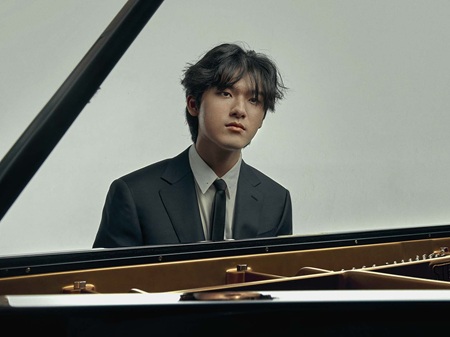
Mozart – Piano Sonatas: C, K 279 (1775); D, K 284 (1774-5); Fantasia in D minor, K 397 (c.1782); Piano Sonatas: F, K 332 (1781-3); A minor, K 310 (1778)
A portrait of Wolfgang Amadeus Mozart graced the Wigmore stage throughout this recital, the young genius looking on as Yunchan Lim, deserved young star of the pianistic firmament, delivered stunning performance after stunning performance. Lim is a bit of a Golden Boy at the moment, with his Chopin Etudes (in 2022 he became the Chopin Competition’s youngest ever winner) and Bach Goldberg Variations creating waves in the classical music industry. But it was Mozart who was the clear star here – perhaps reflected in Lim’s closing placement of audience bouquets at the foot of the painting.
Lim is offering cycles in London here and New York. There is something of a tired old trope that Mozart sonatas are somehow the composer’s ‘diaries’ and somehow ‘less than’ – thankfully, those days are receding rapidly in the past. I think of fairly recent complete cycles by Robert Levin (ECM) and Mao Fujita (Sony).
Lim started with the Piano Sonata K 279 of 1775 (No.1 – Levin precedes this on his set with his own completion of a Sonata Fragment also in C major, sans K number but previously listed under K 42/ 35a/Fr. 1771a, so arguably not quite ‘Genesis’). One can point to influences, imprints, for sure, not least Haydn in the slow movement, and the sonatas of Anton Steffen, widely used as teaching material in Vienna of the time. The ornate first movement poses huge technical problems if taken at a proper allegro given the ornate nature of the writing: Lim’s articulation was superb, the resultant sense of ebullience palpable. He is also unafraid of rubato in Mozart (something Levin also espouses) – and Lim, like Levin, makes it sound perfectly natural. His control is total, both of prestidigitation and of timbre; dynamic terracing was ideally realised. The only issue was a settling in of projection – the opening moments felt overdone (the Wigmore Hall is a pianist’s graveyard in that respect). The central, Haydnesque Andante was positively vocal in Lim’s hands, almost an early Mozart opera aria, while the finale returned us to the speed and excitement of the first movement, now more concentrated, as if an overture in the theatre.
It was the D minor Sonata, K 284 (No.6), composed in Munich in 1784, that completed the first half – this is the one with the extended, quarter-hour Tema con variazioni as finale (Mozart’s longest single keyboard sonata movement). The first movement begins as if a symphony, with its bold chord – D major is one of Mozart’s brightest keys, the dynamic exposition emphasised by the repeat. This is followed by a Rondeau en polonaise, marked Andante, full of emotion before those variations in which Lim, again with no sense of leaving Mozart’s style, used his Steinway to the maximum: pedalling double trills to contrast with the clear-eyed theme. He also realises that Mozart’s cross-handed writing is a form of dialogue; most of all Lim found the drama here, unafraid of long silences filled with tension and again, the sustaining pedal in the Adagio cantabile section. Magnificent – the young Mozart laid bare as genius.
Post-interval, the D minor Fantasia, the opening arpeggios a slow emerging from the depths, projection now perfectly judged. Mozart’s tear-jerker of a theme in the treble against slowly pulsating chords lower down was truly heart-breaking here. There were huge differences in tone and dynamic, the repeated E naturals are Mozart’s pre-echo of Chopin’s raindrops. Where in the first half sonatas Lim had consistently realised structure perfectly, here it was gesture that was to the fore, and brilliantly so, ascending appoggiaturas breathless, while an ascending scale positively melted into a return of the weeping theme. Mozart does offer a ray of light at the D major Allegretto, its placement in Lim’s programme enabling it to function as a precursor of the F major brightness of the contemporaneous Piano Sonata, K 332; a link especially obvious as, quite rightly, there was no applause between pieces. This is a gem of a sonata, and Lim captured the brightness of its first movement while revelling in its counterpoint and near-orchestral syncopations, accents nicely jarring. The slow movement is another of Mozart’s divinely inspired moments of heartbreak, and Lim fully honoured this in his choice of a proper Adagio; pauses electric, speaking silences. The finale is a real finger-twister, its technical challenges as nothing to Lim’s technique – Mozart’s music sparkled, teased, rapid passages just so even, minor-mode contrasts a gentle Rückblick to the slow movement. A joy.
Finally, the A minor Sonata, K 310. There are certain pieces in the repertoire for which there exist recordings that are embedded in classical music’s collective consciousness. This is one of them: Dinu Lipatti’s last recital in Besançon in September 1950 (he famously precedes the opening with a small improvisation). The sonata is surely Mozart’s most profound, the composer at the time deeply affected by the death of his mother. Lim rightly conjured a completely different sound from his Steinway, unafraid of pedal, the repeat only increasing the music’s vehemence. Perhaps there was, again, a hint of over-projection. Against that sheer energy, was the deep grief of the Andante cantabile con espressione, daring rubato and stabs of pain absolutely heartbreaking. The finale was, as Mozart asks, Presto, but also restless, breathless.
Interestingly, Lim’s concert manner is almost brusque – there is no show, no shuffling about at the piano stool, no long pauses between pieces. He simply sits down and delivers – and how.
The concert was repeated on two consecutive evenings to meet demand.
Colin Clarke