
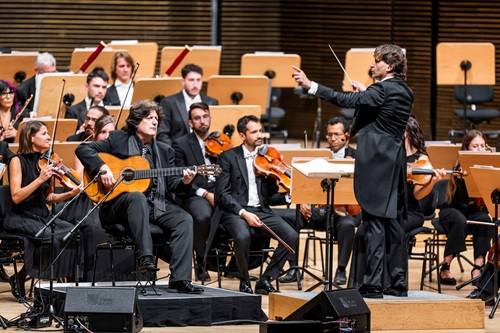
 United States Various, Fire – Guitar – Legend: Adriana González (soprano), Juan Manuel Cañizares (guitar), Teatro Real Orchestra / Gustavo Gimeno (conductor). Wu Tsai Theater, David Geffen Hall, New York, 15.10.2026. (ES-S)
Manuel de Falla – El amor brujo (fragments); Siete canciones populares españolas
Encore: Guridi – ‘Goizeko eguzki argiak’
Joaquín Rodrigo – Concierto de Aranjuez
Encore: Cañizares – ‘Cádiz’
Rimsky-Korsakov – Scheherazade, Op.35
Returning to New York for what has become an annual tradition, the Teatro Real Orchestra, under Music Director Gustavo Gimeno, presented a program that moved from Spanish repertoire to the orchestral storytelling of Rimsky-Korsakov’s Scheherazade.
The concert, dubbed Fire – Guitar – Legend, opened with four excerpts from El amor brujo, a work with particular historical resonance for the ensemble: members of the Madrid Symphony Orchestra, resident at the Teatro Real since 1997, gave the concert version’s premiere in 1916. The performance lacked some rhythmic bite. Sharper accents and a stronger sense of dance would have given the music greater urgency.
In Siete canciones populares españolas, heard in Luciano Berio’s orchestration, Adriana González sang with a warm tone and clear Spanish diction. Her middle register projected well, though her voice occasionally struggled to carry over the orchestra at both extremes of her range. From where I sat, the songs’ contrasting characters seemed to emerge through a translucent veil, their differences perceptible but insufficiently defined.
A winner of both the First Prize and Zarzuela Prize at the 2019 Operalia competition, González offered ‘Goizeko eguzki argiak’, the flower aria from Jesús Guridi’s Basque-language opera Mirentxu, as an encore. Her voice sounded freer here than in the preceding songs.
Juan Manuel Cañizares brought crisp articulation and rhythmic flexibility to the outer movements of Rodrigo’s Concierto de Aranjuez, with a subtle flamenco inflection. The opening Allegro con spirito was buoyant, while the celebrated Adagio featured a particularly expressive cor anglais solo by Ricardo Herrero. The beautifully shaped melody, reminiscent of the Adagio from Alessandro Marcello’s Oboe Concerto, elicited a sensitive response from Cañizares. The guitarist brought dramatic intensity to his extended solo passage, building toward the movement’s climax. The finale was graceful and playful, with well-coordinated exchanges between soloist and orchestra. As an encore, Cañizares performed ‘Cádiz’ from his Suite Al-Ándalus, a solo-guitar arrangement derived from his Concierto Al-Ándalus.
Rimsky-Korsakov’s Scheherazade offered a different world of orchestral color, though dance rhythms remained a link to the Spanish works of the first half. Conducting with elegant, precise gestures, Gimeno drew from the Teatro Real Orchestra an alert, well-crafted performance that sustained a sense of narrative across its four movements. Changes of tempo and mood flowed naturally, while careful balances allowed the score’s instrumental details to emerge without compromising its broader sweep.
The contrast between the forceful opening theme and concertmaster Gergana Gergova’s supple response established the work’s dramatic premise. Expressive and unforced, her recurring interventions provided a thread of continuity. Taking few rhythmic liberties, she knew when to let the line soar and when to blend into the ensemble. The other principals showed similar sensitivity, bringing character to their contributions while respecting Gimeno’s overall conception. This was particularly evident in the second movement, ‘The Legend of the Kalendar Prince’, where bassoonist Francisco Alonso, followed by oboist Guillermo Sanchis, introduced the main melody after Gergova’s opening statement and, later, clarinetist Luis Miguel Méndez delivered a plangent, recitative-like solo.
In ‘The Sea and Sinbad’s Ship’, the warm strings’ undulating accompaniment gave the music breadth and a natural swell without heaviness. ‘The Young Prince and the Young Princess’ combined tenderness with flowing phrasing, its dance passages adding charm and lift. The finale built excitement through the rhythmically incisive Baghdad festivities, followed by the return of the opening sea theme and the shipwreck’s orchestral climax. Brass and percussion added weight without overwhelming the strings or obscuring inner detail. The quiet close contrasted with the work’s imposing opening.
The interpretation offered no fresh insights into the score, but its strengths lay in proportion, continuity and assured ensemble playing.
Edward Sava-Segal