
 Canada Various: Augustin Hadelich (violin), Vancouver Symphony Orchestra/ Clemens Schuldt (conductor). Orpheum Theatre, Vancouver, 10.10.2026. (GN)
Estacio – Frenergy
Brahms – Concerto for Violin and Orchestra in D major, Op.77
Encore: R. Schumann – ‘Träumerei’ from Kinderszenen
Dvořák – Symphony No.6 in D major, Op.60
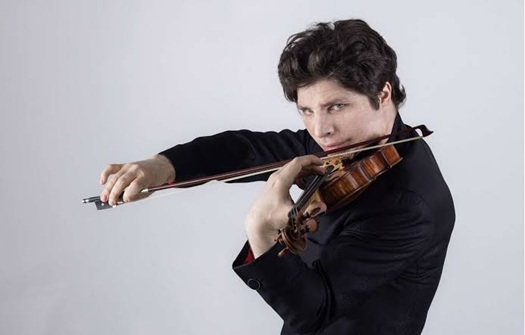
This concert marked the Vancouver debut of young German conductor Clemens Schuldt, currently in his third year as Music Director of Orchestre Symphonique de Québec and who previously served as Chief Conductor of the Munich Chamber Orchestra from 2016-2022. Here he collaborated with the inestimable Augustin Hadelich in the Brahms Violin Concerto, and celebrated a truly fertile period in 19th-century romantic composition by adding Dvořák’s Sixth Symphony, written only two years later in 1880 as a homage to Brahms’s Second Symphony. All these works share the common key of D major. It was the Dvořák that turned out to be the winner in a performance full of idiomatic thrust and joy, with a wonderful contribution from the orchestra. For all the pristine beauty and intelligence in Hadelich’s playing, the Brahms was less concentrated, often settling for a warm lyricism over a full penetration of the work’s architectural and emotional range.
Though some concertgoers might want to wade gently into an evening of music, Canadian John Estacio’s opening Frenergy (1998) certainly would have woken them up with a bang. It is a breathless scherzo overture, ignited by a tempestuous timpani attack that soon gives way to sharp, minimalist syncopation and a jazz band feeling. The piece formally develops from a relentless ostinato that flies around the orchestra as it transfers between the strings, winds and brass. A brief reprieve comes through airy wind lines where the flute is most notable, but the driving force becomes fully unstoppable again as we reach the tumultuous close. The overture’s athletic energy and contrapuntal texture are very effective and actually bear a resemblance to both the symphonic works of American composer Peter Mennin and types of modern ‘industrial music’. This is one of Estacio’s most popular pieces.
It is a major switch to the Brahms Violin Concerto, and I am not sure Schuldt made the transition particularly well. He opened at a very relaxed tempo with a feeling of padded warmth but, instead of instating the required Brahmsian architectural ‘blocks’, he then tended to push the orchestra with a clipped, linear drive that seemed slightly forced. There was energy but little majesty or vertical reach, and this type of orchestral flattening seemed to continue throughout the movement. Usually, each orchestral tutti takes you from one compelling vista to a new one – where the violin can explore a different range of feelings – but Schuldt’s treatment invariably seemed to leave one in the same place. In between, Schuldt seemed to work towards a generalized warmth.
The absence of structural terracing potentially could make things difficult for Hadelich, since he might have to instill the missing features on his own. But his temperament and style are hardly that of Itzhak Perlman or David Oistrakh; the violinist offers wonderfully fine-spun articulation and a pristine sense of line, but he aims more at lyrical expansion and intimacy than assertiveness and top-to-bottom contrast. Overall, he gave a lovely, clean rendering of the solo part – sometimes very sweet and sometimes rhapsodic – yet the reading ended up with a chamber music or a serenade profile, punctuated by orchestral interludes. While the detailing was exceptional, it seemed on the analytical side: even the movement’s famous swinging cantabile theme was beautifully sculpted but did not push out with full feeling or release. We therefore got many moments of interpretative nuance and beauty but insufficient architecture or friction to meaningfully hang them on.
An additional novelty of the opening movement was Hadelich’s new cadenza, replacing Joseph Joachim’s traditional one. It was tastefully constructed and often featured a refined and inward treatment of core motives. However, the unintended result was that it was so gentle and ruminative towards its end that the wonderfully suspended, quiet coda following the return of the orchestra seemed anti-climactic. I think the performance actually needed the grit and brazen virtuosity of the Joachim cadenza to offset the softness elsewhere.
Brahms often referred to the slow movement of this concerto as ‘fragile’ and it has always been a movement that requires a combination of vulnerability and distilled beauty. Yet here the opening oboe was warm and fulsome rather than plaintive and pastoral, perhaps almost sentimental as it progressed. Lovely as it was, the poignancy of Hadelich’s entry somehow did not quite fit, and the violinist’s playing eventually became warmer and (again) more serenade-like as the movement proceeded. In fact, the reading moved closer to the sweeter feelings of the Bruch Concerto as we reached the rarified musings at the end. The Hungarian rondo finale can hardly fail but, on this occasion, I felt that the consciously clipped playing of the tuttis was a constraint on its motion. The violinist played with great adeptness, but textures were not as clear as they might be and there was not enough real ebullience and joy exposed.
Overall, the full performance turned out as a rather comfortable affair that only intermittently got to the heart of the work’s combination of struggle and flowering joy. Hadelich’s encore was one of his own transcriptions: the touching ‘Träumerei’ from Robert Schumann’s Kinderszenen, where the purity of his very high whispers in the fifth position would be enough to place him in the highest echelon of violin artistry ever.
Fortunately, there was joy aplenty in Schuldt’s Dvořák’s Symphony No.6 where the maestro’s accents and drive secured a much more natural home. In fact, the whole work flowed from beginning to end with compulsion. The strings soared beautifully to open the Allegro and the climaxes were built with unerring rhythmic strength and decisiveness. The winds were excellent in finding rustic point in the quieter lyrical transitions, and the unanimity of the brass was noteworthy. The dramatic tensions were expertly managed to keep the sense of anticipation high and the intensity in place.
The Adagio was lyrically aware and set an almost perfect tempo, leaving plenty of room for the overwrought dramatic statement in the middle and winding things down with a special rustic charm. The timbre of the winds gave the right naturalistic feel to the piece. The striking Furiant may have started a little quickly but soon settled into its insistent Bohemian rhythms with unbounded energy and flair. The conductor might have slightly damped the first violins at the opening of the Finale but soon the sharply-etched attack of the orchestra took over, slicing through the movement’s hills and valleys with genuine elan and an incredible feeling of joy.
There was compelling concentration here, and the climax was perfectly judged, setting the seal on an exceptional performance. The treatment was thoroughly idiomatic, perhaps more in the classic tradition of Karel Ančerl than the more recent Jiří Bělohlávek, and all sections of the VSO played splendidly. The brass may have seemed slightly too enthusiastic and brazen at points – but that is what fresh discovery is about and I thoroughly enjoyed it. This wonderful symphony is played much less than it should be.
This was truly an evening of ‘swings and roundabouts’ – as long-time British critic Trevor Harvey was often wont to say. Nonetheless, Schuldt’s Dvořák certainly provided special information about his conducting potential.
Geoffrey Newman