
 United Kingdom Puccini, Tosca: Soloists, Chorus and Orchestra of the Welsh National Opera / Gergely Madaras (conductor), Wales Millennium Centre, Cardiff, 14.9.2025. (LJ)
Production:
Director – Edward Dick
Set designer – Tom Scutt
Costume designer – Fotini Dimou
Lighting designer – Lee Curran
Choreographer – Maxine Braham
Cast:
Tosca – Natalya Romaniw
Cavaradossi – Andrés Presno
Scarpia – Dario Solari
Spoletta – Alun Rhys-Jenkins
Sciarrone – George Newton-Fitzgerald
Sacristan – Ross Fettes
Jailer – Stephen Wells
Tosca is having its moment. In the UK there are currently two Floria Toscas vying for our attention. Anna Netrebko has just returned to Covent Garden’s Royal Opera House after a six-year absence to take up the role – the very place that Natalya Romaniw sang Tosca in 2022, having made her role debut for Scottish Opera in 2019. Romaniw stepped back into Tosca’s shoes, this time with the Welsh National Opera at Cardiff’s Wales Millennium Centre. Parallels will not be lost on the politically-minded as two divas, one Russian the other Ukrainian-Welsh, perform in England and Wales. But to point simply to the politics outside the opera is to miss allusions to politics within the opera and to sidestep completely the argument that Tosca could fall under the category of ‘art for art’s sake’ (after all, Tosca herself is an opera singer and her ill-fated lover, Mario Cavaradossi, is a painter). Perhaps the reason why Tosca is currently enthralling audiences across the country is a combination of all these things.
Tosca is replete with the component parts required of an archetypal opera: love, jealousy, politics, religion, murder, and suicide. It is an intense story of lust and political manipulation set in the heart of a city controlled by an autocratic leader. In the original libretto, the opera is set in Rome over the course of twenty-four hours: 17-18 June 1800, the very date Napoleon re-entered Italy.
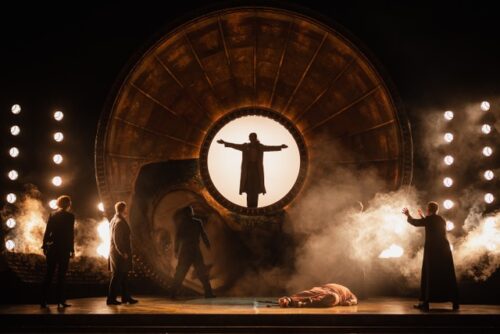
In this Opera North production (first staged in 2018), Edward Dick’s modern interpretation hints at Rome with a set piece suggestive of a cupola featuring Cavaradossi’s painting of Mary Magdalene. It also clearly reflects our contemporary moment with Scarpia showing Tosca footage of Cavaradossi’s torture on a laptop and then lustily recording her on his mobile phone as she sings ‘Vissi d’arte’ in Act II. Tosca lends itself well to contemporary stagings: a megalomaniac seeking pleasure from political and sexual power by whatever means available brings to mind any number of despots currently in power. (Indeed, the RBO has also opted for a contemporary staging.) At times, however, Tom Scutt’s set design felt incoherent. Perhaps he was intending for a timeless quality, but the production would have been more convincing if firmly rooted in either the nineteenth or twenty-first century.
Costuming was also incongruous. Scarpia donned a contemporary business suit, but Cavaradossi’s smock resembled the attire of an eighteenth-century painter. Sadly, the costuming of Tosca herself was the most incoherent. Here, there is opportunity to represent courage, vivacity, devotion, even jealousy, but Fotini Dimou’s costuming saw Romaniw wear muted, slightly dated, unremarkable clothes. Was Dimou aiming to show Tosca as an everywoman, someone at the mercy of those more powerful? If so, she misses the point that, despite Tosca’s suffering, she never gives up on love and her final act is one of defiance, not merely defeat.
The set was primarily dimly lit with lighting cleverly employed by Lee Curran throughout. For example, in the opening of Act I, torches, lamps, and candles were used skilfully to convey moments of intrigue, self-reflection, and piety, with Romaniw quite literally shining a spotlight on herself. In terms of her performance, this spotlight was well deserved.
Romaniw’s intonation, characterisation, and vocal control were astonishing. She possessed the power, levity, and tenderness required of this role. In the scene where Scarpia shows her Cavaradossi’s torture during Act II, Romaniw’s deep and sorrowful delivery of the lines ‘Che v’ho fatto in vita mia? / Son io che cosi torturate! Torturate l’anima…’ (‘What have I done to you in my life? / It is I you torture so! / It is my spirit…’) will be difficult to forget as she laid bare the plight of the wronged – an eternal theme.
As Cavaradossi, Andrés Presno was strong and commanding. Presno has an earthy voice that paired well with Romaniw’s. At times, however, excessive power rendered his voice overly recitative during moments that required more vocal dexterity. This was evident when he sang Puccini’s majestic aria ‘E lucevan le stelle’, which was moving but frayed slightly at ‘E non ho amato mai / tanto la vita’ (And never was life so dear, / to me, no never’). By contrast, as the evil Scarpia, Dario Solari was mendacious but not quite strong enough vocally to carry off the brazen brutishness of this self-confessed Iago-like character. Solari sung the ‘Te Deum’ well in the closing of the first act, but his voice did not stand out when accompanied by the impressive WNO Chorus and WNO’s ‘Tosca Bells’.
The WNO orchestra also performed Tony Burke’s reduced score very well. The opening of Act III afforded the horn section an opportunity to announce sunrise and hint at a sense of hope (even if this is soon to be flouted). This, and the ensuing string section, was played brightly at first, and then with a tender solemnity that foreshadowed Cavaradossi’s and Tosca’s fate. Hungarian conductor, Gergely Madaras, was attentive to such nuances in Puccini’s score and did not succumb to melodramatic tendencies that Puccini’s motivi conduttori, or leitmotivs, invite. This is not to say that there was no might as the orchestra’s performance of the brass- and percussion-heavy entrance theme for Scarpia, which consists of the unsettling tritone, often referred to as the ‘devil’s interval’, was a reminder of Tosca’s tragic proportions.
Romaniw gave audiences a Tosca despairing at the crossroads at which she finds herself (only if she submits to Scarpia’s lust will Cavaradossi live). By presenting Tosca as agonising over her dilemma and innocently believing that love will conquer all, the audience could experience the unjustness of her situation but with a knowing sense that such a high concentration of corruption cannot be diluted, not even by love. Thanks to Romaniw’s intelligent characterisation, in this production, Tosca’s suicide is not melodramatic but a logical conclusion that must befall an earnest soul suffocating in a world that values power (political and religious) over compassion.
If this is a moment for Tosca, above all it is a moment for Natalya Romaniw who was unmatched during this performance. This Swansea-born singer from Morriston (home of the internationally acclaimed Welsh male voice choir, the ‘Morriston Orpheus’) can be added to the growing list of great Welsh singers.
Lucy Jeffery
Featured Image: Natalya Romaniw (Tosca) © Dafydd Owen