 United States Korngold, The Silent Serenade: Soloists, Mannes Orchestra / Cris Frisco (conductor). Mannes Opera, The Gerald W. Lynch Theater at John Jay College, New York, 13.3.2026. (RP)
Hollywood fame, including three Oscars for best score, doesn’t guarantee success on Broadway. Erich Wolfgang Korngold had hits with Rosalinda (1942) and Helen Goes to Troy (1944), but he struck out with The Silent Serenade (1946). It has finally had a US premiere 80 years later, not on the Great White Way but in a delightful production by Mannes Opera, a training program for operatic artists at The New School’s Mannes School of Music.
The Silent Serenade was ill-starred almost from the beginning. The libretto is an adaptation of a short story by Raoul Auernheimer, an Austrian who, like Korngold, emigrated to America to escape Nazi persecution. Multiple writers worked on the libretto, with Auernheimer engaged to translate the final English version into German. Korngold hoped that The New Opera Company, which had produced his prior two Broadway successes, would stage it, but that never materialized.
The Schubert brothers, America’s leading theater owners and managers, were interested only if they were given control over the libretto, orchestration and other artistic elements. Rejecting those conditions, Korngold saw the German version, Die stumme Serenade, as a way to revive his European career. It was first performed in 1951 as a live broadcast production for Vienna Radio, with Korngold playing one of two pianos that served as the orchestra. The first staged production took place in Dortmund in 1954, but it wasn’t performed again until 2007 in Munich. The world premiere of the English version, The Silent Serenade, occurred in 2013 at the Royal Conservatory in Toronto.
The convoluted plot concerns a dressmaker, Andrea Coclé, who is secretly in love with a famous actress, Silvia Lombardi, for whom he creates clothes. Too shy to profess his love, Coclé pines away in secret, even silently serenading Silvia while trespassing in her garden. On the same night, a bomb is planted under the bed of Prime Minister Lugarini, to whom the actress is engaged. There is another lighthearted, endearing romance between Tony Borza, an always broke cub reporter, and Louise, Coclé’s assistant.
The Chief of Police convinces Coclé to plead guilty to both crimes, with the promise of a royal pardon to mark the king’s birthday. The scheme is foiled when the king dies before issuing the pardon. Enter Carlo Marcellini, who actually planted the bomb beneath the prime minister’s bed. In the blink of an eye, Marcellini deposes Lugarini and becomes prime minister. Somehow, Coclé becomes a popular hero and is pardoned. He and Sylvia, who turns out to be a sleepwalker, fall into each other’s arms and are, hopefully, destined to live happily ever after.
Emma Griffin, Managing Artistic Director of Mannes Opera, lent a deft touch to the production, instilling it with equal parts melodrama and comedy. The story is set in Naples and was updated from 1825 to what felt like the 1930s, a move that fits perfectly with the work’s musical and dramatic sensibilities. The mirrored, geometric set lent a touch of Art Deco glamour, as did the parade of Coclé’s colorful, alluring creations.
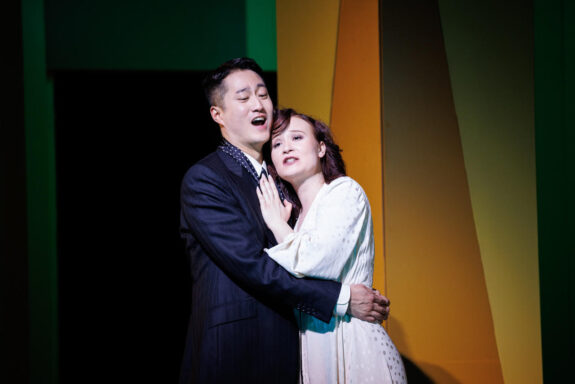
Korngold’s score is rich in beautiful melodies rooted in Viennese operetta, and the youthful voices carried the day. As Sylvia, Dasha Tereshchenko had the requisite glamor, physically and vocally. The beauty of her voice was most evident in her rich middle range, which permitted her to fill the bittersweet ‘Don’t Let Happiness Pass You By’ and ‘Till Tonight’ with warmth and richness.
Sean Cha’s Coclé was impeccably dressed and proper, and his elegant baritone was cut from the same cloth. He took a while to ease into the performance, but once he did he charmed, especially in ‘Reminiscence’. The duets he sang with Tereshchenko – from the first act in which Sylvia dismissively sings that dressmakers are not men, with Coclé forlornly acknowledging the fact, to their final duet – brought out the best in both artists.
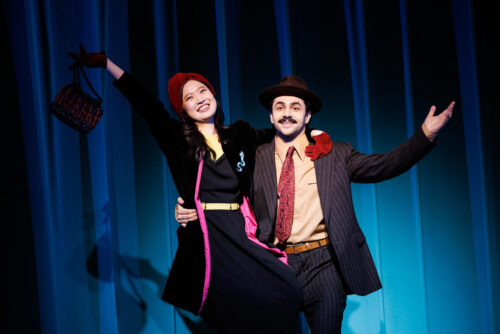
Tereshchenko and Cha sang the bulk of Korngold’s lovely melodies, but Thomasluke Flórez-Mansi’s Tony and Enes Pektas’s Caretta got the laughs. Their jokes always landed but, to be on the safe side, they were punctuated with rim shots. Flórez-Mansi’s Tony was warmhearted and rich-voiced, and he was matched by Gaeun Song’s winning Louise. Their romance was devoid of angst, which they expressed with delight in ‘You’ve Got it!’, which Flórez-Mansi and Song certainly do.
Enes Pektas displayed his resonant baritone as Caretto, the policeman whose dashes across the stage had a whiff of the Keystone Cops. Pektas zipped through a patter song with panache, lamenting that crime would have been a more lucrative career after the mishap with the bomb cost him his job and pension.
Oddly, for a student production, more energy was needed, but it wasn’t totally lacking. Dima Mironov’s zany Lugarini provided it, although his outlandish accent made his words incomprehensible. He wasn’t alone in being saddled with an accent. Jack Gustafson’s Carlo Marcellini was only briefly on stage but shot across it like a cannonball.
Cris Frisco led the eight players in the pit in a lyrical, romance-infused reading of Korngold’s original orchestration in which there was color and excitement galore. Frisco spun romance from Korngold’s melodies, played with such finesse by the violins, and added excitement and energy to the fast-paced numbers.
Rodgers and Hammerstein’s groundbreaking Oklahoma (1943) swept in a new age of musical theater. The Silent Serenade must have seemed a relic of another age to post-World War II audiences. Korngold’s musical has its charms, and Mannes Opera provided the rare opportunity to experience them in this charming production, as well as to escape into an earlier era where charm, wit and loveliness held sway.
Featured Image: Sean Cha (Andrea Coclé ) and Dasha Tereshchenko (Sylvia Lombardi ) in The Silent Serenade © Maria Baranova
Production:
Director – Emma Griffin
Sets – Amy Rubin
Lighting – Masha Tsimring
Costumes – Terese Wadden
Cast:
Sylvia Lombardi – Dasha Tereshchenko
Louise – Gaeun Song
Laura – Megan Barker
Andrea Coclé – Sean Cha
Caretto – Enes Pektas
Tony Borza – Thomasluke Flórez-Mansi
Lugarini – Dima Mironov
Model 1 – Elise Martinez
Model 2 – Mia Farinelli
Model 3 – Zoe Brooks
Carlo Marcellini – Jack Gustafson