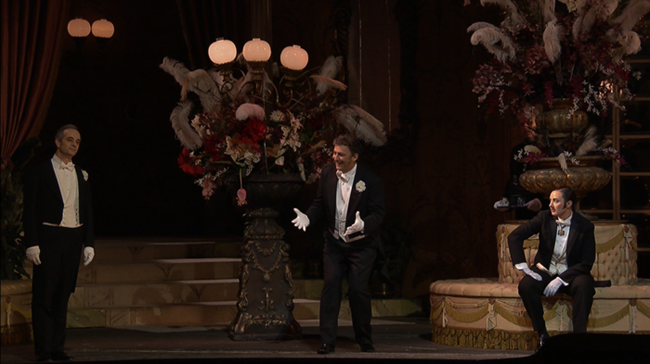
 Austria Johann Strauss II, Die Fledermaus: Soloists, Dancers of the Vienna State Ballet, Chorus and Orchestra of Vienna State Opera / Markus Poschner (conductor). Broadcast live (directed by Jakob Pitzer) from the Vienna State Opera, 31.12.2025. (JPr)

Vienna was in lockdown when I first saw a 2020 New Year’s Eve Die Fledermaus from the State Opera and I have always believed it affected the performance considerably and so probably did deserve my downbeat headline at that time. Three years on and things were much better since there was an audience thoroughly enjoying themselves, which helped to make me enjoy Die Fledermaus too, and much fun was had by all again in 2025.
I have written before – and unashamedly write again – how with any Fledermaus it is almost impossible not to rekindle memories of past performances I have seen and heard of this thoroughly entertaining work over six decades (!) and those who have appeared in it, such as Adele Leigh, Hermann Prey, Marilyn Hill Smith, Eric Shilling, Alan Opie … and even Frankie Howerd in the 1980s as the non-singing jailer, Frosch. My first Fledermaus was at the Vienna Volksoper – although I can’t really remember much about it – and I have seen it there since and also in London. How does 2025 with its starry leading couple compare? Very highly I am pleased to report.
The libretto for Johann Strauss II’s operetta was by Karl Haffner and Richard Genée and the plot has its roots in French farce, especially with nearly all of the characters being someone else for most of it. The wealthy philanderer Gabriel von Eisenstein has been sentenced to eight days in jail for calling a policeman ‘a jackass’. However, his friend Dr Falke convinces him to spend his last night of freedom at a ball thrown by Prince Orlofsky, an eccentric Russian who has money to burn and is desperate for a good laugh. Falke has a hidden agenda, and he is seeking revenge for a humiliating prank Eisenstein played on him years before. Falke introduces Eisenstein at the ball as a French marquis and also invites the prison governor Frank (also posing as a Frenchman), Eisenstein’s chambermaid Adele (supposedly now hoping to act in the theatre), and his wife Rosalinde (pretending to be Hungarian). Rosalinde has been ‘entertaining’ Alfred, a singer, in Eisenstein’s absence and he has been mistakenly taken to jail. In the end, husband and wife – who have been somewhat estranged – are happily reconciled and Eisenstein accepts the joke was on him. Vienna is the ideal place to luxuriate in the 3/4 time music from the ‘Waltz King’ and allow the absurdities of the plot to wash over you.
This production by Otto Schenk – who sadly died earlier this year at 94 – dates from 1979 and the lavish sets (by the late Günther Schneider-Siemssen) and Milena Canonero’s exquisite costumes are all redolent of fin-de-siècle Vienna. It is a little cluttered at times but there is a stunning use of a turntable in the second act revealing a sumptuous ballroom with a large table elaborately set for dinner. What is sometimes a rather stiffly staged ball, is now a riot of swaying, swirling – drunken or otherwise – figures, and ends with the collapse of a conga line of virtually everyone on the stage. This merriment is underscored by Strauss’s Unter Donner und Blitz (Thunder and Lightning) polka!
It is almost impossible to find anything really new to say about this wonderfully traditional Fledermaus. While I sometime adhere to Wagner’s ‘Kinder, macht Neues!’ for both opera and ballet, I am happy, on certain occasions like this, for productions to survive long after their ‘sell-by date’. This performance had some joyous moments and – with certain caveats – ranks as one of better ones I have seen. Who cares – though some might – that we are enjoying watching rather mature, skirt-chasing men, a mega-rich Russian performed en travesti, and jokes at the expense of the lawyer Dr Blind with his speech impediment and sight-impairment name.
For a very good Fledermaus – as this was – you need a cast of fine singers who are equally good at comedy and who may be required to dance well too! The 2025 cast was not as ‘starry’ as in 1979 which included several legendary names (Bernd Weikl, Lucia Popp, Brigitte Fassbaender, Walter Berry, and Edita Gruberová) but with Jonas Kaufmann making his stage debut as Eisenstein and Diana Damrau as Rosalinde they headed a fine cast which made the champagne-fuelled shenanigans fizz and this is all that ultimately matters. Not only does a Fledermaus need consummate actor-singers, but they must also be capable of creating exactly the onstage chemistry for its various couplings (Eisenstein/Rosalinde; Falke/Ida; and prison governor Frank/Adele) as they did here.
My major concern was Kaufmann as Eisenstein: not that he didn’t wholeheartedly throw himself into the role and was a bundle of energy throughout. I prefer Eisenstein to have total self-confidence and a clear lack of conscience, here Kaufmann cavorted around rather like a mature student at Freshers’ Week, with a fine line in exasperation and later an incendiary urge for vengeance when he believed Rosalinde to have been unfaithful. Kaufmann’s singing of course was sublime, almost too good. Adrian Eröd’s Falke was suitably conspiratorial and he brought a suave eloquence to the highpoint of his vocal performance, ‘Brüderlein, Brüderlein und Schwesterlein’, in Act II.
The Vienna State Opera rarely seems to fail when casting Adele and Ilia Staple was an absolute delight in the role displaying disarmingly easy coloratura (notably for her Act II ‘Laughing Song’) and instinctive and lively acting. Jörg Schneider is something of a veteran in the role of Alfred, the lovestruck patsy, and his experience showed. There was some classy parodic singing from him in all the tenorial ‘sampling’ that Alfred is given. Notably there was Handel, Mozart and Verdi, with Rosalinde greeted in the final act by him singing Florestan’s ‘O namenlose Freude!’ Jochen Schmeckenbecher seemed less sleazy than some as Frank, but it is still obvious he has an ulterior motive in supporting Adele’s acting plans. (I have lost count of the times I have seen Frank fall asleep in Act III under the newspaper with his cigar burning through it!) However, the moments of mock-French between ‘Marquis Renard’ (Eisenstein) and ‘Chevalier Chagrin’ (Frank) were really funny with all the ‘Can-Can, Can-Can-ing’ and ‘Oui, Oui, Oui-ing’.
It is Prince Orlofsky who saves Adele from Frank’s advances and Daria Sushkova’s ‘Champagne Song’ was as sparkling as it should be. Sushkova impressed as the initially po-faced Orlofsky yet laughs uproariously after all the Act II antics. Diana Damrau capped a fine performance by making Rosalinde’s famous ‘Czárdás’ genuinely sound like ‘Klänge der Heimat’ (‘Sounds from home’). Otherwise, her performance erred on the side of being domineering rather than captivating and vivacious. It didn’t really spoil anything, though I was left a little uncertain how much she was in on the joke for most of Act III. Hannah-Theres Weigl was a spirited Ida and, as in the previous performances, the chorus were wonderfully committed and showed a great energy, as did the enthusiastic dancers in the second act. As heard through loudspeakers, I found little fault in Markus Poschner’s conducting which had all the vitality and headlong rush this operetta needs from a rampant overture to the joyful reprise of the ‘Champagne Song’ at the very end.
Act III was its usual drawn-out affair for someone not a native German speaker and not au fait with the Austrian political class, though Trump and Putin were also mentioned in passing. The English subtitles failed to translate much of the stand-up routine of popular Austrian-Iranian comic Michael Niavarani as Frosch. I understood some of what he was saying and enjoyed much of his Slivovitz-fuelled antics, especially when dropping his keys into the orchestra pit and coming down amongst the musicians to retrieve them. He confronted Markus Poschner before relieving him of his baton and whipping the orchestra into starting the Carmen Overture.
Jim Pritchard
Featured Image: Adrian Eröd (Falke), Jonas Kaufmann (Eisenstein) and Daria Sushkova (Orlofsky) © Wiener Staatsoper
Production:
Production – Otto Schenk
Revival director – Katharina Strommer
Stage design – Günther Schneider-Siemssen
Costume design – Milena Canonero
Choreography for ‘Unter Donner und Blitz’ – Gerlinde Dill
Chorus master – Martin Schebesta
Cast:
Gabriel von Eisenstein – Jonas Kaufmann
Rosalinde – Diana Damrau
Frank – Jochen Schmeckenbecher
Prince Orlofsky – Daria Sushkova
Alfred – Jörg Schneider
Dr Falke – Adrian Eröd
Dr Blind – Lukas Schmidt
Adele – Ilia Staple
Ida – Hannah-Theres Weigl
Frosch – Michael Niavarani
Iwan – Jaroslav Pehal
‘I prefer Eisenstein to have total self-confidence and a clear lack of conscience…..’
I prefer a man with grey temples, who never really grow up. Otherwise he never would be tricked by the others! In that sense Kaufmann created the very best possible character, similar to Eberhard Wächter, one of the most famous Eisensteins.
JP for S&H: I do not want Eisenstein to be a sympathetic character but need a certain air of sophistication, raffish charm and, indeed, not to be the overgrown schoolboy Kaufmann seemed to be. Overweening self-belief would make the pranks played on him all the more credible.