 Switzerland Puccini, Madame Butterfly: Soloists, Chorus and Orchestra of Zurich Opera / Evan Rogister (conductor). Zurich, 3.1.2026. (AL-L)
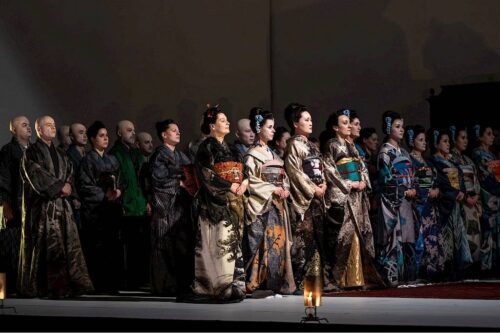
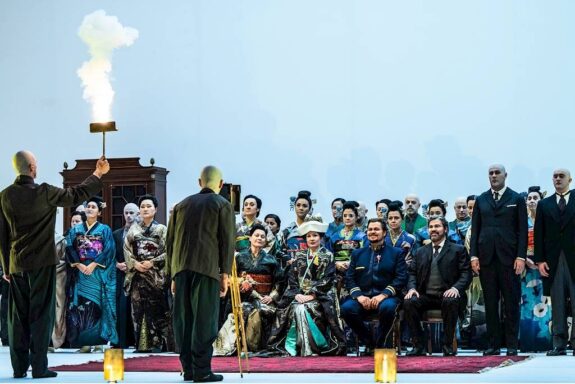
This revival of Ted Huffman’s 2017 production (review here) continues to demonstrate the virtues of theatrical restraint. The production opens with a bare stage framed by three walls, a minimalist approach that articulates the story efficiently. This is less-is-more staging at its best, allowing the focus to remain squarely on the drama unfolding before us.
Personenregie proved equally effective. Small but telling details spoke volumes: the knowing glances exchanged between Pinkerton and Sharpless when they mention that Butterfly is fifteen years old, or the subtle shifts in lighting that mark pivotal moments in the narrative. These touches demonstrate a director’s understanding that suggestion often works more powerfully than statement.
One small musical misjudgment marred the otherwise careful staging. In the sublime trio ‘Io so che alle sue pene’, Pinkerton was positioned at the back of the stage, creating an unfortunate imbalance among the three singers and diminishing what should be one of the opera’s most profound moments.
The production departs from tradition at the ending, where Cio-Cio-San takes her life not alone but in the presence of Pinkerton and Sharpless, the latter shielding her son’s eyes from the tragedy. This choice adds a layer of complicity to the male characters’ guilt that resonates powerfully.
Evan Rogister’s conducting proved well-matched to the production’s aesthetic. His precise, somewhat brisk approach brought modern sensibility to Puccini’s score. While a touch more tenderness might have been welcome in certain passages, the interpretation remained consistently effective. By evening’s end, the string section showed signs of fatigue, with intonation wavering in a few places, though not enough to seriously mar the overall impression.
Elena Guseva commanded the second act with dramatic intensity and vocal power. Her performance illustrated a common challenge with this role: conveying both the fifteen-year-old girl of Act I and the mature, desperate woman of Act II requires exceptional acting skills. While Guseva’s first act was less fully realized, her strong middle register and largely secure high notes carried the evening. Some of the highest notes could have been broader and more confidently delivered, but the overall effect remained compelling.
Stefan Pop brought genuine ringing high notes with significant power to Pinkerton. His voice possesses the qualities that mark him as a future Otello – though one hopes he will resist that repertoire for some years yet. For now, he needs to develop more varied tonal colours when singing at less than full voice, so as to find similar tenorial tones in quieter passages.
Making his Zurich debut, Davide Luciano cut a commanding figure as Sharpless. His strong projection, clear diction, and musical phrasing demonstrated why this role suits him so well. The smaller roles were capably handled by regular members of the company. The chorus, though somewhat uncertain when entering from the wings at the start, found surer footing as the performance progressed.
In the moderately-sized Zurich Opera House singers need not battle with an oversized orchestra, and the physical proximity of stage and audience creates genuine theatrical intimacy. Even with its small imperfections, this Madama Butterfly achieved the weight and dimension that Puccini’s score demands. The rapt silence of the audience and the enthusiastic ovation that followed testified to a performance that honoured both the work and the performers.
Antoine Lévy-Leboyer
Featured Image: Zurich Opera’s Madama Butterfly (earlier performance) © Toni Suter
Cast:
Cio-Cio-San – Elena Guseva
Suzuki – Siena Licht Miller
Pinkerton – Stefan Pop
Sharpless – Davide Luciano
Goro – Martin Zysset
Uncle Bonze – Stanislav Vorobyov
Kate Pinkerton – Annemarie Woods
Prince Yamadori/Registrar – Steffan Lloyd Owen
Imperial Commissioner – Lobel Barun
Production:
Director – Ted Huffman
Set – Michael Levine
Costumes – Annemarie Woods
Lighting – Franck Evin
Chorus master – Ernst Raffelsberger