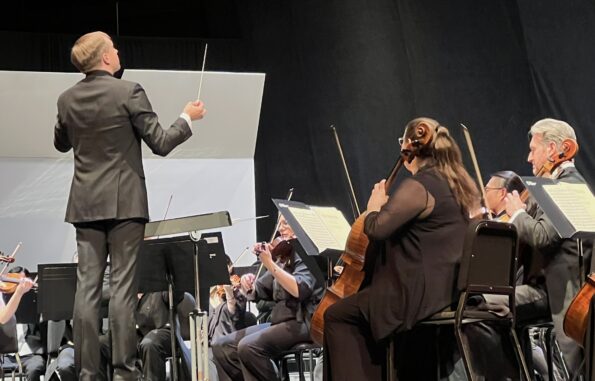
 United States Various: (1) The Cleveland Orchestra / Franz Welser-Möst (conductor). Stern Auditorium, Carnegie Hall, New York, 21.1.2026. (2) Boris Giltburg (piano), Royal Philharmonic Orchestra / Vasily Petrenko (conductor). Tilles Center for the Performing Arts at Long Island University, Brookville, NY, 24.1.2026. (ES-S)

21.1.2026: The Cleveland Orchestra / Franz Welser-Möst (conductor)
Mozart – Symphony No.41 in C major, K.551, ‘Jupiter’
Shostakovich – Symphony No.11 in G minor, Op.103, ‘The Year 1905’
24.1.2026: Boris Giltburg (piano), Royal Philharmonic Orchestra / Vasily Petrenko (conductor)
Berlioz – Béatrice and Benedict, H 138: Overture
Beethoven – Piano Concerto No.1 in C major, Op.15
Shostakovich – Symphony No.10 in E minor, Op.94
By one of those quiet miracles of concert programming, two major post-Stalin symphonies by Dmitri Shostakovich were heard in the New York area only days apart, offering an unusually clear perspective on how the composer reckoned with the conflicting signals emanating from the Soviet regime in the 1950s. At Tilles Center for the Performing Arts, the Royal Philharmonic Orchestra under Vasily Petrenko performed Symphony No.10, a work shaped by psychological volatility and guarded self-assertion. Two nights earlier at Carnegie Hall, the Cleveland Orchestra led by Franz Welser-Möst offered Symphony No.11, a vast public memorial that transforms violence into a frozen historical tableau. Taken together, the symphonies revealed Shostakovich’s efforts to confront both private experience and collective memory in a period of profound uncertainty.
In Symphony No.10, Vasily Petrenko, at the helm of a responsive RPO ensemble, shaped an inward, unsettled interpretation that avoided both bombast and melodrama, resisting episodic emphasis and overt dramatization. Given the work’s persistent ambiguity – and the absence of any definitive statement from the composer himself – Petrenko’s reading privileged balance and proportion over assertion. Throughout, he sustained a careful equilibrium between forward motion and contemplation, volatility and discipline, color and structure.
The first movement was allowed to unfold patiently, its elegiac undercurrent maintained without heaviness. Petrenko shaped its large arc with a firm sense of proportion: the central climax emerged organically from the surrounding string texture and then subsided, leaving the movement’s expressive ambiguities intact. The visceral second movement, so often exaggerated into a presumed caricature of Joseph Stalin, was kept within bounds. Its ferocity was controlled through precision and drive, not volume.
In the Allegretto, Petrenko avoided imposing a single expressive narrative on music that thrives on contradiction. Nervous dance rhythms, recurring horn calls and the shadow of Dmitri Shostakovich’s DSCH musical monogram were allowed to coexist, sustaining tension without forcing resolution. The finale gathered momentum decisively but without triumphal display. Even as the music pressed toward assertion, its energy remained provisional and hard-won, tempered by a lingering unease.
Shostakovich’s Symphony No.11, subtitled ‘The Year 1905’, occupies a distinctive place in his symphonic output. Written half a century after the events it evokes and framed around revolutionary songs of the period, the work transforms the massacre of unarmed demonstrators before the Winter Palace into a public memorial whose force extends beyond historical re-enactment. In the Cleveland Orchestra’s performance under Franz Welser-Möst, the symphony’s power emerged not through overt theatricality or emphasis on its programmatic associations, but through sustained control. Welser-Möst shaped the four connected movements as a single, tightly governed span, in which tension accumulated gradually and resolution was repeatedly deferred. The effect was one of inexorability rather than cinematic narration, as though the music were less re-enacting history than absorbing it.
The opening movement, set on Palace Square before the violence unfolds, was shaped with an impersonal stillness that exceeded mere atmosphere. Quiet dynamics were held at the edge of audibility, allowing the recurring figures in low strings and percussion to function less as backdrop than as latent threat. The sense of suspension was not pictorial but structural, with pulse and steadiness sustaining the tension. When the music edged toward eruption, the action felt like the consequence of forces already set in motion.
In the second movement, the violence of 9 January when soldiers opened fire on unarmed demonstrators was articulated without exaggeration. Climaxes were fierce but proportioned, and the orchestral texture remained lucid even at its most brutal, so that the massacre registered not as shock or spectacle but as pressure brought relentlessly into the open.
Relying on the orchestra’s strings, Welser-Möst reframed the third movement, In Memoriam, as collective loss, its funeral march unfolding with restraint. Phrasing remained carefully weighted, and the tempo was kept marginally forward-moving, binding the absorbed grief to the symphony’s larger trajectory. In the final movement, The Tocsin, the return of earlier material and the tolling conclusion were shaped without triumph or release. Bells and brass sounded as warnings left deliberately unanswered.
Shostakovich’s symphonies anchored the two programs, each included contrasting works by earlier composers. Vasily Petrenko and the RPO adopted a traditional overture–concerto–symphony layout, prefacing Symphony No.10 with Berlioz and Beethoven. If the rendition of Berlioz’s Béatrice et Bénédict Overture projected a quasi-casual air, the performance of Beethoven’s Piano Concerto No.1 was compelling in the way it situated the work at the threshold between Classicism and early Romanticism.
Boris Giltburg fashioned the opening Allegro con brio with a finely judged interplay between staccato articulation and legato line. His touch was crisp without dryness, lyrical without indulgence, and from the outset there was an evident partnership with the orchestra, Petrenko keeping textures light and responsive. In the Largo, the pianist sustained a long-breathed cantabile, his phrasing poised and unforced. The finale combined wit and propulsion, its playful turns articulated with precision and rhythmic buoyancy, soloist and orchestra again acting as a cohesive whole.
The performance only sharpened the regret that the RPO’s current U.S. tour did not bring the orchestra to New York City itself.
There is little doubt that the Cleveland Orchestra has for decades ranked among the world’s great ensembles, and its appearances at Carnegie Hall are always eagerly anticipated. The cohesiveness was immediately evident: the relationship between strings and winds was exemplary in their interpretation of Mozart’s Symphony No.41, and clarity of texture never came at the expense of weight or propulsion.
Under Welser-Möst, the performance combined refinement with a sense of underlying firmness. Tempos were finely judged, allowing Mozart’s architecture to speak with clarity and momentum. Inner voices were plainly audible, subtle dissonances coming through the texture, before the finale brought the orchestra’s contrapuntal precision fully into focus.
Heard in the context of Shostakovich’s confrontation with terror and memory, this Mozart felt like a reaffirmation of order and proportion – of what musical form, at its most lucid, can still offer in a world in turmoil.
Edward Sava-Segal
Featured Image: Vasily Petrenko conducting the Royal Philharmonic Orchestra © Edward Sava-Segal