 Spain Tchaikovsky, Eugene Onegin: Soloists, Generalitat Valenciana Chorus, Comunitat Valenciana Orchestra / Timur Zangiev (conductor). Palau de Les Arts, Valencia, 23.1.2026. (JMI)
After15 years, this Tchaikovsky masterpiece has returned to the stage of Valencia’s Palau de Les Arts. On the earlier occasion, the result was a triumph, and something similar can be said of this performance, although I believe a few observations are needed.
The production bears the signature of French director Laurent Pelly and is a co-production of La Monnaie in Brussels and the Royal Opera in Copenhagen. The first thing that surprised me was the need for two intermissions, especially given the staging’s considerable simplicity, particularly in Acts I and II.
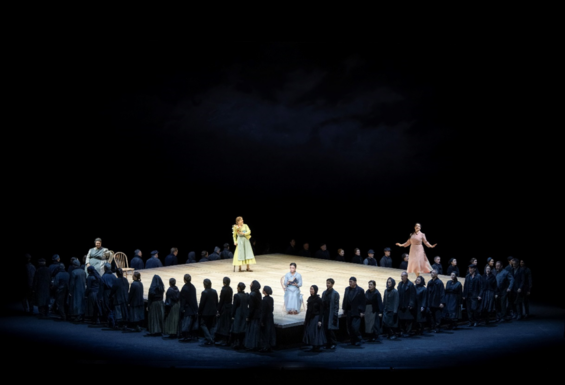
The stage in the first two acts features a large revolving platform that moves for the grand scene of Tatyana’s letter, returning to its original position for Act II. This platform serves as the set for both Tatyana’s party and the duel between Onegin and Lensky. In Act III, the platform is replaced by a stage with stairs, where both Gremin’s party and the duet between Tatyana and Onegin take place. Overall, it is not a remarkable production although it remains faithful to the libretto.
The musical direction was entrusted to the young (31) Russian conductor Timur Zangiev, who is developing an important career. His conducting was outstanding in the last two acts, which were brilliant and moving, and he drew a magnificent sound from the always superb Valencia orchestra. I found his interpretation in Act I less convincing: it lacked emotion, especially in Tatyana’s grand scene. The outstanding work of the Generalitat Valenciana Chorus was noteworthy throughout.
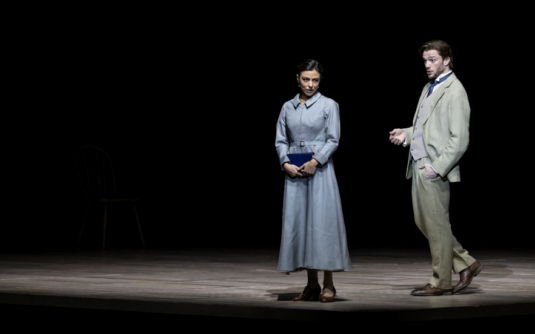
The title role was sung by Italian baritone Mattia Olivieri, who once again offered his beautiful lyric baritone voice with its remarkable volume and great homogeneity of registers. He was truly notable – a convincing Onegin in every sense.
Tatyana was sung by American soprano Corinne Winters, who has a fine voice though not a big one, and was a good interpreter of the character. Where she fell short was in her important Letter Scene in Act I which requires the singing to be accompanied by great emotional depth, something that was lacking.
Russian tenor Dmitry Korchak repeated his Lensky, having previously sung it here in 2011. His voice is not particularly beautiful, but he sings with extraordinarily good taste. He was deservedly acclaimed for his great aria ‘Kuda, kuda’.
Prince Gremin was sung by Georgian Giorgi Manoshvili, whose voice sounded like that of a bass-baritone rather than a true bass which is what Gremin requires. His voice is large, but falls short on the lower notes, and especially at the end of his aria. I confess that it is impossible for me not to remember the first Prince Gremin I ever heard: Nicolai Ghiaurov, accompanied by his unforgettable wife, the great Mirella Freni, as Tatyana!
The supporting roles were cast well, with excellent performances from mezzo-sopranos Ksenia Dudnikova as Olga and veteran Margarita Nekrasova as Filipyevna. Alison Kettlewell was less memorable as Madame Larina, and Monsieur Triquet, sung by veteran tenor Mark Milhofer, was vocally short of interest.
José M. Irurzun
Featured Image: Eugene Onegin Act I © M. Lorenzo, M. Ponce
Production:
Director – Laurent Pelly
Sets – Massimo Troncanetti
Costumes – Laurent Pelly, Jean-Jacques Delmott
Lighting – Marco Giusti
Choreography – Lionel Hoche
Cast:
Onegin – Mattia Olivieri
Tatyana – Corinne Winters
Lensky – Dmitry Korchak
Gremin – Giorgi Manoshvili
Olga – Ksenia Dudnikova
Madame Larina – Alison Kettlewell
Filipyevna – Margarita Nekrasova
Mr Triquet – Mark Milhofer
Zaretsky – Agshin Khudaverdiyev