
 Netherlands Liszt Utrecht Piano Competition 2026 [2] – Grand Finale: Kang Tae Kim, Thomas Kelly, Alexander Kashpurin (piano), Netherlands Radio Philharmonic Orchestra / Stéphane Denève (conductor). TivoliVredenburg: Grote Zaal, Utrecht, 24.1.2026. (LV)
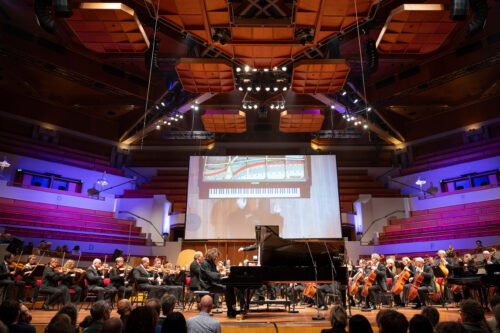
Liszt – Piano Concerto No.1 in E flat major, S124; Piano Concerto No.2 in A major, S125
The Grand Finale of the Liszt Utrecht Piano Competition brought the week-long intensity of the festival’s semi-finals phase to its inevitable climax. In the Grote Zaal of TivoliVredenburg, two broadly comparable readings of Liszt’s concertos were sharply contrasted by a third that fully met the music’s demands. That outcome was all the more striking given that first prize winner Alexander Kashpurin had entered the competition as a late substitute, advancing to the finals only after another pianist withdrew, and had been preparing his repertoire for the competition just since mid-December.
Conducted by Stéphane Denève and played by the Netherlands Radio Philharmonic Orchestra, the performances ultimately clarified why the jury – composed notably of active pianists rather than pedagogues – reached a decisive consensus. In performances where authority proved harder to establish than brilliance, the decisive factor was not virtuosity alone but the ability to project and sustain a musical voice through Liszt’s densely layered orchestral writing and a conspicuously loud and over-shaped orchestral accompaniment whose internal balance was not always firmly controlled – an additional challenge soloists inevitably encounter in professional life.
The evening opened with Kang Tae Kim in Liszt’s First Piano Concerto. Although Kim’s opening statement in his video introduction – ‘I feel many strong spirits’ – promised intensity, he struggled to generate sustained tension across the concerto’s tightly linked episodes, and the music’s lyrical spine never quite asserted itself. While he occasionally achieved moments of closer ensemble playing with the orchestra, balance became a recurring issue, and fortissimo orchestral tuttis frequently swallowed the piano line whole. Kim’s lyrical surge toward the end lost some of its profile, and a well-meant but ill-timed whoop from the audience just before the final bar seemed to punctuate an uneasy conclusion rather than crown it.
Thomas Kelly followed with Liszt’s Piano Concerto No.2 in a performance grounded in solidity and structural awareness. He appeared ready to accommodate the concerto’s continuous metamorphosis within a closely managed orchestral fabric. Yet the work’s elusive poetry – its sense of transformation unfolding over long spans – proved harder to sustain. Kelly’s passagework under the woodwinds was clean but rarely airborne, and his fundamental steadiness, so effective earlier in the competition, sometimes registered as cautious here.
The orchestral textures were often weighty, leaving limited room for the piano to reframe the argument dynamically. The concerto’s improvisatory illusion – its sense of spontaneous invention – was therefore difficult to maintain. Although Kelly’s cadenza, meandering and exploratory, was beautifully played, it did not clearly redirect the work’s trajectory. The closing pages moved forward dutifully rather than irresistibly, and the sense of inevitability Liszt can generate never fully arrived.
Alexander Kashpurin playing the Second Piano Concerto changed the temperature of the hall almost immediately. In a concerto that offers little shelter to a soloist unwilling to claim space, Kashpurin asserted command from within the music rather than negotiating it from the margins. ‘It was not a week for me’, he said of his week’s labors during the competition, ‘it was a little life’, and that lived-in quality permeated his playing. From the opening chords in the orchestra, better voiced than previously heard, the clarinet solo emerged with nuance and pliant phrasing. Most crucially, Kashpurin understood how to use silence: how to place it, inhabit it and leave the orchestra and conductor with no other choice but to listen and follow.
From the beginning, he articulated his musical priorities clearly, shaping phrases that the orchestral fabric accommodated rather than obscured. His runs were not displays of velocity but sweeps of beauty, and his long arcs unfolded with stunning impact. The famously long-limbed melodies of the concerto found their natural protagonist, and even the orchestra’s heavier moments in the cellos and double basses became part of an ongoing dialogue rather than an obstacle. In the great outbursts, Kashpurin exulted, and the orchestral response broadened accordingly.
The spiritual sections were the emotional core of the performance. Kashpurin’s playing beneath the cello solo was hypnotic, encouraging the principal cellist to give more of himself in return. His chamber-music instincts, already evident earlier in the competition, proved decisive here. He knows how to elicit rapt silence from an audience and how to maintain it. There was no sense of the trudging that had characterized the first two recitals anywhere in the structure; instead, the concerto unfolded as a series of vivid, magical musical moments.
In the pages surrounding the march motif, Kashpurin varied his triplets subtly, coloring repeated figures with shadowed half-tones. His last eruption of volcanic energy felt paradoxically intimate, and the ending snapped into place as he punctuated the tempo with authority. Liszt’s genius as a pianist-composer – rhetorical, theatrical but grounded in listening – was fully realized.
Awarded both the First Prize and the Audience Award, Kashpurin emerged as a musician and artist who listens, leads and transforms collaboration into conviction. Thomas Kelly received Second Prize, Kang Tae Kim the Third, and the hierarchy that night was unmistakable. Liszt Utrecht’s 40th anniversary was thus marked not only by nostalgia, but by the arrival of a pianist who demonstrated that in Liszt’s Second Piano Concerto, authority is not optional – and who supplied it with the rare assurance of an emerging superstar.
There was a bittersweet undertone to the evening: for Kang Tae Kim and one of the semi-finalists the failure to secure either first or second prize meant that their return from Amsterdam would also mark a return to compulsory military service, an abrupt interruption to careers momentarily exposed on an international stage.
Laurence Vittes