 Germany Smetana, Die Verkaufte Braut (The Bartered Bride): Soloists, Chorus of Stadttheater Bremerhaven, Philharmonic Orchestra Bremerhaven / Davide Perniceni (conductor). Stadttheater Bremerhaven, 24.10.2026. (DM-D)
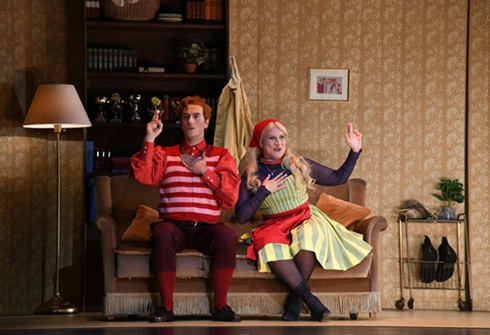
This production of The Bartered Bride at the Municipal Theatre in Bremerhaven, sung in German and directed by Sebastian Kranner, was gentle and witty, focusing on the nature of love across relationships and generations. Of course, the love between Marie and Hans was central – here even more so than in the opera as originally written, because the events of the plot were observed, as if from memory, by old Marie and old Hans, silent characters. The main part of the set was the warmly lit, cosy, old-fashioned 1960s flat of the old couple, with typical period wallpaper and furniture that demonstrated people had lived here happily for decades. The love between old Marie and old Hans was still very much alive: even though old Hans was very frail indeed and old Marie had to help him quite a bit with daily things, she did so lovingly rather than with any hint at the exasperation of a permanent carer, and he was keen to be helped. For one scene they snuggled up in bed, their wriggling and intertwining feet visible to the audience. Local colours came in through videos of the surrounding area by Elisabeth Pscheidl, and removal boxes from a well-known local removal company. Even the removal people were hand-picked, selected to represent the usual range of a group of movers: the older, wise leader who arranges the others who do the majority of work. The joker, who asks for the next coffee before the previous one has been distributed and keeps the nervous movers happy. The wiry man who does most of the work without saying a word, and the youngster apprentice, physically stronger than all the rest put together but just as awkward as he is strong. The love of long-married couples was equally present in the respective parents, as was the emerging potential love between Wenzel and Esmeralda, and finally Kezal’s self-love.
The clever set, designed by Anna Kreinecker, showed different scenes merging from within the core living environment of the old couple. Most imaginatively, after the movable furniture had been removed from the stage by the removals people, they ended their job by tilting the wall with the inbuilt kitchen on its side, and from the upside-down kitchen units, the numerous members of the circus emerged, one by one (presumably with a trap door on the stage floor under the unit). The costumes, also designed by Kreinecker, were lively and very colourful, adding to the production’s cheerful atmosphere.
Conductor Davide Perniceni had full awareness and control of the rhythms of Smetana’s music strongly influenced by Bohemian – Czech national traditions. He paid special nuanced attention to the frequent passages where big orchestral sounds form the climax of musical ideas developed, almost hesitantly at first, across various instrument groups before exploding with full orchestra – you get an idea from the beginning of Smetana’s later signature orchestral piece The Moldau (Vltava).
As is often the case for opera in Bremerhaven, in some way more obviously so than in other productions by different companies, the soloists clearly relished the production and their roles and performances within it. With Marie, Victoria Kunze added a further musical highlight to her impressive career. Her Marie was a strong, determined young woman, and she expressed this not least by way of a vigorous attack on the music, with thrilling exposed high notes. Alexander Geller as Hans was on an equal footing, and together they made a strong central couple. His bright tenor was clear, open and unforced. Kellan Dunlap in his first major role as a new member of the resident Bremerhaven company was very convincing as Wenzel. He presented the character’s simplicity and stutter without being embarrassing, but actually quite endearing. In comparison with Geller, his lighter tenor was very well suited to the role and its music, and his future in the character tenor area looks promising. MacKenzie Gallinger, formerly a member of the Bremerhaven resident company as a character tenor soloist and now a member of the resident chorus, sang the circus director with a firm and broader tenor voice, again well differentiated from Dunlap.
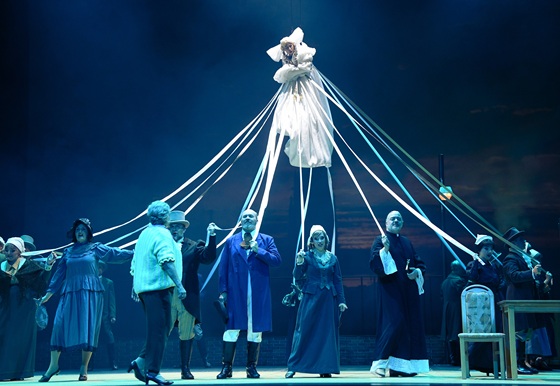
Timothy Edlin sang the self-loving marriage broker, Kezal, with gusto, with a lean but sonorous, well-focused bass. Kai Preussker, also new to the resident company (as is Dunlap), excelled as Kruschina, very well supported by Boshana Milkov as Kathinka. Yvonne Blunk (member of the resident chorus) and visiting artist Maurice Giancarlo Avitabile were on a par with the other singers as the other couple, Agnes and Micha. Patrick Ruyters (from the resident chorus) was indeed very funny as the circus comedian, and Heesu Kang was appropriately cheeky as Esmeralda, with a bright and secure lyrical voice. For the scene with the circus, the company recruited aerial acrobat Mareike Koch, who did a particularly impressive number suspended from the fly tower.
Daniel Meyer-Dinkgräfe
Featured Image: Bremerhaven’s Die Verkaufte Braut © Heiko Sandelmann
Production:
Director – Sebastian Kranner
Set and Costumes – Anna Kreinecker
Video – Elisabeth Pscheidl
Light – Katharina Konopka
Chorus director – Kristina Pernat Ščančar
Dramaturgy – Paula-Sophie Reif
Cast:
Marie – Victoria Kunze
Hans – Alexander Geller
Kezal – Timothy Edlin
Wenzel – Kellan Dunlap
Kruschina – Kai Preussker
Kathinka – Boshana Milkov
Micha – Maurice Giancarlo Avitabile
Agnes – Yvonne Blunk
Circus director – MacKenzie Gallinger
Esmeralda – Heesu Kang
Comedian – Patrick Ruyters
Circus artist – Mareike Koch
Old Marie – Daniela Hüchting
Old Hans – Gerrit Lühr