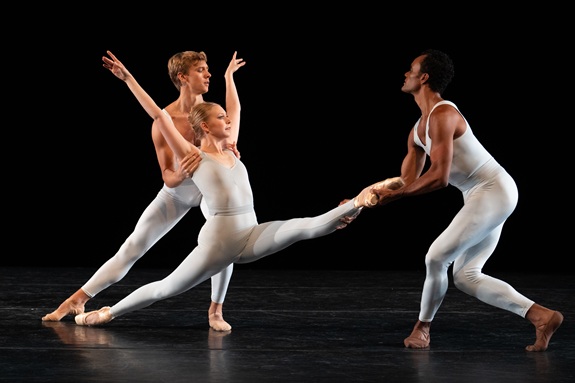
 United States ‘Ballet Festival: Jerome Robbins’: Dancers of New York City Ballet, San Francisco Ballet, Houston Ballet. Ahmanson Theatre, Los Angeles, 23.10.2026. (JRo)
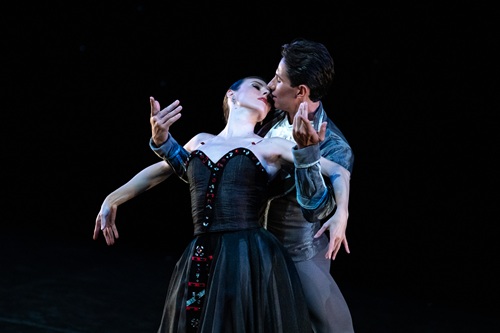
An evening of Jerome Robbins’s choreography as danced by Tiler Peck, Roman Mejia and company was a delight from start to finish. Curated by New York City Ballet principal Peck, the production originated at the Joyce Theater in New York. The choreography for two of the works, Four Bagatelles and Other Dances, felt organically imprinted on the bodies of the dancers, as if they lived in and for the music and the movement.
Emma Von Enck and David Gabriel danced to four of the Beethoven Bagatelles, played with gracious ease by pianist Elaine Chelton. A childlike simplicity emanated from their partnership and their dancing felt wonderfully authentic to the spirit of the choreography. In a pale-green gauzy skirt and bodice, Von Enck and her cavalier were a pair out of a Romantic-era story ballet. The opening steps reminded me of Saint-Léon’s Coppelia with its playful peasant dances. Amid the virtuosic pirouettes and fouettés of Gabriel and the transparent delicacy of Von Enck’s solos there were hints of folk dance which added touches of humor to the piece. Beethoven’s music was enhanced and enlarged by Robbins’s choreography and the consummate partnership of Von Enck and Gabriel.
When speaking of consummate partnerships, Tiler Peck and Roman Mejia are famous for their formidable skills, intense musicality and undeniable chemistry (in fact, they are married). All of this was on display in Other Dances set to four mazurkas and a waltz by Chopin. The piano was placed onstage and, as Elaine Chelton played, she became intrinsic to the dance. Perhaps the most impressive aspect of Peck and Mejia’s dancing was in the details: every gesture, no matter how slight, was considered. Virtuosity was present even in the smallest movements – the flick of a shoulder, the tilt of the head or the tap of a foot. Peck’s arms floated while her legs produced gorgeous chaîné turns, attitudes and arabesques. At one instance she paused, touched the piano and, as if transported by the music, resumed dancing. She seemed to move from sheer inspiration and some inner necessity, so at one was she with the melody.
Though Robbins originally created Other Dances for Natalia Makarova and Mikhail Barishnikov, he wanted his dancers to put their own stamp on the roles. Peck and Mejia’s personalities shone through and it was a pleasure to behold. Mejia is an inspired partner and thrilling performer, and he brought a sultry intensity to the dance while projecting humor: he can wink at the audience and dance the elegant, attentive cavalier at the same time. Robbins’s sly wit abounded in the folk movements for both dancers: alternating heel and toe steps and cabrioles with one hand on hip and the other behind the head. Robbins’s love of Chopin led him to create many enduring ballets, and this is certainly one of his masterpieces.
Set to Chopin Nocturnes, again played by Chelton, In the Night is a romantic melodrama for three couples set against a backdrop of stars. It is less joyful and transparently lyrical than Other Dances with the exception of the middle sequence danced by Sasha de Sola and Aaron Robison. At times their partnership felt exuberant, as if they were dancing a divertissement from Act III of Swan Lake. At other times, the mood was steeped in the wistfulness of Chopin’s Nocturne in F minor, Op.55 No.1 (and my favorite of his Nocturnes). There’s a poignant moment towards the end when Robison lifted de Sola and she was upside down at an angle nearly perpendicular to the floor. Her legs were crossed at the ankles and one leg quavered against the other, putting me in mind of Odile’s birdlike fluttering in Swan Lake. The first pas de deux danced by Lauren Lovette and Joseph Gordon to the familiar Nocturne Op.9, No.2 had a more formal ballroom quality and was charming but their partnership felt a bit unformed. The third couple, Mira Nadon and Chun Wai Chan, danced with passionate abandon fueled by anger. There were tempestuous lifts and melodramatic struggles – a kind of push-me pull-you aspect to the choreography. The piece ended with the three couples dancing, but so thoroughly engrossed in each other that they were surprised when they no longer found themselves alone.
Concertino was the second ballet on the program, but I saved my comments for last because, in some ways, it was unlike the others. Robbins’s ballets grow organically out of the music and Stravinsky’s score has none of the romanticism of Beethoven’s Bagatelles or Chopin’s Nocturnes and Mazurkas. Rather, it has some of the primitive textures of Rite of Spring and much in common with the neoclassical Pulcinella composed in 1920 – the same year as Concertino. It was performed convincingly by five instrumentalists along with Stravinsky’s Three Pieces for Clarinet Solo from 1919 with Danny Mui on clarinet.
The choreography had something in common with Balanchine in the use of forward thrusting hips, so familiar from Balanchine’s The Four Temperaments. Given Robbins’s dazzling wit, it was not surprising that the initial seriousness gave way to comical antics as Dominika Afanasenkov, Aaron Sanz and Taylor Stanley cavorted on the stage. At moments the dancers seemed to lose control of their movements – in the middle of her dancing, Afanasenkov bent in half like a marionette whose puppeteer had dropped the strings. There were small Charleston moves with knees turning in and out and a prancing about like horseback riders. A circus-like atmosphere prevailed.
Pleasure abounded throughout the four ballets, and it is hard to imagine an evening better spent than in the company of Jerome Robbins and the superb dancers who brought his work to life.
Jane Rosenberg
Featured Image: Taylor Stanley, Dominika Afanasenkov, Aaron Sanz © Steve Pisano/Ballet Festival Jerome Robbins
Four Bagatelles
Dancers – Emma Von Enck and David Gabriel of New York City Ballet
Music – Beethoven, Bagatelles, Op.33 No.4 in A major, No.5 in C major, No.2 in C major; Op.126 No.4 in B minor
Solo piano – Elaine Chelton
Costumes – Florence Klotz
Lighting – Ronald Bates (recreated by John Cuff)
Concertino
Dancers – Taylor Stanley (former NYCB), Dominika Afanasenkov and Aaron Sanz of New York City Ballet
Music – Stravinsky, Concertino for Twelve Instruments (originally for string quartet); Three Pieces for Clarinet Solo
Musicians – Danny Mui, Jeffrey Ho, Veronika Manchur, Adam Millstein, Val Serrano
Lighting – Ronald Bates (recreated by John Cuff)
Other Dances
Dancers – Tiler Peck and Roman Mejia of New York City Ballet
Music – Chopin, Mazurkas: Op.17 No.4; Op. 41 No.3; Waltz, Op.64 No.3; Mazurkas: Op.63 No.2; Op.33 No.2
Solo piano – Elaine Chelton
Costumes – Santo Loquasto
Lighting – Jennifer Tipton (recreated by John Cuff)
In the Night
Dancers – Lauren Lovette, Paul Taylor (resident choreographer), Joseph Gordon of New York City Ballet Sasha de Sola (San Francisco Ballet), Aaron Robison (Houston Ballet), Mira Nadon and Chun Wai Chan of New York City Ballet
Music – Chopin, Nocturne, Op.27 No.1; Op.55 No.1, No.2
Solo piano – Elaine Chelton
Costumes – Anthony Dowell
Lighting – Jennifer Tipton (recreated by John Cuff)