 Ireland Wexford Festival Opera 2026 [2] – Prokofiev, The Gambler: Soloists, Dancers, Chorus and Orchestra of Wexford Festival Opera / Valentin Uryupin (conductor). O’Reilly Theatre, National Opera House, Wexford, 24.10.2026. (RB)
The second opera to feature at this year’s Wexford Opera Festival was Prokofiev’s The Gambler. Like most of Prokofiev’s operas, this work has not been staged as often as it should be. It is Prokofiev’s first mature opera. The composer adapted the libretto himself from Dostoyevsky’s novella of the same name. The work was initially scheduled to premiere at St Petersburg’s Mariinsky Theatre in 1917, but the production was cancelled and the opera did not see the light of day until 1929. The opera focuses on several key themes including financial desperation, romantic obsession and compulsive gambling.
Prokofiev abandons arias and set-piece numbers in the opera and instead follows Mussorgsky’s lead by using speech-inflected declamation. The score features driving motoric rhythms and constantly shifting textures in the orchestra. Many of the characters in the opera (and indeed in Dostoyevsky’s original novella) are Dickensian caricatures. Prokofiev uses angular melodies and biting dissonant harmonies to illustrate the grotesque elements of their characters and to heighten the satire.
The opera takes place in the fictional spa town of Roulettenburg. Alexei is a tutor to a Russian general’s family and is passionately in love with Polina. Polina asks him to pawn her jewelry so she can repay her debt, but he gambles the money away. The General himself is drowning in debt and hopes for an inheritance from his wealthy aunt, known as Grandmother or Babulenka, so that he can marry the gold-digging Blanche. Babulenka unexpectedly arrives in person, and she gambles recklessly and loses a fortune destroying the General’s hopes of inheritance. Blanche ditches the General and the family’s financial situation collapses. Polina reveals to Alexei that she had been desperate to pay off a debt to the Marquis. In order to prove his devotion, Alexei returns to the casino and wins a huge sum. He offers to give Polina the money she needs to pay off the debt, but she rejects him by throwing the money in his face.
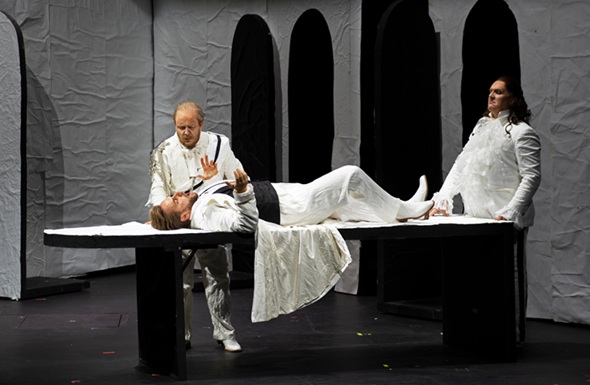
Ivan Popovsky’s production sets the opera in an absurd Alice in Wonderland two-dimensional fairytale world. The set and costumes were all in monochrome black and white. Most of the cast wore white costumes and some of the men wore top hats and the ladies more fashionable summer hats. The exception was the Babulenka who was dressed all in black, marking her out as the wicked fairy in this tale. Maria Tregubova’s sets were disappointing; they consisted of minimalist painted background structures with the words ‘Casino’ and ‘Hotel’ written on them. The large cardboard leaves and chandeliers which adorned the set were like elaborate pencil drawings. The set seemed to get increasingly dark in the second half of the opera and red colours started to seep into the monochrome world.
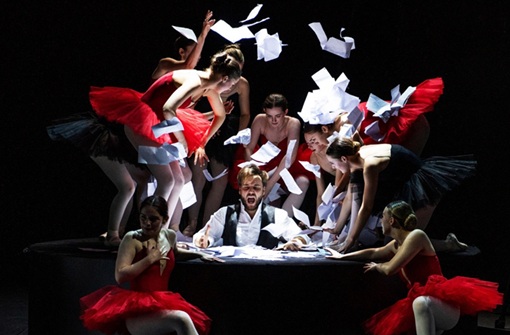
There were a few striking effects in the production including the use of flashing lights to signal the arrival of Babulenka’s coach, and the whisking away of the demented General on a red carpet at the end of the third act. The casino scene in the final act was particularly inventive. The cast were assembled around gaming tables and dancers from the Wexford School of Ballet whirled around in black and red tutus; this was an imaginative and effective representation of the roulette ball revolving around the wheel. The dance movements were asymmetrical, reflecting the random nature of the game. Giant roulette balls also seemed to appear on the stage out of nowhere, seemingly by chance.
I liked Popovsky’s concept and the idea of placing Dostoyevsky’s gallery of grotesques in this monochrome world. It underlined the absurdity of the situation and the fact that many of the characters had become addicted to consuming drives they were no longer able to control. The irrational obsessions and unpredictable actions of these characters somehow belonged more to this very artificial setting. However, there was scope for the production team to develop the concept in more imaginative and eye-catching ways.
Ukrainian tenor, Taras Prysiazhniuk, was excellent in the central role of Alexei. He clearly has star quality and commanded attention whenever he was on the stage. He did a superb job depicting the obsessive and erratic sides to the character in the early parts of the opera while in the final act he seemed to be in the grip of a manic delirium as he went on his winning spree. He had an excellent rapport with Sophie Gordeladze’s Polina and it was fascinating to watch the development of their turbulent and fractured relationship. Prysiazhniuk displayed immense vocal stamina and was able to project powerfully over large orchestral forces. His articulation was very good indeed and he delivered Prokofiev’s rapid speech declamations with exceptional clarity of line and rhythmic control.
Sophie Gordeladze also gave a very fine performance in the role of Polina. She portrayed Polina as an imperious and calculating character in the early scenes. She brought the sadomasochistic elements of the character to the fore as we watched her humiliating Alexei before exerting sexual control over him. Gordeladze also delivered Prokofiev’s lines clearly and with good diction. I was very impressed with the scenes where she conspired with Alexei to insult the guests; she used her voice to project very sinister and dangerous emotions. In the final scene Gordeladze seemed to depict Polina having a breakdown. She was able to move seamlessly from moments of immense power while singing in very high tessitura to whispering softness and delicacy.
Alexei Botnarciuc gave a fine performance in the role of the General, depicting the character’s descent from arrogant aristocrat to broken hysteric as his fortune vanished underneath him. He had a very powerful voice and successfully cut through large orchestral textures while negotiating those rapid speech driven declamations. Clarry Bartha’s Babulenka conveyed authority when she was on stage and could be spiky and outspoken. She gave an assured performance of the demanding vocal line. The rest of the cast gave fine performances and helped maintain the driving momentum of this work.
Valentin Uryupin and the Wexford Opera Festival Orchestra were superb throughout. Uryupin brilliantly maintained the momentum of the music with its constant driving ostinatos and shifting textures. He ensured there was a good balance between the singers and the instrumentalists even in the most explosive passages. He used the web of leitmotifs in the score to illuminate the characters; I enjoyed the way the brass and lower woodwind depicted the pomposity of the General. Prokofiev’s music is permeated with elements of parody and the grotesque; and those elements came to the fore in this performance. The dry strings and biting woodwind gave the music a biting satirical edge.
Overall, there was a lot of very fine singing and playing in this opera although the set was disappointing and there was scope for the production team to develop their ideas more.
Robert Beattie
Featured Image: Wexford Festival Opera’s The Gambler © Padraig Grant
Production:
Stage Director – Ivan Popovsky
Set and Costume designer – Maria Tregubova
Choreographer – Luisa Baldinetti
Lighting designer – Paolo Bonapace
Chorus master – Andrew Synnott
Wexford School of Ballet and Performing Arts
Cast:
Alexei – Taras Prysiazhniuk
Polina – Sophie Gordeladze
The General – Alexei Botnarciuc
Blanche – Hilary Ginther
The Marquis – Gavan Ring
Mr. Astley – Rory Musgrave
Grandma – Clarry Bartha
Prince Nilsky – Seán Tester
Potapytch – Ross Cumming
The Baron – Wonsick Oh
The Baroness – Olga Conway