
 United States Beethoven, Schubert: George Li (piano), New Jersey Symphony / Xian Zhang (conductor). New Jersey Performing Arts Center, Newark, 24.10.2026. (DS)
Beethoven – Piano Concerto No.5 in E-flat major, Op.73, ‘Emperor’
Schubert – Symphony No.9 in C major, D944, ‘Great’
Encore: Debussy – Clair de lune
If there has been a study of how much conductors smile at players and audiences, I am not aware of it. Either way, I suspect Xian Zhang, who is in her 11th season as Music Director of the New Jersey Symphony, would be in the lead. This is no placating smile: it radiates energy, inclusivity and inimitable fervor for her craft. Zhang has an enviable musical intuition combined with a gold-standard understanding of musical works. Even more admirable is her ability to communicate her vision clearly to the musicians under her baton. Their buy-in is evident to an audience.
At the 2026-27 season opener this past weekend, the New Jersey Symphony performed Schubert’s Symphony No.9 with a singularly tight continuum of expression across all four movements of this nearly one-hour work (now in its centennial year). To watch Zhang conduct with her signature swirling gestures and swift bodily shifts that beckon across various orchestral sections is to watch a creator in action. It is also fun – which classical music can use a good dollop of right about now.
Despite the warm melodic sections and soaring moments of heart-wrenching material, Schubert’s ‘Great’ can be potentially onerous with its heavy dependence on re-worked thematic material and repetition. The Viennese tendency to extend an idea proliferates throughout. Undaunted, Zhang and the musicians of the New Jersey Symphony transformed it into a story-like narrative that also revealed its genius as a portrait of the art of orchestral playing.
Zhang’s use of clearly tiered stepwise dynamics unlocked a new way of hearing developing themes. In the Andante con moto movement, brilliantly interpreted (and perfectly pitched) dialogue between wind solos and string sections held a breathtaking balance that revealed nuanced internal orchestral relationships. Zhang and the musicians pulled from a vast trove of texturing techniques – exemplified by the precise yet ethereal string spiccatos that fluttered against supple brass sounds filling the hall in the last movement. The symphony delivered a riveting performance, elegantly woven with cohesive interpretation.
Opting out of an opening overture or even a world premiere (so often part of a season opener), the evening focused on standard repertoire and did not suffer for it. Perhaps this was a product of New Jersey’s ‘not New York, not Philadelphia’ audience. But sticking to the canon while excavating it for newfound possibilities was a successful hallmark of the evening.
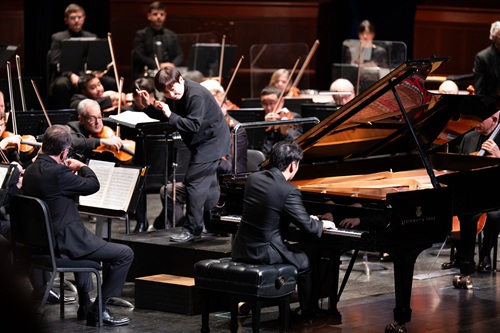
Guest soloist George Li similarly gave a sterling and intelligent reading of Beethoven’s ‘Emperor’ Piano Concerto. He not only matched Zhang’s tireless energy, but his approach also drew out the soloistic aspects of the orchestral parts even more enticingly (especially in passages he played alone with timpani). Together conductor, pianist and orchestral musicians created a fresh experience of Beethoven’s best-known piano concerto.
Building from stacks of scales and arpeggios, Beethoven places a challenge in the pianist’s literal and figurative hands. Li was master of both. His technique was staggering to behold (his hands often flying off the keys practically pulling his body right off the bench), but it was the evident curiosity to dig into a work’s possibilities that made this experience so magnetic. He brought out the left-hand voice in unexpected moments. He channeled different styles of playing to suit different passages: classical restraint, Liszt-like glamorizing and Chopin-like lyricism.
Notably, Li explored the work’s underlying momentum while focusing on the myriad juxtapositions of material that fill all three movements. Though the orchestra stumbled behind Li’s forward-leaning drive in a few spots, the grandeur was never lost and, with Zhang bridging the gap, the performance felt no less polished – especially in their remarkable working of the solemn, otherworldly transition that Beethoven crafts to bridge the middle and final movements. Hearts stopped.
As Li walked off stage, Zhang followed him, only to hang back at the last moment. She leaned over into the audience and gestured to us to keep clapping with a grin that seemed to spell out: ‘I bet he’ll come back out for an encore!’ Li did just that. After the stormy Beethoven, he mesmerized us with a soothing rendition of Debussy’s Clair de lune.
New Jersey has a reputation of being merely the freeway connection between Philadelphia and New York City. But Zhang and the New Jersey Symphony have proven it is more than just a corridor, especially when it comes to music. Concerts of stature and exceptional musicianship abound – this season opener proved so.
Daniele Sahr