 France Verdi, Un ballo in maschera: Soloists, Choir and Orchestra of the Opéra national de Paris / Speranza Scappucci (conductor). Opéra Bastille, Paris, 5.2.2026. (RP)

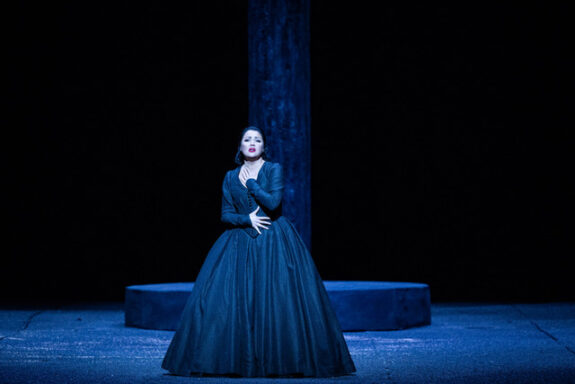
Voices are what make opera grand, not the staging, and Un ballo in maschera at the Opéra national de Paris unequivocally proved the point. As to the staging, Gilbert Deflo’s 2007 production is impressive enough by any measure, but the undisputed star of this performance was Anna Netrebko. As Amelia, she was every inch the diva, singing magnificently and commanding the stage with her charisma and beauty.
Verdi faced down the censors in bringing Un ballo in maschera to the stage. Antonio Somma’s libretto is based on the assassination of King Gustav III of Sweden at a costume ball in 1792. Regicide was too hot a topic for mid-nineteenth-century Neapolitan officials, and the location ultimately had to be changed to colonial Boston to satisfy the censors in Rome where Un ballo in maschera premiered in 1859.
The story centers on the secret, unconsummated love between the charismatic head of state, Riccardo, and Amelia, the wife of his best friend and most fervent supporter, Renato. Once Renato discovers their love, he vows to kill Amelia and Riccardo, although he softens on the fate of his wife. Renato stabs Riccardo at a masked ball but is instantly overcome with remorse, realizing that his wife was indeed innocent and that his friend was honorable and benevolent.
Deflo set the opera in America, rather than Stockholm which is more common nowadays in traditional stagings. However, he updated the action to the early 1860s during the Civil War. The fracture lines in American society and politics were represented by the two main motifs, the eagle and the snake. They, along with the rest of the set’s elements, are conceived on a monumental scale, with architectural references leaning towards New Deal-style tinged with Fascist triumphalism.
In the first act, Riccardo holds a public audience in a gleaming, white-marble council chamber, with a throne at its center topped by an enormous eagle and flanked by rows of benches where supporters and foes alike sit. Ulrica reads people’s futures in a flame-lit space dominated by three towering columns that sprout serpents’ heads. To gather the herb that will soothe Amelia’s tormented heart, Ulrica sends her to a towering gallows surmounted by two enormous eagles.
Inflamed by jealousy and rage, Renato plots his revenge in a space dominated by a black stone structure with a gleaming white statue of Riccardo at its center. It is also where Renato, in a game of chance, wins the right to murder Riccardo. The guests at the ball where Riccardo is murdered are formally dressed in black and white, with the dancers adding grace and energy in harlequin-style costumes.
Netrebko’s voice has darkened considerably in recent years but it remains a sumptuous instrument. The palette of vocal colors at her command has expanded, especially in her middle and lower ranges which are now more alluring due to their even darker luster. Her ability to spin long lines with subtle dynamic shadings remains peerless, and the top notes still shimmer when gently floating, or stir when ringing out forceful and true.
The same can be said of Matthew Polenzani’s tenor which, over time, has gained body and a more dramatic thrust. His Riccardo was remarkably human, evolving in turn from a political powerhouse into a youthful and buoyant sailor in disguise, an ardent lover and, ultimately, a stoic dreamer, heedless of death threats and intent on making things right with Renato. Netrebko and Polenzani filled the second act duet, ‘Teco io sto…oh, qual soave brivido’, which many consider to be Verdi’s finest love duet, with the requisite ardor and glorious sound.
Ludovic Tézier’s Renato got pulses racing in his Act I aria, ‘Alla vita che t’arride’, in which he warns Riccardo of the plots to kill him. The freedom and force of his blazing top notes was impressive. As Renato’s mood darkened, Tézier’s baritone became ever more focused and intense, ultimately collapsing as he regrets his rash acts.
Deflo envisioned Ulrica as a voodoo priestess but perhaps one not quite as glamorous as the red-turbaned and sheathed Elizabeth DeShong. The sonorous depths of her voice, coupled with the intensity of her delivery, made Ulrica’s incantations and prophesies terrifying. Sara Blanch’s Oscar sparkled in Verdi’s joyous coloratura, with the soprano singing with the same agility with which she moved.
The Paris forces were in great form, with Speranza Scappucci leading a performance that captured all the fervor and sorrow in Verdi’s score. She drew tenderness from the orchestra in the opera’s more intimate scenes, but it was the intensity of the scenes where passions overflowed that made this performance so exceptional.
Rick Perdian
Featured Image: Anna Netrebko (Amelia) © Benjamin Girette/OnP
Production:
Director – Gilbert Deflo
Sets & Costumes – William Orlandi
Choreography – Micha van Hoecke
Chorus master – Alessandro Di Stefano
Cast:
Amelia – Anna Netrebko
Riccardo – Matthew Polenzani
Renato – Ludovic Tézier
Oscar – Sara Blanch
Ulrica – Elizabeth DeShong
Samuel – Christian Rodrigue Moungoungou
Tom – Blake Denson
Silvano – Andres Cascante
Judge – Ju In Yoon
Amelia’s Servant – Cyrille Lovighi