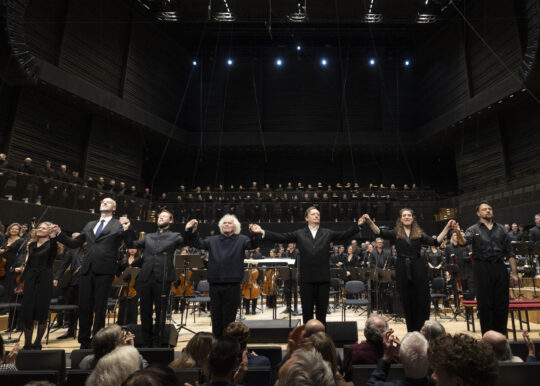
 Germany Neuwirth, Henze: Jörg Widmann (clarinet), Kathrin Zukowski (soprano), Georg Nigl (baritone), Michael Rotschopf (speaker), Tölzer Knabenchor, Bavarian Radio Chorus, WDR Radio Chorus, Bavarian Radio Symphony Orchestra / Sir Simon Rattle (conductor). Isarphilharmonie, Munich, 6.2.2026. (AL-L)
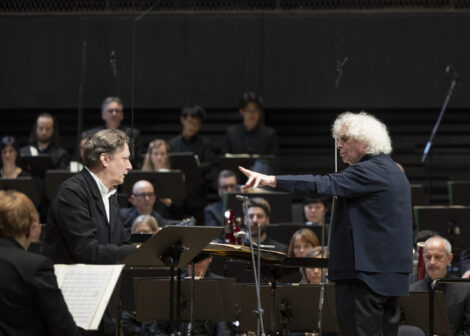
Neuwirth – Zones of Blue (world premiere)
Henze – Das Floss der Medusa
The world premiere of Olga Neuwirth’s clarinet concerto Zones of Blue opened this musica viva evening in Munich with undeniable virtuosity from Jörg Widmann, for whom the work was written. Beginning with hushed tones that gradually saturated into fuller sonorities, Widmann demonstrated complete instrumental mastery throughout the 19-minute score. Yet the piece itself proved less convincing in its larger architecture. The integration between solo clarinet and orchestra remained tenuous, with insufficient dialogue between the forces. A brief citation of George Gershwin’s Rhapsody in Blue, echoed momentarily by the orchestra, hinted at deeper connections that never fully materialized. As is common in modern orchestral writing, Neuwirth deployed a substantial percussion section, though the musical development felt episodic rather than architecturally coherent. Those in Cleveland, Barcelona, Stockholm, and Grafenegg will have opportunities to hear the work when Widmann performs it with their orchestras in the coming months.
The second half brought the evening’s revelation: Hans Werner Henze’s Das Floss der Medusa, deployed with the colossal forces it requires — approximately 200 performers including a large orchestra and several choruses. This oratorio, inspired by the 1816 shipwreck of the French frigate Méduse and Théodore Géricault’s monumental painting, has long carried the weight of its notorious aborted Hamburg premiere in December 1968, when political demonstrations led to its cancellation. The work’s explicit leftist politics — conceived as a requiem for Che Guevara — aligned Henze with the romantic communist and anti-capitalist positions embraced by many artists and intellectuals of that era. History and a clearer understanding of the realities of former communist countries have not been kind to these artists, now often viewed by younger generations as naïve and dogmatic at best.
Yet whatever one makes of the work’s political context, the music itself remains unbelievably strong both musically and dramatically. As Mark Berry observed in his review of the 2023 Komische Oper staging, the work deserves the opportunity to speak ‘for itself’ to engage new generations of listeners. His assessment after the 2025 Salzburg Festival performance that the work is ‘of its time, no doubt, but equally of ours’ proved entirely accurate in Munich.
The oratorio traces the agonizing loss of lives over several days on the raft, as Death (the soprano) calls victims one by one from the living to the dead, beginning with the children, until only fifteen survivors remain. For those experiencing the work live for the first time, the impact proves overwhelming — this is emphatically a piece that demands to be seen and heard on the stage rather than encountered through recordings only.
Like Mahler’s Eighth Symphony, Henze deploys gigantic forces without ever approaching saturation. His orchestration achieves unique, distinctive sounds and balances throughout. Electric guitars blend with imaginative instrumental combinations, and every performer contributes meaningfully to the whole. The dramatic tension emerges immediately through Ernst Schnabel’s text, sustained by the spatial deployment of the multiple choruses spread across the stage. As chorus members moved from one section to another — from the living to the dead — the staging created a palpable sense of inexorable tragedy. This is a work that truly benefits from live performance, much as one can only fully appreciate Monteverdi’s Vespers with a spatial sense of distributed forces.
The acoustics and dimensions of the Isarphilharmonie proved ideal for such a work, enabling both clarity and balance and allowing Henze’s intricate polyphony to register with proper impact. The Bavarian Radio Chorus and WDR Radio Chorus, always assets of these organizations, were astonishing in their clarity of diction, unity of ensemble and warmth of tone. They sang as one voice across the vast canvas.
The soloists matched this exceptionally high standard. Georg Nigl brought remarkable expressivity to the baritone role, his care for the text evident in every phrase. Anna Kathrin Zukowski’s soprano combined sweetness with glorious high notes in music of considerable beauty. Michael Rotschopf’s Sprechgesang in the middle section, alongside the orchestra, proved particularly powerful.
Credit must go to Sir Simon Rattle for believing in this work and approaching it with the same understanding and commitment he brings to a Mahler symphony. His conviction in the piece’s worth was evident throughout, as was his deep appreciation of its musical and dramatic architecture. That the work received two performances before packed audiences — both held in rapt silence and exceptional concentration — speaks volumes about Munich concertgoers. A standing ovation confirmed that this oratorio, whatever its historical baggage, still has the power to move and engage new generations.
Antoine Lévy-Leboyer
Featured Image: Curtain call for Henze’s Das Floss der Medusa © BR musicaviva/Astrid Ackermann