 United Kingdom Mozart, Così fan tutte: Soloists, Skills Ensemble, Chorus and Orchestra of the English National Opera / Dinis Sousa (conductor). London Coliseum, 10.2.2026. (CSa)
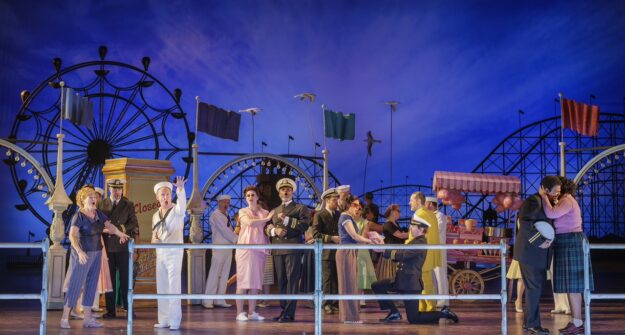
In his iconic 1982 English National Opera production of Verdi’s Rigoletto, the late Sir Jonathan Miller brilliantly relocated the Renaissance court of Mantua to 1950s mafia-run Little Italy, in the dark heart of New York City. Following in Miller’s inspirational footsteps, but in a rather heavy-footed way, director Phelim McDermott and his designer Tom Pye have chosen the same period in which to transport the late eighteenth-century setting of Mozart’s Così fan tutte from the Arcadian gardens and placid waters of the Bay of Naples to the tawdry charms of Brooklyn’s Coney Island. It was last seen at the London Coliseum in 2022.
In this production the action takes place between the rides and hotdog stands of a gaudy amusement park or in a bedroom of the neon-lit Skyline Motel. Here the opera’s central themes – fidelity, deception, and the uncertainties of love – are played out against the symbolic silhouettes of a roller coaster and a Ferris wheel. A troupe of circus performers of every shape and size juggled, danced, ate fire and swallowed swords throughout the performance, and once emerged from a large box during the overture, were employed to wave signs warning of ‘lust’, ‘betrayal’ ‘intrigue’ and ‘lies’; an in-your-face teaser trailer promising that the events to follow would be not merely theatrical but sensational too. Undeterred by these fairground distractions, an outstanding cast of singers and ENO musicians, assembled under the skilful baton of Dinis Sousa, gave superlative performances which faithfully preserved the integrity and intensified the complex beauty of Mozart’s sublime masterpiece.
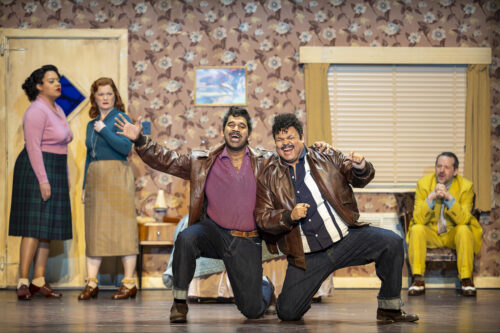
The plot is deceptive in its simplicity. Two conceited young officers Ferrando and Guglielmo are about to be married to sisters Fiordiligi and Dorabella. Certain that their fiancées are entirely faithful, the two men are persuaded by their cynical old friend Don Alfonso to place a bet on their fidelity and predicts that they will cheat within a day. With the help of the ladies’ maid Despina, he devises an elaborate scheme whereby the men pretend to go off to war but return in disguise (in this production as two leather jacketed, slick-haired greasers) to seduce the other’s sister. If the women succumb, the bet is lost. Modern day sensibilities recoil from the portrayal of deceived women as inherently fickle and manipulative men as morally superior. Critics argue with justification that these characterisations reinforce outdated stereotypes about female loyalty and male entitlement, and it would be easy to dismiss the story of the opera as frivolous and misogynistic. One need not go further than the title which loosely translated means ‘all women are like that.’ Yet grotesque comedy and poignant tragedy can co-exist. In these respects, Lorenzo Da Ponte’s libretto, to which Mozart responds with such dazzling brilliance, offers a deeply perceptive insight into the timeless aspects of human emotion, male and female: desire, jealousy, doubt, and the fragility of monogamous relationships.
As Fiordiligi, Lucy Crowe, unquestionably one of Britain’s greatest lyric sopranos, combined impeccable vocal technique and accomplished acting skills. In her heroic Act 1 aria ‘Come scoglio’ (‘Like a mountain’) – a declaration of her unwavering fidelity – she overcame Mozart’s extreme vocal demands with consummate ease. Rapid runs and large interval leaps were delivered with gleaming precision, and silvery sustained high notes must have floated effortlessly to the highest reaches of the auditorium. She also met some challenging directorial demands too. In Act II, gently serenaded by a French horn, she gave a heart-melting rendition of the aria ‘Per pietà, ben mio, perdona’ (‘Have pity, my beloved, forgive me’), albeit required to express her repentance and vulnerability from a hot-air balloon. As her sister Dorabella, velvet-voiced American mezzo-soprano Taylor Raven provided perfect balance, singing with brilliance and conviction throughout. The male pairings were excellent too. Tenor Joshua Blue in the role of Ferrando, combined bell-like clarity and tenderness in his arias. His lyrical Act 1 ‘Un’aura amorosa’ (‘A loving breeze’) was searingly beautiful, while richly robust baritone (Darwin Prakash) as his stalwart comrade-in-arms Guglielmo provided the necessary macho heft. Ailish Tynan, savouring every word of Jeremy Sams’s ingenious translation, and with Irish brogue and wit fully employed, positively dazzled as the mischievous Despina. She was ably counterbalanced by vibrant bass-baritone Andrew Foster-Williams whose innate comic talent made for an almost clubbable Don Alfonso.
Strong individually, the six principals were at their best when singing together in various combinations in the many glorious ensembles, the textures of their voices blending perfectly. Undergirding the production from the pit, Sousa and his responsive musicians wove together all the musical and dramatic strands in a magnificent tapestry of music-making.
Chris Sallon
Featured Image: The cast of ENO’s Così fan tutte © James Glossop
Cast:
Fiordiligi – Lucy Crowe
Dorabella – Taylor Raven
Ferrando – Joshua Blue
Guglielmo – Darwin Prakash
Don Alfonso – Andrew Foster-Williams
Despina -Ailish Tynan
Creatives:
Director – Phelim McDermott
Set designer – Tom Pye
Costume designer – Laura Hopkins
Lighting designer – Paule Constable
Movement director -Iskandar R. Sharazuddin
Translator – Jeremy Sams
Chorus director – Matthew Quinn