
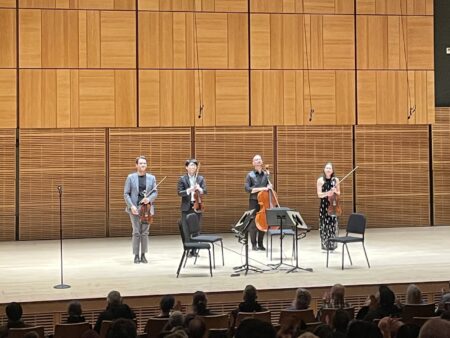
 United States Various – ‘United in Sound: America at 250’: Dover Quartet (Joel Link, Bryan Lee [violins], Julianne Lee [viola], Camden Shaw [cello]). Carnegie Hall, New York, 10.2.2026. (DS)
Mendelssohn – String Quartet No.6 in F minor, Op.80
Pura Fé – Rattle Songs (orchestrated by Jerod Impichchaachaaha’ Tate)
Jerod Impichchaachaaha’ Tate – Abokkoli’ Taloowa’ (Woodland Songs)
Dvořák – String Quartet No.12 in F major, Op.96, ‘American’
To embody a space between grandeur and precision, a chamber ensemble must have an exacting combination of player chemistry, musical agreement and otherworldly technical prowess. The Dover Quartet has all three. They recently performed with their signature clean, thrilling sound at this year’s ongoing (and proving to be superb) Carnegie Hall festival, ‘United in Sound: America at 250’.
Showcasing their skill, the Dover opened with the turbulent Mendelssohn String Quartet in F minor. Tiny, precise amounts of bow in the first measures captivated the room with charged energy: these sharp, biting tones led into ever quickening passages, and the ensemble established a blend of beauty and technical grace – not to mention an astonishing grasp of speed – which would fill the program. Across all four movements, the players followed an arc of emotional intensity that required an admirable amount of flawless planning on their part. The perfectly synchronized vibrato passages in the Adagio were memorable, as were the terrifically accented dissonant chords scattered in the opening of the Finale. Short, cadenza-like passages in the last movement sparkled with triumph. A cautious group might have held back in this complex Mendelssohn quartet to ensure meaning was not lost to tempo. But Dover proved, excitingly, that they need not sacrifice one for the other. Like a perfectly cut zipper, they pulled each part together tightly through to the end.
How Mendelssohn connects to American history eludes me, but the rest of the program returned to the topic of the New World. That is, new to Europeans, which was an apt reminder by the programming of two works by Native American composers. First, a string orchestration of singer Pura Fe’s Rattle Songs was a modern reflection on Tuscarora songs (a Haudenosaunee nation) that typically are played by Native bead-filled shakers. Without adding percussion or a singer to the string quartet, the orchestration required an intuitive, tactical understanding of how to use pizzicato, ostinato, dotted rhythms and tremolo layered amidst lyrical melody to capture the texture and structure of these songs. Composer Jerod Impichchaachaaha’ Tate, who wrote the arrangement, deftly did just that. Coming to the stage with his son, he demonstrated one snippet of a song using the shakers in a quick tutorial. In response, the quartet played the string-version passage which did capture quite exquisitely the aura and lilt of the rattle. Made up of seven songs, Rattle Songs revealed a shared Judeo-Christian and Native culture – especially in movements like ‘Grammah Easter’s Lullaby’ and ‘Women’s Shuffle’. Sounds of Appalachian folk songs and country square dances met the indigenous material elegantly. America is the land of many separate nations but in culture we are inevitably intertwined, as this music reminds one.
Tate returned to the stage ebulliently and with a voice that could generously embrace any crowd to introduce his Abokkoli’ Taloowa’ (Woodland Songs), commissioned by the Dover Quartet. He again demonstrated a song with shakers which had the effect of shifting the concert into an intimate storytelling mood. As the quartet performed the five movements, they continued this narrative atmosphere. The ‘Squirrel’ ran, like its moniker, with enlivened relentlessness shifting into sneaky, sleek passages. ‘Woodpecker’ evoked a sense of flight through waves of soaring harmony and swirls of fast fingerwork in the viola part that were joyfully executed. And ‘Deer’ was the pinnacle with an extensively developed song line nestled into the lower registers of the strings yet framed by hollow sounds that would fall into exchange with dense material and luscious tremolos. The sonic material seemed to evolve into images of land and space. All the movements really read like a love poem to Tate’s Chickasaw ancestry and their deep ties to the woodland animals of their homeland.
The Dover Quartet closed the night with Dvořák’s ‘American’ Quartet, and their version proved with each ensuing movement that it is the best anyone can hear right now – and luckily. they have recorded it. They strike a balance between a deliberately archaic sound embedded in nostalgia and the tonic of classical structural form played with modern flair. The ensemble’s genius is in finding the juxtapositions throughout: the playful against the stark, lulling broad strokes against blooming energy and moments of fanfare material mellowed out with a sultry veneer. It was like hearing an old standard birthed anew: an excellent choice for this 250-year celebration.
I could not help thinking that Dvořák would have loved being paired with Tate’s work. During his time in the United States at the end of the 1800s, he was known for encouraging composers on this side of the Atlantic to look for inspiration from material on the homefront. In the 19th century, many still hesitated where he had encouraged them to take risks. Ironically, Dvořák’s sounds of the ‘New World’ – to keep the term – are some we associate the most with America, even to this day. It is apt we should hear these familiar classical themes against the backdrop of those who called this land home long before any Europeans had set their sights across the sea.
Daniele Sahr