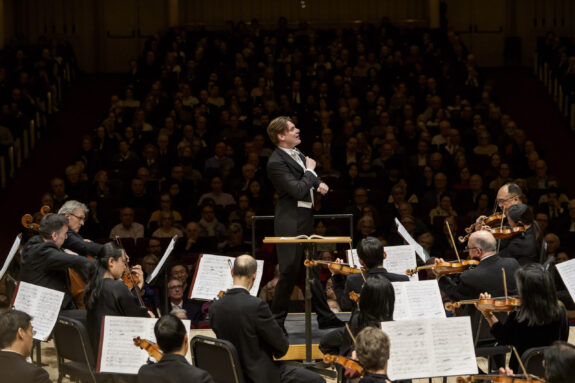
 United States Richard Strauss, Sibelius: Chicago Symphony Orchestra / Klaus Mäkelä (conductor). Stern Auditorium, Carnegie Hall, New York, 25.2.2026. (ES-S)
R. Strauss – Ein Heldenleben, Op.40
Sibelius – Lemminkäinen, Op.22
Heroism was the explicit theme of the Chicago Symphony Orchestra’s latest program under Music Director Designate Klaus Mäkelä, pairing Jean Sibelius’s Lemminkäinen Suite with Richard Strauss’s Ein Heldenleben. Both works were conceived in the 1890s, both unfold on a symphonic scale and both center on outsized protagonists. Yet for all their structural and thematic similarities, their inner worlds – and their conceptions of heroism – could hardly be more different.
Originally announced with Sibelius first, the sequence was reversed at the last moment, bringing Strauss before intermission and reserving Sibelius for the second half. Whether practical or interpretive, the change proved revealing. Heard this way, the concert moved from Strauss’s self-fashioned modern hero toward Sibelius’s mythic landscape – from individual assertion to something older, more elemental, less ironic.
In Ein Heldenleben, the composer casts himself as protagonist, amid critics, his spouse, battles and artistic triumphs. Mäkelä approached the score less as satire than as architecture, emphasizing sweep and coherence over provocation. The opening theme strode forward with unapologetic breadth, low strings and horns defining the work’s scale from the outset. Concertmaster Robert Chen’s extended solos portraying soprano Pauline de Ahna, Strauss’s spouse, were polished and characterful, though phrasing occasionally felt more contained than conversational. The winds etched Strauss’s caricature of his critics with sharp precision, their sardonic interjections cutting through the orchestral fabric. In the extended passage of self-quotation, where Strauss revisits themes from his earlier works, the music unfolded with supple momentum; ideas surfaced and receded without sagging into episodic display. Even in the battle scene, where Strauss piles force upon force, Mäkelä – gestures firm and without flamboyance – maintained structural control, shaping climaxes through articulation and balance.
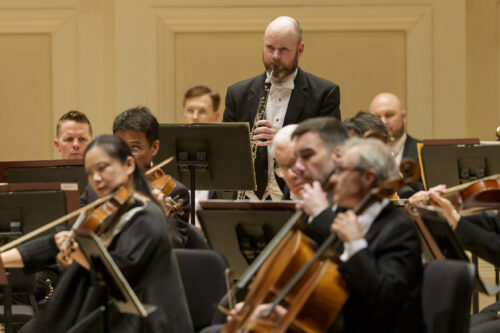
Sibelius’s Lemminkäinen Suite, drawn from the Finnish epic Kalevala, inhabits a different expressive world. Here the hero is part of a narrative shaped by landscape and collective memory. Mäkelä led the opening of ‘Lemminkäinen and the Maidens of Saari’ with patient breadth: horn calls hovered before strings and clarinet established a fluid, unsettled terrain. The sense of ebb and flow was palpable. Brass entered with rugged force, while woodwinds offered understated lyricism that kept the texture supple. In the closing pages, as the hero departs, Mäkelä let the sound recede, the orchestral weight thinning into distance.
‘The Swan of Tuonela’, the best known of the four tone poems, unfolded with grave stillness, solemn but never lugubrious. Mäkelä drew from the strings a tremolo barely above a whisper, creating a dark, suspended backdrop over which Scott Hostetler, standing with his cor anglais, projected the swan’s solitary line. His tone was focused and unforced, melancholic without excess, the legato sustained with quiet concentration. Principal cellist John Sharp’s lines, emerging beneath the English horn, lent a darker counterpoint that anchored the swan’s melody. The surrounding orchestration – muted strings, low winds and restrained percussion – deepened the atmosphere without disturbing its inward poise.
If ‘The Swan’ held time in suspension, ‘Lemminkäinen in Tuonela’ introduced sharper unease. Low strings murmured with ominous weight, and winds moved in restless, circling figures that suggested dangers lingering beneath the surface calm. The line unfolded in rhapsodic, associative strands, tension gathering incrementally. Mäkelä maintained tight control of balance, allowing brass interjections to emerge clearly without overwhelming the ensemble. He shaped that mounting severity with the same clarity that marked the Strauss rendition.
‘Lemminkäinen’s Return’ brought a surge of forward motion. Strings drove the music with incisive propulsion, their rhythmic figures crisply etched. Brass lent brilliance without excess, the texture remaining transparent even at full animation. The closing pages resolved in temperate triumph.
On Wednesday night in the Stern Auditorium, Mäkelä presented these two fin-de-siècle visions of heroism with discipline and proportion, drawing playing of strength and focus from the ensemble. His ability to command a large orchestral apparatus with fine-grained control was evident throughout.
Edward Sava-Segal
Featured Image: Klaus Mäkelä conducts the Chicago Symphony Orchestra at Carnegie Hall © Todd Rosenberg