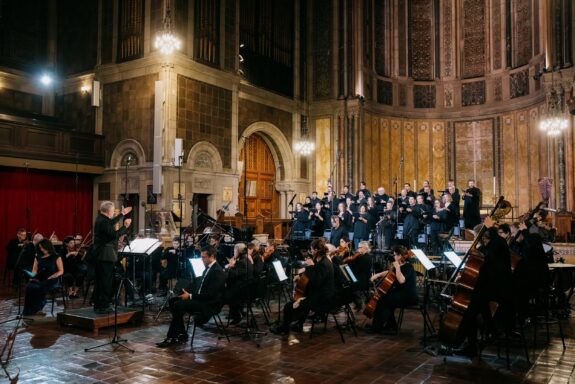
 United States Shaw, Oquin: Susanna Phillips (soprano), John Moore (baritone), Jesse Mills, Emma Frucht (violins), Kal Sugatski (viola), Arthur Fiacco, Jr. (cello), Peggy Kampmeier (piano), Musica Sacra Chorus and Chamber Orchestra / Kent Tritle (conductor). St. Bartholomew’s Church, New York, 11.3.2026. (RP)
Caroline Shaw – ‘Entr’acte’
Wayne Oquin – ‘O Magnum Mysterium’, ‘Alleluia’, On the Words of Walt Whitman
Encore: Oquin – ‘Sure on This Shining Night’
For its final concert of the season, Musica Sacra premiered Wayne Oquin’s On the Words of Walt Whitman in the Neo-Byzantine splendor of New York’s St. Bartholomew’s Church. The American poet’s verses, especially Leaves of Grass, have inspired well over 500 works. In Great Britain, composers such as Hubert Parry, Charles Villiers Stanford, Gustav Holst and Ralph Vaughan Williams all set Whitman’s poetry to music. Meanwhile, in America, the list includes John Adams, George Crumb and Ned Rorem.
Oquin has an international footprint as a composer with premieres on five continents in 21 countries and 46 US states, and his music has attracted the attention of major conductors. Yannick Nézet-Séguin led The Philadelphia Orchestra in Oquin’s Resilience, with additional performances in Brussels, Hamburg and Luxembourg. The composer’s Echoes of a Solitary Voice, a tribute to the late Lorin Maazel, received its premiere with Rafael Payare conducting the Danish National Orchestra, and was then reprised with the Munich Philharmonic.
On the Words of Walt Whitman is Oquin’s setting of 17 poems by the 19th-century American poet for soprano, baritone, chorus and orchestra. It includes some of Whitman’s most famous poems, including ‘Song of Myself’, ‘I Hear America Singing’ and ‘When Lilacs Last in the Dooryard Bloom’d’. Less familiar ones, such as ‘A Clear Midnight’, ‘A Word Out of the Sea’ and ‘Then Last of All’, inspired Oquin to create musical gems which may find a future as individual works in song recitals and choral concerts.
Oquin displayed his skills as a choral composer in pieces as varied as his expansive, rambunctious ‘I Hear America Singing’ and his sensitive a cappella setting of ‘Then Last of All’. His urgent setting of ‘The Ship Starting’ was cinematic in scope and effect. The choral sound was consistently impressive, although diction was lost in the work’s louder passages. The words were so clear in the softer ones that the church’s tricky acoustics were undoubtedly the culprit.
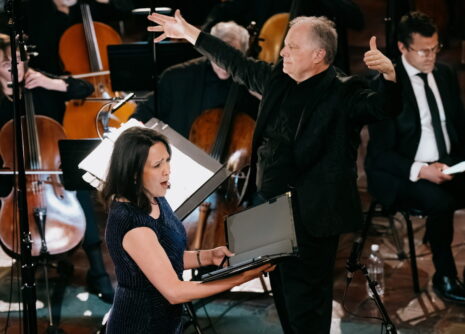
Oquin composed the soprano solos with Susanna Phillips’s creamy soprano in mind. She has long championed the composer, as has Tritle. Oquin set her voice like a gem, often with the harp as accompaniment, and it did shine. Phillips brought heartfelt simplicity to ‘A Clear Midnight’ and to ‘Twilight’, which follows immediately, in which she sang of the void of emotion that nightfall brings. Phillips was at her most passionate in ‘The Last Invocation’ where her soprano took flight, lifted by violin and cello solos.
Oquin set much of the baritone line in its higher ranges, which suited John Moore perfectly. In the opening song, ‘Introduction – Fragments’, Moore sang of a leaf of grass being the work of the stars in soft, sweet tones. His sotto voce singing in ‘A Word Out of the Sea’ was achingly beautiful, as he beckoned the sea winds to blow his love back to him. Moore released the full richness of his voice in ‘When Lilacs Last in the Dooryard Bloom’d’, which ends the piece, although the chorus gets the last triumphant word.
Oquin’s imaginative settings of the text are equaled by the exciting range of instrumental colors he employs in the score. He augments a string orchestra with two percussion ensembles that amplify the drama throughout the work. They include harp, marimba, glockenspiel and vibraphone. None were more powerful than the drums and bells that sound through ‘The Sobbing of the Bells’, adding an ominous gloom in one with Oquin’s setting of Whitman’s somber words.
The concert began with Caroline Shaw’s ‘Entr’acte’, performed by violinists Jesse Mills and Emma Frucht, violist Kal Sugatski and cellist Arthur Fiacco, Jr. Shaw’s starting point was Haydn’s String Quartet No.2, Op.72, although there are no stylistic references to the composer or the era in the work. A wisp of a theme courses through the piece effortlessly. The real musical interest is generated by a variety of string techniques, including toneless friction bowing, pizzicato, sliding harmonics and sonorous senza-vibrato chords. The piece was performed with lightness and spontaneity, resembling nothing so much as a musical cloud floating through the church.
Two of Oquin’s pieces for a cappella mixed choir, ‘O Magnum Mysterium’ and ‘Alleluia’, followed. His moving setting of ‘O Magnum Mysterium’ was rooted in tradition, but with a tonal openness and harmonic richness that, although modern, sounded timeless. Tritle drew seamless legato and a perfect blend from the singers, as he also did in ‘Alleluia’. The conductor summoned a quiet sense of wonder in the piece’s flowing opening measures. As the tension ratcheted and the harmonies became complex, the choir was at its best, singing with crystalline sound and cut-glass precision.
For an encore, Tritle conducted the premiere of Oquin’s ‘Sure on This Shining Night’ in an arrangement for mixed choir, violin and piano. The song was originally part of a cycle, In Dreams Awake, which Oquin wrote for Susanna Phillips and later arranged for male voices. He is not reluctant to bring his artistic voice to bear on texts set by other composers, in this case Samuel Barber’s and Morten Lauridsen’s cherished settings of James Agee’s poem.
Oquin captures the innocence and wonder of Agee’s text with beauty, simplicity and sensitivity and the choir responded in kind. Violinist Jesse Mills and pianist Peggy Kampmeier created a sense of awe with their pristine playing that Agee captured to perfection in the poem, and Oquin did so in music.
Rick Perdian
Featured Image: Kent Tritle (conductor) with Susanna Phillips (soprano), John Moore (baritone), Musica Sacra Chorus and Orchestra © Brian Hatton
The setting of Walt Whitman’s ‘Leaves of Grass’ is testament to Wayne Oquin’s preeminent talent for composing.