 United Kingdom Britten, Peter Grimes: Soloists, Chorus and Orchestra of Opera North / Garry Walker (conductor). Lyric Theatre, The Lowry, Salford, 13.3.2026. (MC)
After Benjamin Britten’s poorly received operetta Paul Bunyan (1941) his next opera was Peter Grimes a large-scale work in a prologue and three acts. When premiered in 1945 at London’s Sadler’s Wells Peter Grimes was a triumph for Britten, soon acknowledged as a masterpiece of the twentieth century. From the opera Britten arranged the orchestral interludes, used to cover scene changes as the Four Sea Interludes and a Passacaglia which were both published separately and are now a common sight on concert programmes.
I was interested to read that Peter Grimes featured in Opera North’s first ever season in 1978/79. Opera North director Phyllida Lloyd’s Peter Grimes when introduced in 2006 was received to significant acclaim. Now in 2026 Opera North has restored Lloyd’s Peter Grimes under revival directors Karolina Sofulak and Tim Claydon.
Often, I find a dark and unsettling undercurrent running through Britten’s music none more so than in Peter Grimes. Set against the cruel and perilous nature of the sea this is a bleak tale of the belligerent fisherman Peter Grimes, accused of killing two of his apprentices. In this production by Lloyd, Sofulak and Claydon it is not hard to see Grimes as a grossly misunderstood outsider fighting against the collective wrath of the hidebound townspeople of the small Suffolk fishing town called the Borough. On the other hand, some might focus on how he treated his apprentices with bullying and a brutish manner and how he may have been responsible for their deaths.
Britten’s librettist Montagu Slater based Peter Grimes on Rev. George Crabbe’s narrative poem The Borough published in 1810. Slater’s libretto was set around 1830. Lloyd had brought her mise en scène forward to around the end of the twentieth century in her production I had not seen until now. I doubt that revival directors Sofulak and Claydon had changed too much. Relatively simple, the highly effective set had little in the way of distractions.
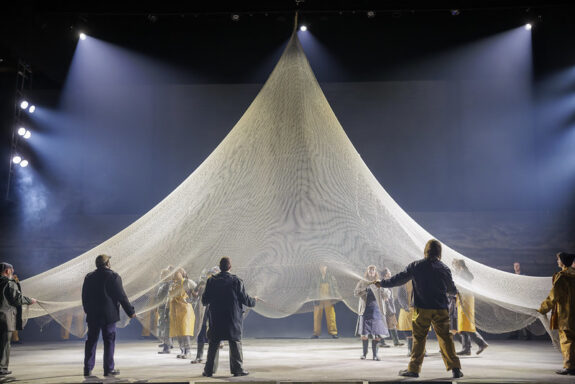
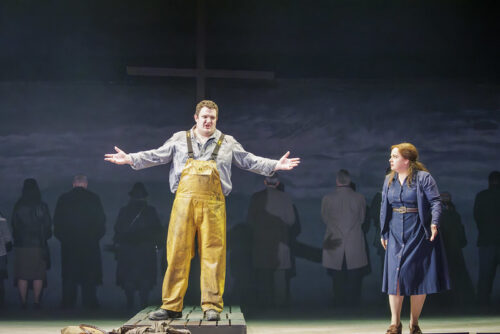
My impression of the everyday clothes of the cast, including yellow bib and brace oilskin trousers for the fishermen, I would place in the 1970s and 80s. Originally designed by Anthony Ward the set of the Borough is primarily one of netting and wooden pallets. On the backcloth there is a grey, grim and angry looking scene of the sea that works exceedingly well. On a minor note, I admit some surprise that video projections of a moving sea-scene weren’t employed.
Emphasising the fishing theme several members of the Borough’s fishing community stood under a large fishing net that was gathered in the middle and pulled up like an Arabian tent. Representing Grimes’s hut on the cliff edge was a tall platform on stilts with roof support chains at each corner where Grimes and John were pitching fishing nets. My heart was in my mouth as Grimes and young John walked around the top of the platform without guard rails. John fell to his death; thankfully held by a safety rope that was barely visible.
Britten’s life partner Peter Pears, who created the role of Grimes, was nothing like the tall, heavy-set tenors that normally have the role today. Here the role of Grimes was taken by the tall, powerfully built John Findon who looked, acted and sang the part to a tee. In this stamina sapping role Findon’s rock-steady and durable tenor was mightily impressive.
Philippa Boyle had the role of empathetic schoolteacher Ellen Orford. The widowed Orford supported Grimes strongly and they planned to marry. She was loyal and stood by him through all the terrible accusations. Relishing the role soprano Boyle was in convincing voice and acted remarkably well.
One of Grimes’s few friends the retired sea captain Balstrode was taken by Simon Bailey. As Balstrode he gave a solid all-round performance exhibiting a voice of clarity and expression. It was a hugely affecting moment when Balstrode told Grimes to sail out to sea and sink the boat. There were too many episodes of note to mention here. One quite splendid example was the interplay between wideboy and drug supplier Ned Keene played by the leather-jacketed Johannes Moore and Mrs Sedley, the unlikely drug user widow, taken by Claire Pascoe.
Garry Walker conducted Britten’s magnificent music score with assurance and the chorus and orchestra of Opera North responded with a top-drawer performance. I am sure Opera North will be delighted by this successful revival of Phyllida Lloyd’s Peter Grimes. Everything worked so splendidly. A huge hit with the audience this production provided drama from start to finish.
Michael Cookson
Featured Image: Opera North’s Peter Grimes © James Glossop
Creatives:
Director – Phyllida Lloyd
Revival Director – Karolina Sofulak
Set and Costume designer – Anthony Ward
Revival Director / Movement director – Tim Claydon
Original Lighting designer – Paule Constable
Lighting designer – Ben Jacobs
Cast:
Peter Grimes – John Findon
Ellen Orford – Philippa Boyle
Captain Balstrode – Simon Bailey
Auntie – Hilary Summers
Ned Keene – Johannes Moore
Bob Boles – Stuart Jackson
First Niece – Nazan Fikret
Second Niece – Ava Dodd
Mrs Sedley – Claire Pascoe
Swallow – James Creswell
Rev. Horace Adams – Daniel Norman
Hobson – Blaise Malaba
Dr Crabbe – Dean Robinson
John – Toby Dray