
 United Kingdom One Damn Thing After Another – Owen, Gipps, Maconchy, Alwyn, Carwithen: Alex Mitchell (viola), Rachel Clegg (cor anglais), Alexandra Dariescu (piano), Manchester Camerata / John Andrews (conductor). Royal Northern College of Music, Manchester, 15.3.2026. (PC)
Morfydd Owen – Beatific Sea
Ruth Gipps – Jane Grey Fantasy for viola and string orchestra
Elizabeth Maconchy – Life Story
William Alwyn – Autumn Legend
Doreen Carwithen – Concerto for Piano and Strings
Under the title of ‘One Damn Thing After Another’, referencing the name of an overture by Doreen Carwithen, one of the featured composers, Manchester Camerata’s afternoon concert included a number of twentieth-century works by British female composers who faced barriers and setbacks in their careers, but who continued to create music despite these obstacles.
The music-making began with Beatific Sea, for string orchestra (1912), by Morfydd Owen (1891-1918). This evocative short piece was restless and rhapsodic, contrasting broadly paced sections using rich, chordal textures with more spirited episodes embracing tremolo effects. The tempestuous material had great intensity, serving as a reminder of a blazing talent who, sadly, died young. Yet Beatific Sea was manifestly the product of a composer of skill and substance rather than one of mere promise. The players ably conveyed the various moods and textures of this arresting, mercurial music.
The Jane Grey Fantasy for viola and string orchestra (1940) by Ruth Gipps (1912-1999) was inspired by the tragic story of Lady Jane Grey, who was Queen of England for just nine days and executed at the age of seventeen in 1554. The eight-minute piece had an impromptu-like freshness, presenting its all-pervading, folk-like main idea in various guises, from rustic tenderness to youthful exuberance and fiery defiance. Containing a tautly expressive, cadenza-like sequence for the soloist, delivered over ominously shuddering, tremolando lower strings, the piece ended solemnly with a brief, hushed coda with a broadened version of the chief theme, soaring in high register. A lyrical concertante piece of considerable range, the Jane Grey Fantasy received an assured and poetic reading by principal violist Alex Mitchell, who was sensitively accompanied by his colleagues in the Manchester Camerata strings, conducted by John Andrews.
After this early work by Gipps, we heard one of the last pieces by Elizabeth Maconchy (1907-1994). Life Story, for string orchestra (1985) was a bold and dynamic, four-movement piece, written in a tonal idiom, yet bristling with pungent harmonies and invigorating rhythms. The opening Andante juxtaposed eloquent falling phrases with incisive chords and the players responded warmly to the narrative’s sharp inventiveness. This was succeeded by a blithe, quicksilver scherzo, which started with airy pizzicato articulation but presently became more grounded, recalling the heavy chords from the preceding movement. An easing of tempo heralded the arrival of the extended slow movement that followed without a break. This was the expressive heart of the piece and the performers embraced its broadly eloquent phrases, brief recollections of the driving chords and soft, dying close. The resolute quick finale rounded off the work with a dramatic final appearance of the motto chords and a closing flourish. It was a great pleasure to hear this fine composer of some 13 string quartets and the glorious Symphony for Double String Orchestra of 1953 still exploring and relishing string sonorities near the end of her creative life. Her Life Story received a refined and detailed account, ideally paced.
Rachel Clegg, principal oboist of the Camerata, was the responsive soloist in Autumn Legend, for cor anglais and strings (1954) by William Alwyn (1905-1985). This darkly wistful score with its florid, questing solo line was well-shaped and had a fluently improvisatory flair.
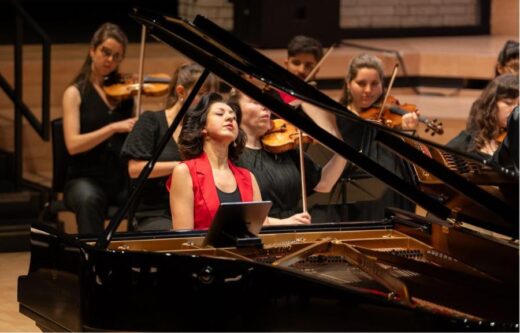
After the interval, Alexandra Dariescu was the soloist in the Concerto for Piano and Strings (1948) by Doreen Carwithen (1922-2003). Containing two memorable, sharply defined themes, the Allegro assai opening movement was vibrantly energetic, with vivid passagework, crisply articulated by the soloist and subtle shading in the writing for strings. The central Lento unfolded a songlike, wide-ranging theme shared between the eloquent solo violinist Caroline Pether and the pianist in an affecting, intimate discourse. The purposeful finale was thrillingly dynamic and included an impassioned, bravura cadenza and a satisfyingly emphatic conclusion, delivered with total commitment. This impressive work has been recorded more than once but it is rarely included in concert programmes, and it was an especial pleasure to hear the piece performed live in such a thoughtful and commanding performance from Dariescu and the Camerata.
It is excellent news that this programme will soon be recorded by these artists for the Resonus Classics label. Such significant and rewarding repertoire merits the widest possible audience.
Paul Conway
Featured Image: Manchester Camerata conducted by John Andrews © Rebecca Everett
Thank you for your review of this concert but unfortunately, Morfydd Owen’s ‘Beatific Sea’ was not a world premiere [Jim for S&H: as the review originally claimed] because two performances are known to have taken place in 1913.
The composer did not conceive her score as a work for string orchestra either. Morfydd Owen’s composition sets a poem by Thomas Campbell for mezzo-soprano soloist and full orchestra (3222 4231 2 harps, timpani and divisi strings) so should not have been programmed or performed using the string parts alone.
This surreal episode highlights the importance of due diligence when reviving historic repertoire because alas, the first modern performance of Morfydd Owen’s ‘Beatific Sea’ last Sunday afternoon misrepresented the composer by omitting the solo vocal line and three-quarters of the orchestration that she intended.
I’ve just seen Rhian Davies’s comment on my review of the RNCM concert.
After the performance of Morfydd Owen’s Beatific Sea, conductor John Andrews told the audience that he and the performers believed they had just given the piece’s world premiere. I should have reported that as a quote in my review rather than taking this claim at face value, so many apologies for that.
However, the online listings of the Cardiff University Archives’ papers of Morfydd Owen has a record for a version for strings of Beatific Sea:
https://archiveshub.jisc.ac.uk/search/archives/7999e2ca-c0eb-3212-86cf-a5f3f8f15324?component=fd04f553-9ce6-37e2-8a75-33571f60c691
The date of this version for strings is given as November 1912: ‘date inferred from Cycle of Sea Songs’
If the information in this record is correct, Beatific Sea would appear to be a separate work from the composer’s Cycle of Sea Songs and maybe it was this version for strings of the movement which was believed to be receiving its premiere performance. John Andrews will obviously know more about the score he used and how and where it was sourced.
Many thanks for your response, Paul, but I fear the weblink relates to a group of parts in the hand of an unknown copyist that replicate the string parts in Morfydd Owen’s full score of ‘Beatific Sea’ as the fourth and final movement in her ‘Cycle of Sea-Songs’ for mezzo and orchestra.