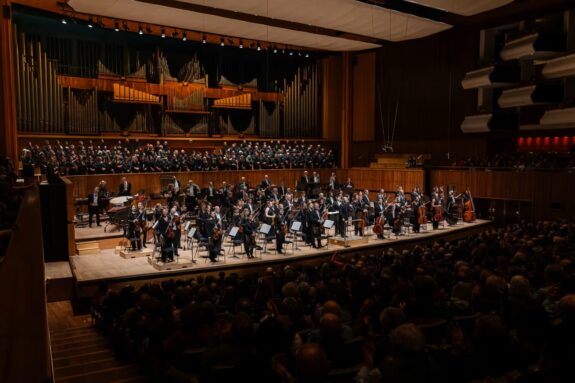
 United Kingdom Tan Dun, Beethoven: Elizabeth Watts (soprano), Hongni Wu (mezzo-soprano), John Findon (tenor), Matthew Rose (bass), London Philharmonic Choir, London Chinese Philharmonic Choir, London Philharmonic Orchestra / Tan Dun (conductor). Royal Festival Hall, London, 28.3.2026. (AV-E)
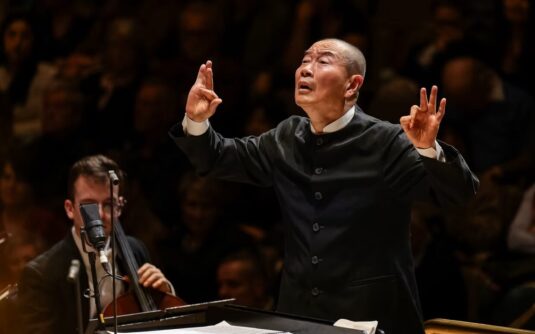
Tan Dun – Choral Concerto: Nine (2020–24, UK premiere)
Beethoven – Ninth Symphony, ‘Choral’, Op.125 (1824)
The concert opened with the UK premiere of Choral Concerto: Nine by the world-renowned Tan Dun, co-commissioned by the Royal Philharmonic Society to commemorate the 200th anniversary of Beethoven’s Ninth Symphony.
Here, Tan Dun’s ‘East meets West’ unification was not merely a United Nations slogan but an aesthetic happening realised as only he could. Both the London Philharmonic Choir and the London Chinese Philharmonic Choir were pushed far beyond the boundaries of traditional choral singing; they were tasked with navigating more than ten varieties of ‘percussive language’ — ranging from ghostly glottal-stops and metallic mouth-ringing to the sharp, rhythmic snap of ‘drum language’ vocalisations.
Spanning three movements — Nine, Wine, and Time — the work reimagined the universal brotherhood of Schiller’s Ode to Joy through the mystical, ancient aesthetics of Taoist poetry. As a piece of performance art, it demands the audience not just to listen, but to bear witness to a bridge being built between ancient enlightened incantations and the emergent rituals of our AI age.
Tan Dun wrote in the programme notes: ‘I use some words from Schiller and quote Beethoven’s renowned “Ode to Joy” – to the creatures of nature, creatures of love, and creatures of our own mind. However, throughout the work, many of the words that the chorus sings and chants are empty words. Some are from Taoist and Buddhist traditions and some are simply nonsense. “Empty” means everything. Nothing exists in an enduring manner. I find it very interesting to use the “emptiness” to represent “everything”. Why do we have to live? We all want to live the same way.’
Are not all words, at heart, ‘empty’? Are not all words, at liver, ‘nonsense’? Are not all words, at pancreas, ‘gibberish’? Yet, listening to the choruses, the ‘empty words’ (non-words) made much more ‘sense’ to me than the ‘full words’ (real-words).
Movement I: Nine (The Call) – The opening ‘empty words’ of Nine were immediately uninviting and embarrassingly enticing, and made ‘no sense’ in their ‘non-human’ quality. I sensed the audience was ill-at-ease hearing these ancient-alien voices. But the very second Tan Dun’s hands summoned his forces, the rhythmic chirp of a phone alarm and a handful of hard bangs sounded in perfect synchronicity with the conductor’s opening gesture. A wave of unsettled uncertainty rippled through my section of the stalls — given Tan’s reputation for odd-object percussion, a few of us were left pondering if these mechanical interjections were written into the score.
These audience sounds certainly felt Tan Dunian — seamlessly integrated with the score’s percussive textures, for they sounded uncannily part of the score, especially as those ‘hard bangs’ were soon echoed by the orchestra.
Dun employs what he calls ‘empty words’ — phonetic, non-semantic vocalisations that bypass the brain and hit the gut. These are not merely ‘abstract’; they are primal exhalations that mimic the wind and the ghosts of the Qu Yuan poetry they accompany. The chorus acts as a nature-instrument, as if Tan had bypassed the human by tapping into an ancient, animalistic form of communication — one far more direct than the spoken language that initiated our breakdown in communication, eventually reaching its final demise and digital death in our era of the zombie smartphone.
Movement II: Wine (The Ecstasy) – Here, the mood meandered into a spectral, liquefied delirium. Using the verses of the ‘drunken poet’ Li Bai, the massed choirs — acting as a single, phantasmal protagonist, engaged in a Dionysian rite that was as lavish and opulent as it was hypnotically rhythmic.
There was a shimmering, hallucinatory intensity to the choral writing, where the ‘empty words’ were transformed into slurred glissandos and collective, rhythmic sighs of unearthly joy. These vocal exhalations perfectly captured the staccato, ghostly spirit of an ancient Tang Dynasty banquet, punctuated by the mercurial, crystal-clear clinking of metallic percussion. It felt less like a mere ‘concert performance’ and more like a hallowed, phantasmagoric rite: where the ‘emptiness’ of the non-words served only to heighten the ‘alterity’ of the ‘abterity’.
Movement III: Time (The Ode to Peace) – The finale is where Tan’s ‘Ritual Theatre’ reaches its zenith zero point. The violins envision the ‘Chinese Soul’ via portamento slides like meowing cats and metallic ponticello bowing to mimic the weeping, vocal quality of the Erhu — undoubtedly my favourite moment of this wondrous work.
The atavistic performativity becomes viscerally visual as the string players begin a ‘Ritual Sway’ — a physical wave that mirrors the ‘empty words’ of the choir. Most striking is the skeletal percussion: the violins tapping their bridges, a dry, clicking heartbeat representing the rhythmic ticking of a nature-clock. As they blend Schiller’s ‘Ode to Joy’ with Laozi’s philosophy, the vocal texture begins to thicken, shifting from ethereal whispers into a relentless, driving ostinato.
Throughout, the choral writing remained an unprecedented primal monolith of inspired inventive genius — as was the orchestral writing with its ‘economy of means’. Brass and percussion were powerful precisely because they were sparse, for Tan never over-orchestrates. As the tension coiled, the ecstatic surge of the primordial Paigu Drums set the audience ablaze.
Despite a full house warmly applauding, the cards are still on the table for Nine, and it remains a high-stakes gamble whether Tan Dun has truly hit the jackpot.
As far as I am concerned, there were only three conductors who really knew how to conduct Beethoven’s Ninth ‘Choral’ Symphony: Arturo Toscanini (live: Buenos Aires, 1941), Bruno Walter (live: London, 1947), and Otto Klemperer (live: London, 1957). All other conductors, including Tan, make it sound far too tame, polite, and ‘civilised’, eschewing the violent drama inherent in the score.
The Allegro ma non troppo was far too polite and well-mannered, suffering from a lack of visceral grit and dramatic attack; those opening horns were coy and subdued. Watching his hands attentively, Tan was sculpting rather than conducting — out of kilter with Beethoven’s ‘uncouth bull in a china shop’ forward-thrust. The pace was more like jogging along than struggling forth; what saved it was the incisively biting timpani of Simon Carrington, whose ‘hard sticks’ kept the manicured movement stitched together (and were the hallowed hallmark throughout this rather restrained rendition).
The Molto vivace fared far better with taut rhythms and agile playing, with Carrington again adding significant dramatic weight and intensity from the timpani to ‘nail’ the rhythmic violence. Yet there was one odd anomaly: a transition from the D minor scherzo to the D major trio that featured a six-second ‘gap in time’, which drew the audience into the silence before the D major section emerged.
It was in the Adagio molto e cantabile, however, that the performance found its heart. This was the evening’s finest hour: reaching a state of genuine spiritual repose that felt as much a ‘homecoming’ as the animalistic cries of the first half. The soft, sedate horns were haunting haloes of light, providing warmth to the serene strings; this was exquisitely played and expansively paced, whilst never dragging.
While the Presto was well paced and the brass playing powerfully projected, the concluding Janissary battery of bass drum, cymbals, and triangle was far too restrained and tasteful, lacking the uncouth ‘carnivalesque’ swagger required; likewise, the massed choruses needed much more ‘oomph’!
Out of the quartet of vocal soloists — Elizabeth Watts, Hongni Wu, John Findon and Matthew Rose – only Rose had presence, power, and projection, with the latter substituting for an indisposed Dingle Yandell.
However, such a celebratory conclusion was bound to elicit a standing ovation — and it did, though likely more for the living legend Tan Dun than the interpretation itself. For myself, all bets were off with Tan dealing Beethoven’s Ninth: a high-stakes gamble that ultimately failed to break the house.
Featured Image: combined forces of soloists, London Philharmonic Choir, London Chinese Philharmonic Choir, London Philharmonic Orchestra and Tan Dun (conductor) © Julian Guidera/LPO
After thoughts…
World premiere of Lotta Wennäkoski’s Zelo, past echoes of future sounds
Voices from Finland: London Philharmonic Orchestra / Robin Ticciati (conductor) Royal Festival Hall, London, 25.3.2026.
Lotta Wennäkoski – Zelo (2025-2026, world premiere)
Although not attending in my capacity as a reviewer for Seen and Heard, I was fortunate enough to witness the world premiere of Zelo by the Finnish composer Lotta Wennäkoski. Commissioned by the London Philharmonic Orchestra as a companion to Sibelius’s Kullervo Symphony (1892), the work proved so vital that it demanded a response for its utterly unique sonic terrain.
What was so remarkable and refreshing about Zelo is that it refused to be composed as ‘contemporary music’ having had been written in a future yet to come, derived and delivered from the past.
To follow in the footsteps of Sibelius is a daunting task for any Finn, but in Zelo, Wennäkoski does not merely walk in his shadow — she illuminates it with a flashlight from the future. Comparisons to the motoric pulses of the American minimalists are quickly dispelled; this is not the clean, mechanical repetition of Adams or Glass, but a maximalist music of grit, soil, and strange, subterranean life. She possesses an elf voice entirely her own — one that feels like a memory of a future Finland yet to be born.
The five-movement structure mirrors Kullervo, but the sounds are obviously ‘not human.’ Wennäkoski taps into a sonic terrain that feels alien, replacing homogenised orchestral humanism with textures that slide, click, and shimmer like bioluminescent organisms in a deep-earth cavern.
- Introduction: The opening movement immediately established the work’s kinetic heartbeat. While traces of Kullervo’s main theme were woven into the texture, they were transformed into something far more volatile. Driven by a relentless engine of percussion and piano, the rhythms felt less like a march and more like a tectonic shift. It was a masterclass in controlled energy.
- Cradling: In the second movement, the mood shifted into a pensive, unsettling stillness. Referring to the lullaby motifs of Kullervo’s youth, Wennäkoski’s Cradling was anything but comforting. It was full of shimmering, spectral strings and worrisome woodwind lines that felt like alien birdsong. The sounds here were primordial, echoing as if through vast, icy grottoes. It suggested a childhood not of a hero, but of something far more of a filthy feral child.
- Zelo: The title movement, meaning ‘zeal’, was the work’s fierce core. Borrowing the dactyl ‘sleigh ride’ rhythm from Sibelius’s third movement, Wennäkoski stripped away the folk-heroics, replacing them with a frantic, metallic chase. Strident crashes and slaps from the percussion acted as a catalyst for a descent into a slithering, presque-absurd soundscape. The appearance of two swanee whistles — positioned like spectral sentinels on either side of the stage — added a bizarre glissando that felt both playful and deeply eerie. It pushed the LPO’s virtuosity to the brink.
- Lamento (del vento): The fourth movement provided the emotional, if alien, heart of the piece. Its subtitle — ‘In the wind I find my fireplace, in the rain I find my sauna’ — evoked a harsh, elemental endurance. The music here was a sonic terrain of ‘not human’ sounds; wind-blown textures and sensuous, subterranean slides created an atmosphere of profound isolation. It felt like the earth itself was grieving, using a vocabulary of shudders and rustles that bypassed traditional melody for something far more primal.
- Epilogue: The finale brought the work full circle, sweeping aside the lamenting mood with a surge of the opening’s kinetic power. Huge waves of sound — dense and overwhelmingly bright — built toward a series of blinding orchestral flashes. The LPO under Robin Ticciati played with extraordinary panache, navigating the tight string ensembles and deft woodwind interjections with predatory precision. The piece reached a fever pitch before ending with a sudden, bone-dry snap — a definitive silence that left the audience breathless.
In Zelo, Wennäkoski has created something rare: a work that respects its ancestry while sounding like nothing else in the contemporary world. It is a vivid, subterranean journey toward Finland’s musical future, saturated in its mysterious, mythical past. Zelo is a masterpiece in orchestration on par with Ravel and Debussy, and it demands to be unleashed often. As the enthusiastic applause continued, the composer took to the stage to thank Ticciati, who conducted with a dedication that suggested an immaculate conception of ‘non-contemporary’ music; it was as if she had written it from the future-past.
Alexander Verney-Elliott