
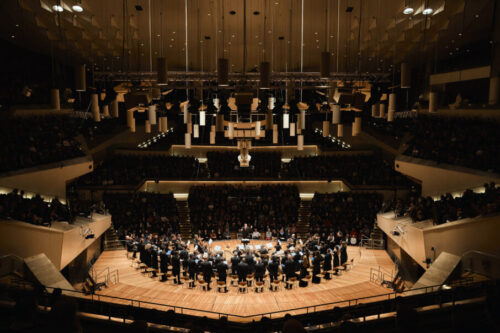
 Germany Bach, St John Passion: Soloists, RIAS Kammerchor Berlin, Akademie für Alte Musik Berlin / Justin Doyle (director), Konzerthaus Berlin, 30.3.2026. (SRT)
Benedikt Kristjánsson – Tenor, Evangelist
Martin Hässler – Bass, Jesus
Katharina Konradi – Soprano
Sarah Romberger – Alto
Julian Habermann – Tenor
Marcus Farnsworth – Bass
Berlin is a city that has hedonism and irreverence written through its DNA. It’s not a place you would naturally associate with the penitence and devotion of Holy Week. ‘Tis the season, however, and whatever can be said about the city’s religious observation, there is no doubt it takes its music seriously.
So, it is hardly surprising that musicians like these could put together a St John Passion that was as classy as it was spiritually focused. Led by British-born conductor Justin Doyle, the approach taken by the musicians of the Akademie für Alte Musik Berlin was stately and refined, a world away from the dynamic rush of Pygmalion’s recently released recording; but instead their opening chorus became a reflection of deep grief, a meditation rather than a dramatic recreation. In fact, that was characteristic of much of this performance, and that is a perfectly valid way to interpret Bach’s multifaceted masterpiece.
Most importantly, never for a second did it sound dull or formulaic. Instead, it sounded as though Doyle had considered every phrase and built the whole edifice carefully from the ground up. In that he was helped by a deeply thoughtful performance from the RIAS Kammerchor: all those repeated Herrs in the opening chorus, and no two sounded the same. Instead, the opening of the da capo sounded like a horrified whisper, and it was something of a luxury having a chorus of about fifty singers, supplemented in some of the chorales by the talented youngsters of the Vicco-von-Bülow-Gymnasiums. They too dialled down the drama in favour or contemplation, which meant that the turba choruses may have been less gripping, but the chorales were spiritually rich.
The soloists seemed to buy into this, too. Benedikt Kristjánsson’s light-voiced Evangelist might not have always been as dramatically engaged as he could have, but he sang with tremendous beauty and deep understanding of the text. Martin Hässler’s Jesus was statuesque and a little remote: both he and Kristjánsson seemed to sing their parts as though standing somewhat back from them.
Dramatic engagement came in spades from the other Brit in the cast, however: Marcus Farnsworth sang Pilate with bluff directness but he brought marvellous lyrical beauty to his arias, and coloratura of pinprick precision in Himmel reisse. Katharina Konradi sang Ich folge dir with buoyant energy and brought heartbreaking, crystalline beauty to Zerfliesse, mein Herze. Julian Habermann sang the tenor arias with brightness and energy. Only Sarah Romberger brought any disappointment, barely audible for much of Von den Stricken, and she had only partly solved the problem by the time she got to Es ist vollbracht.
The programme book made a big play of the way that this work never really reached a definitive form in Bach’s lifetime. This gave Doyle license to put together a version whose choices were sometimes surprising but repeatedly fresh. That mattered less in the big picture, however: this was a St John Passion that sought to move the heart and succeeded in doing so.
Simon Thompson