 Germany Berlin Festtage 2026 [1]: Richard Strauss, Der Rosenkavalier: Soloists, Children’s Choir of the Staatsoper Unter den Linden (chorus director: Vinzenz Weissenburger), Staatsopernchor Berlin (chorus director: Gerhard Polifka), Staatskapelle Berlin / Christian Thielemann (conductor). Staatsoper Unter den Linden, Berlin, 31.3.2026. (SRT)
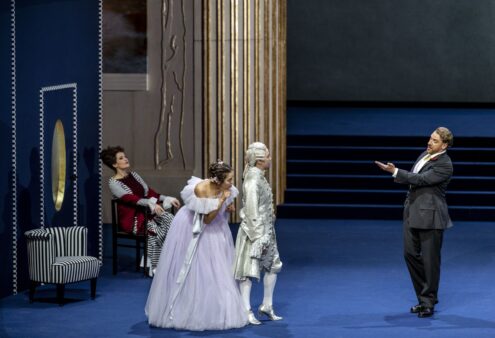
At first glance, André Heller’s 2020 production of Der Rosenkavalier doesn’t seem to be taking itself too seriously. And why should it? After all, Richard Strauss described his opera as a Komödie für Musik, and it would be a brave director who steps too far from that tone. Some might argue, however, that Heller and his designers veer dangerously close to parody rather than comedy, with gaudy neon colours for both the sets and the costumes, and both a levée and an inn scene that seem to be populated with comic caricatures rather than real people, somewhat detracting from the serious tone that lies beneath the action. During the Italian Singer’s aria (Andrés Moreno García), we even see the stagehands wandering onto the stage, gesturing and shrugging as if to say ‘we’re not really doing this, are we?’
And yet, when it needed to, Heller’s production could break your heart. In this current revival that happened most forcefully at the end of Act I, Strauss’s (anyone’s?) greatest end-of-act-wind-down. When the curtain rose at the start of the act, Octavian opening exclamations of love for the Marschallin – ‘Wie du warst, wie du bist…’ – were a poem that he had written and read for her. After the Marschallin was left alone at the act’s end, she rediscovered the poem lying on the bed and, as the violins played their expansive final chord, she gently ripped it up and let the pieces fall to the floor. Julia Kleiter, whose aristocratic, humane Marschallin had already given a masterclass in refined beauty and understated emotional control, left me in pieces at that.
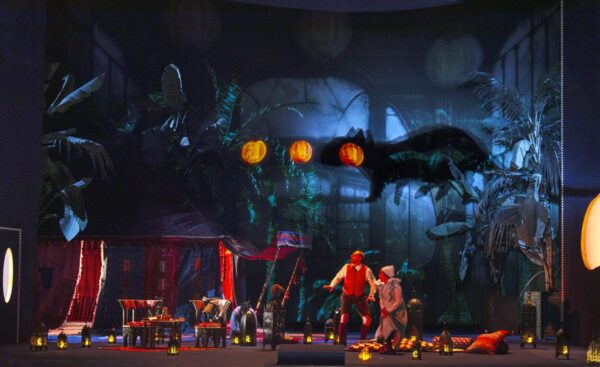
Mostly, Heller’s production does a good job of letting the story unfold clearly and unfussily, particularly in the crowd scenes of the first two acts. He cannot solve the congestion problems inherent in the third act, and setting it in a Turkish-themed palm house doesn’t seem to bring many obvious benefits. However, he has a clear feel for the period, setting it firmly in fin-de-siècle Vienna – Gustav Klimt himself turns up to do a painting in Faninal’s house – and once he clears away all the clutter from the final scene, the effect is close to overwhelming as the three singers are simply left to do their thing against an empty stage.
And, boy, do they do their thing well! Kleiter is a marvel as the Marschallin, and Patricia Nolz’s Octavian is a bouncing ball of juvenile energy next to her, convincingly boyish both in her mannerisms and in her vocal colour. Nikol Hillebrand sings Sophie with pearly brightness, contrasting the other two ladies wonderfully, and it is stylish indeed to have singers of the calibre of Christa Mayer and Daniela Köhler in minor roles, not to mention Roman Trekel, who still sounds solid as Faninal. This is the fourth time in three decades that I have heard Peter Rose as Baron Ochs, and he has still got it. Living with the role for so long means he gets every nuance of the part: the repulsiveness but also the humour, the self-delusion and even the pathos. His voice still sounds terrific, too: close your eyes and you would think you were listening to a singer three decades younger.
Binding together all of this was the sheer magnificence of the Staatskapelle musicians, conducted by their boss, Christian Thielemann. If anyone knows this music well, it is them, and you could tell from the opening bars of the prelude that you were in the safest of hands. The whoop of the horns, the sheen of the violins the unstoppable momentum of Thielemann’s reading, tempered deliciously in winningly idiomatic Viennese waltzes. Thielemann brought the whole orchestra onto the stage for their final bow, and they deserved every roof-raising cheer.
Simon Thompson
Featured Image: Staatsoper Unter den Linden’s Der Rosenkavalier (previous performance) © Ruth Walz
Production:
Director – André Heller
Set designs – Xenia Hausner, Nanna Neudeck
Costumes – Arthur Arbesser, Onka Allmayer-Beck
Lighting – Olaf Freese
Video – Günter Jäckle, Philip HillersT
Cast included:
The Marschallin – Julia Kleiter
Baron Ochs – Peter Rose
Octavian – Patricia Nolz
Herr von Faninal – Roman Trekel
Sophie – Nikola Hillebrand
Marianne Leitmetzerin – Daniela Köhler
Valzacchi – Karl-Michael Ebner
Annina – Christa Mayer
Police Officer – Friedrich Hamel