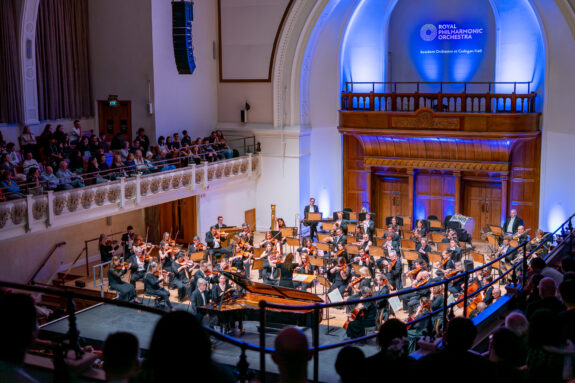
 United Kingdom Rossini, Rubbra, Rachmaninov: Mark Bebbington (piano), Royal Philharmonic Orchestra / Nil Venditti (conductor). Cadogan Hall, London. 31.3.2026. (AV-E)
Rossini – The Barber of Saville Overture (1813-16)
Rubbra – Piano Concerto in G major (1956)
Rachmaninov – Symphony No.1 in D minor, Op.13 (1943)
The primary draw of this programme was the Edmund Rubbra Piano Concerto, a work that has languished unheard in the concert hall for some seventy years. Denis Matthews premiered the work on 21 March 1956 at the Royal Festival Hall with the BBC Symphony Orchestra under Sir Malcolm Sargent. It is frankly reprehensible that BBC Radio 3 failed to broadcast this performance; such a long-overdue homecoming deserved a national platform.
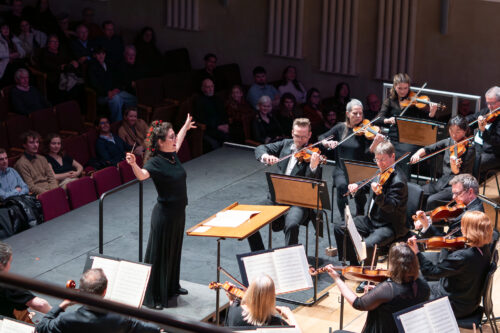
The vivacious Italian-Turkish conductor, Nil Venditti, charmed the audience with an introductory speech on each work; it was a model of spontaneous, whimsical communication — a far cry from the pedantic, written-down, and laboriously long-winded introductions that have unfortunately become the nauseating norm in London concert halls recently.
Following this, Venditti opened with a ballistically buoyant and suavely stylish rendition of Rossini’s The Barber of Seville Overture. Seizing the score with an elegant-eloquence of executed-economy, she teased the music’s high-spirited humour with a wink and a nod. Every crescendo was lapidary in its execution, bubbling over with a sprightly, infectious energy that felt entirely spontaneous. Venditti had promised in her preamble that the overture would leave a ‘smile on your face’; and it did indeed!
In the Rubbra Piano Concerto, Mark Bebbington was the ideal advocate for a work that defies the ‘Romantic’ label in the traditional, emotionally laden sense. The opening movement, titled Corymbus, refers to a botanical cluster where stalks lengthen towards the edge; musically, this was represented by motifs that unfurled and extended with each reappearance. Bebbington captured the tentative, seeking quality of the opening perfectly, navigating the improvisatory lines with a cultivated sound that avoided any maudlin excess.
Rubbra dedicated this work to the virtuoso Hindustani sarod player Ali Akbar Khan, and one could hear that ‘devotional attitude’ in the performance. For those who erroneously brand Rubbra’s textures as opaque, this was the perfect response; despite the dense textures, Venditti brought a luminous transparency where every strand of orchestral detail came through with an incised eloquence.
The central Dialogue was a highlight, played with an austere, autumnal alienation. Bebbington’s interpretation felt like a marooned, melancholic memorial moment, his fingers finding a bemoaning beauty welded within the decimated desolate time-torn textures.
The finale, marked Danza alla rondo; Allegretto giocoso, maintained this elusive mood; while the orchestral textures remained clean, Rubbra added dashes of percussion that provided an overt brilliance previously unsought. Both pianist and conductor received a deservedly warm reception for what was a flamboyantly inflammable performance of Rubbra’s magnificent masterpiece.
I have never heard the Rachmaninov First Symphony conducted ‘naturally’ before, which was quite a feat and a revelation. Conductors so often succumb to ‘interpreting’ the score, cluttering it with fussy agogic accents and laboured inflections that can make the work feel episodic. Venditti, however, delivered a sweeping performance of expressive economy; it was brisk, fleeting, and refreshingly unfussy, allowing the music to surge forward with an inexorable, symphonic drive.
The Royal Philharmonic Orchestra deserves the highest praise for their compassionate contribution and pulsating playing. Every member of the ensemble felt upfront and distinct, aided by the Cadogan Hall acoustics, which are arguably the finest in London for such clarity.
In the Grave—Allegro non troppo, Venditti maintained a purposeful momentum that integrated the movements into a singular, cohesive arc. The poignant, woodwind playing was exceptional, cutting through the textures with surgical precision, while the Allegro animato showcased a remarkable stygian string tone that provided a gritty heavy foundation for the conductor’s propulsive energy.
In the Larghetto, the ‘natural’ phrasing allowed the flowing melodic lines to breathe freely without the distorted stretching of time that so plagues this often molested movement.
The closing Allegro con fuoco brought the tragic symphony to a shattering climax. Here, the music moved with a swift, sweeping, thrusting urgency that avoided any hint of the fragmented. The brazen brass was powerfully projected, maintaining its nobility even at full tilt, while the percussion provided a visceral force that felt integrated into the very marrow of the score. The sheer scale of the sound in the final bars had an overwhelming impact — a wall of sound that was as clear as it was apocalyptic.
I have heard the Rachmaninov First Symphony at the Barbican Hall and the Royal Festival Hall, but only the Cadogan Hall acoustic delivers the work with such ‘in your face’ immediacy; it is the only venue where you truly hear this music in the flesh.
The attentive audience applauded with an appreciative aplomb for what was a paradigm performance of what is arguably Rachmaninov’s greatest symphony. It was a performance where structural logic and emotional depth were held in a rare, unwavering equilibrium, by a prodigious conductor of the first rank.
Alexander Verney-Elliott
Featured Image: Nil Venditti conducts pianist Mark Bebbington and the Royal Philharmonic Orchestra © Jasmine Waterfield/RPO
Your comment about it being “reprehensible” that BBC Radio 3 did not broadcast, or at least record, this concert for broadcast, IMVHO, rather ignores financial and logistical reality. From looking at R3’s schedule, R3 does not regularly feature concerts from Cadogan Hall, since the end of the Monday afternoon Chamber Music Proms some years back. And even then, these were chamber concerts, not concerts with orchestras on the order of 60 players on stage. To my understanding, there is currently not a regular working relationship between the BBC and Cadogan Hall whereby the BBC can set up the standard forest of microphones to capture Cadogan Hall concerts for relay. Such relationships currently exist between the BBC and Wigmore Hall, the Barbican, the Southbank Centre, and the Royal Albert Hall, when it comes to London venues.
Or to put it another way, the BBC and Radio 3 are not exactly rolling in infinite pots of money from the licence fee to be able to drop into a venue to record and/or broadcast for a one-off concert offering, however wonderful that one-off concert offering may be. That would be a nice world to live in, but that’s not the current world, especially after long-term actions by past UK governments to ‘starve the beast’ by keeping the licence fee effectively frozen for years, without adjustment for inflation.