 United Kingdom Double Indemnity: Palace Theatre, Westcliff-on-Sea, Essex, 31.3.2026. (JPr)
As complimentary as it was, I would rather not be asked at the interval ‘You’re intelligent, do you know what’s going on?’ or hear somebody else say at the end ‘Well, that’s three hours of my life I cannot get back.’ The latter was not a surprise because although this stage version of Double Indemnity (excluding the interval) is less than two hours long, at times it seemed much longer (sorry).
Firstly, let me add that although I have not read James M Cain’s original 1943 novel (originally a 1936 eight-part serial) I have seen Billy Wilder’s famous 1944 film noir version more than once over the years. It was inspired by a 1927 real-life murder trial that Cain attended when he was a journalist. It is the story of an insurance salesman (Walter Huff) seduced by a femme fatale (Phyllis Nirdlinger) into murdering her husband for insurance money. They plot to trigger a policy’s ‘double indemnity’ clause for a $50,000 payout by making out his death was due to accidentally falling from a train. The cigar-smoking Barton Keyes is a shrewd claims investigator who has seen it all and doggedly won’t accept it was an accident. This is basically a murder mystery anybody with an encyclopaedic knowledge of the Columbo TV movies of the 1960s to the noughties (and yes, I have seen them all) will recognise. Most of these saw the murder planned and committed at the start before the killer is quickly identified by the famous rumpled LA police lieutenant and finally something gives them away. Like Walter in Double Indemnity, they believe they have concocted the ‘perfect murder’ …until it all unravels.
Tom Holloway’s adaptation for the stage relies more on the original novel than – possibly a mistake in hindsight – Billy Wilder and Raymond Chandler’s screenplay. Holloway has Walter narrate his own demise, though the breaking of the fourth wall and Walter telling his tale in ‘this place of dreams’ (Hollywood) gets forgotten as the play goes on and definitely needed some context anyway. I thought about the character Joe Gillis in Wilder’s 1950 Sunset Boulevard and Fred MacMurray as Walter Huff in the Double Indemnity film who is recording a confession for Keyes. I am strenuously trying not to spoil the play for you if you do not know the story but will add that the ending has been changed from the novel and is now more in line with Sunset Boulevard, arguably the finest movie ever made about Hollywood.
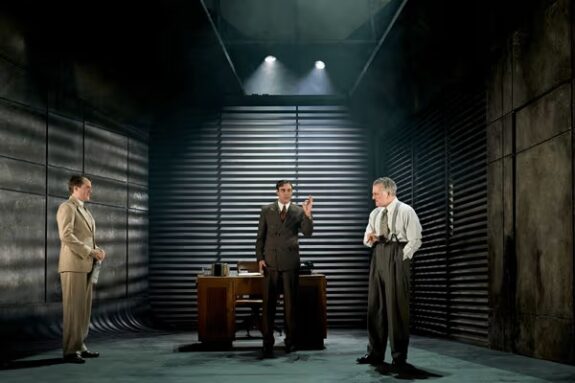
The HOLLYWOODLAND sign (this is post-depression Los Angeles) looms over Ti Green’s set; well, at least some of its letters (and maybe not in the right order). Otherwise, what we see is a concrete bunker receding into the distance with some louvres sometimes at the back or on the side. I’m not sure what inspired this, maybe LA’s underground culverts or the sewers in Carol Reed’s 1949 The Third Man. Green is also responsible for the appropriate period costumes whilst Josh Gadsby’s lighting is possibly a little too noir for its own good with everything – especially in the first half – much too dark. Very little stage furniture is involved and is little more than a drinks trolley, a desk and chairs, a bench and a hospital bed used to distinguish between scenes. Composer Dan Balfour’s soundscape (with additional composition from Zac Gvi) helps rack up what tension there is at times, whilst sounding at odds with what we see at others.
There is exposition worthy of a radio play before the interval all about how to trick Mr Neidlinger into the signing and payment for the accident insurance policy he knew nothing about. More attention is given to that than developing any sort of sexual chemistry between Phyllis and Walter; they just seem to meet, kiss and conspire. Scenes of driving in a car, being on the train or finally on a boat are rather poorly staged; as too was the murder of Mr Nirdlinger, the fall from the train, shooting of Walter, or the abrupt denouement (which leaves the audience initially wondering ‘Has it finished?’).
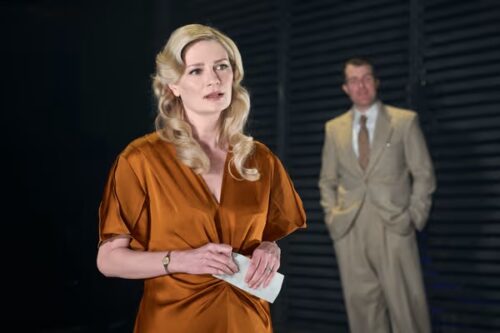
Even though in my opinion what they were acting left something to be desired that there are fine performances from the entire ensemble is not in doubt. The play is advertised as ‘Mischa Barton in Double Indemnity’ yet the Hollywood star of film, television and stage merely drifts in and out of the story as Phyllis, although Barton was suitably alluring and coldly manipulative throughout. Ciarán Owens brings a certain charisma to Walter who if the story was not to take the turn it does you might find yourself rooting for as an (anti-)hero. It is those turn of events which transforms Owens’s cocksure (!), brash, devious and ambitious Walter of the first half into the insecure, doomed figure of the second half. Best of all of them was Martin Marquez as the gruff, take no nonsense Keyes with his fierce loyalty to Walter. Marquez gives an acting masterclass as he unpicks – Columbo-like – the fiction of the supposed train accident yet appreciates that he needs more proof. More than just solid support comes from Oliver Ryan and Joseph Langdon in a number of roles. Langdon is especially fine as Mr Norton the insurance company boss fearful of the implications of a huge claim settlement. Sophia Roberts gets her own moment in the spotlight as Lola Nirdlinger, Phyllis’s stepdaughter, when she reveals how she believes Phyllis caused the death of her mother. Finally, Gillian Saker makes more of the role of Nettie, Walter’s bright and efficient secretary, than Tom Hollway gives to her character.
Jim Pritchard
For more about Double Indemnity on tour click here.
Featured Image: Ciarán Owens (Walter Huff), Joseph Langdon (Mr Norton) and Martin Marquez (Keyes) © Manuel Harlan
Cast:
Mischa Barton – Phyllis Nirdlinger
Ciarán Owens – Walter Huff
Martin Marquez – Keyes
Gillian Saker – Nettie / Waitress / Usher
Joseph Langdon – Mr Norton / Nino / Joe Pete
Oliver Ryan – Mr Nirdlinger / Jack Christholf / Jackson
Sophia Roberts – Lola Nirdlinger
Ensemble – Estelle Cousins, Simon Victor, Patrick Fleming
Creatives:
Book – James M. Cain
Adaptation for the stage – Tom Holloway
Director – Oscar Toeman
Set and Costume designer – Ti Green
Lighting designer – Josh Gadsby
Sound designer and Composer – Dan Balfour
Additional Composition – Zac Gvi
Movement director – Chi-San Howard
Fight and Intimacy director – Enric Ortuño
Voice and Dialect coach – Aundrea Fudge
My friend and I watched the play last night at the Palace Yheatre, Westcliff. I wasted 3 hours of my life. I had a good snooze however. Hated it I’m afraid.
Same here, thought Walter and Nettie were let down by most of cast. It was like watching a High School performance.
Extremely disappointed, which is an unusual experience from the many shows attended at Southend Theatres. It would cost £208 for my family of four, and it was not enjoyed at all – ending up with us leaving at the interval. This has never happened before. The staging was sparse and seeing the murdered victim, get up and walk away, didn’t help to as to the realism. A total waste of money, I’m afraid.
We saw this at the Palace Theatre in Southend on Saturday 4th April.
1. Too wordy – causing confusion as to what they were specifically talking about.
2. Dragged on – with some scenes repetitive and going in circles.
3. Sparse props – it was unclear where they were (office/lounge/ship/car/station) or whether they were in the same room or on phone.
4. Actors used as two or three different characters with not even dress change – caused confusion as to what character was on stage at any given time. At one point the murdered husband returned, walked on, said a line and walked off again. One actor played a boyfriend, a security guard and later the insurance boss. We all thought he was meant to be the same person moonlighting. Another played a secretary, an usher and a maid, again with no costume change other than a ponytail for one.
5. Loads of fussing and prancing about the stage doing nothing.
6. Wooden actor playing the lead female character; completely unbelievable
7. The two male actors were good but terrible overly-played American accents which grated.
8. Overall – terrible. Dozens of people we spoke to afterwards felt the same confusion as to the characters, the storyline and the conclusion.
9. Expensive – given the lack of actors, props and scenery this was VERY overpriced.
10. Finally, the Palace Theatre toilets were broken and dirty, with leaking pipes and taps and frail hand-dryers. Given the extortionate prices of ice-creams (£5.50 for a tiny pot) and drinks, they really should be re-investing in the hygiene and toilet facilities.
I completely agree with everything said in this comment (apart from the Manchester Opera House toilets were ok!).
My least favourite thing I have seen at the theatre ever. I nearly fell asleep several times and only stayed because I was meeting someone afterwards!!
I wondered whether I should bother after reading these reviews. So glad I did. It was fabulous and the actors were brilliant. If you have imagination and immerse yourself in this twisty murderous plot you will enjoy every second. Thoroughly recommend.
Not had much clue what was going on, actors trying to make up the show but just cause more and more confusion. I give a sold 2/10 – 2 points for the man lead actor for not forgetting his lines…..
While I agree with some of the comments here I wouldn’t say it was as bad as all that. To be fair it may have helped that I knew a little bit about it having read a book recently which talked about the real life case. But yes, there was some confusion, caused largely by the quickfire dialogue, and the whole thing was let down by a rather weak ending. I had sort of expected the conspiring pair to face trial and execution, but I guess that would have made the play much longer! This was at Cardiff New Theatre and there was an issue with the sound which meant two interruptions in the first act, after which the actors ditched their microphones and relied on their own voices, which I actually found better! The technical letdown can’t have helped them but they brushed it off and carried on like real pros.