 Germany Berlin Festtage 2026 [3] – Verdi, Un ballo in maschera: Soloists, Staatsopernchor Berlin, Staatskapelle Berlin / Enrique Mazzola (conductor). Staatsoper Unter den Linden, Berlin, 1.4.2026. (SRT)
Watching his new production of Un ballo in maschera for the Berlin Staatsoper, you get the strong impression that director Rafael Villalobos doesn’t like the opera very much. He spends pages of the programme book complaining about Ballo’s tricky racial and gender politics, and his staging determines to tackle those elements head-on; yet he seems strangely unbothered by the fact that the opera contains more overtly problematic elements, such as domestic abuse and a murder, passing over these in favour of more zeitgeisty concerns.
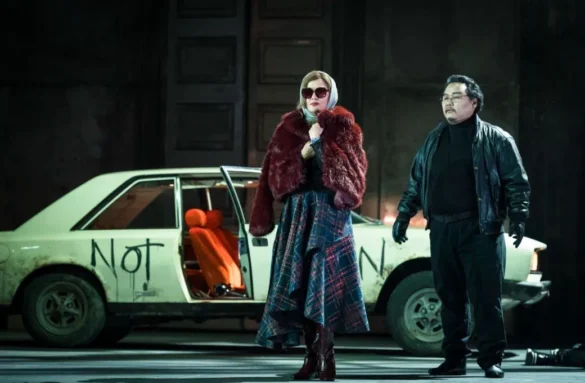
So he sets the opera in 1980s USA, at a time when de-regulated media had just opened the path for politicised news networks, and he makes Riccardo (not Gustavo, note) a TV personality whose face appears on multiple TV screens and the cover of Time magazine. Ulrica runs a TV show that delivers on-air tarot readings via a racially exploited black subordinate, and Oscar becomes the son of Renato and Amelia who suffers gender dysphoria – really! – and receives no support from his parents.
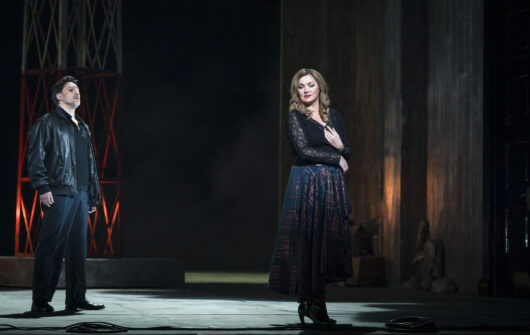
If you are wondering what all of this adds to one of Verdi’s tightest emotional dramas then you might not be surprised to hear that the answer is: not much. If Villalobos really has such a low opinion of Ballo then you wonder why on earth he said yes to directing it and why he was so determined to try and turn it into something it isn’t. Emanuele Sinisi’s set designs are consistently and irredeemably tawdry, not least when Amelia goes not to pick herbs from the gallows field at midnight but instead to buy drugs from a gay S&M gathering in a late-night car park.
If only the singing had given something more positive to write home about. Unfortunately, few of the leads were firing on all cylinders. Charles Castronovo’s tenor had little gold or sunlight in it: instead, his Renato seemed consistently to be struggling to find the lyricism in the role. Only in the death scene did he finally find the nub of the part; up until then the voice sounded effortful and a trifle coarse throughout. In fairness, he seemed to recognise that he was having an off night, snatching a slightly embarrassed bow at the final curtain calls. UK audiences can hear him singing the part at the Edinburgh International Festival this August – I very much hope his voice has settled into it more by then.
Nor did Anna Netrebko justify her billing. Her Amelia was monochrome and one-note throughout. There was no desperation, no despair, not even an over-swelling of love: in its place every musical and emotional tone was sicklied over with a constant voluptuous creaminess which was pleasant enough in its way, but not enough to encompass one of Verdi’s most engaging soprano roles. And it is not even as though she made that sound comfortable. Pitching was consistently and worryingly approximate, and she showed an alarming tendency to attack from below the note. It is still an engaging voice with which to spend time, but I couldn’t shake the nagging feeling that she is entering the final third of her career, and she is going to have to choose her roles very carefully if she is to steward her voice effectively in future.
Very much in the first third of his career is Mongolian bass Amartuvshin Enkhbat and, boy, did he sound it. He had all the freshness, juice and excitement that his companions lacked, and his third-act aria was the highlight of the evening. He might not have had the dramatic physicality the part needed, but he did all the acting he had to with his voice and the impact was palpable.
Anna Kissjudit’s Ulrica was throaty, deep and exciting, while Enkeleda Kamani’s Oscar was fresh, if slightly brittle. The most uncomplicatedly successful musical contribution came from the pit, with the velvety playing of the Staatskapelle and Enrique Mazzola’s intelligent direction. He conducted the piece with all the discipline of a bel canto opera but with the dramatic urgency that mature Verdi requires, consistently slowing up the pacing to highlight a dramatic turning point, most effectively in the lot-drawing scene of Act III. Otherwise, however, this was an Un ballo in maschera which failed to ignite, and the responsibility for that lies only partly with the director’s aversion to it.
Simon Thompson
Featured Image: Anna Netrebko (Amelia) and Amartuvshin Enkhbat (Renato) © Stephan Rabold
Production:
Director – Rafael R. Villalobos
Set designs – Emanuele Sinisi
Costumes – Lorenzo Caprile
Lighting – Felipe Ramos
Choreography: Javier Pérez
Chorus director – Dani Juris
Cast included:
Riccardo – Charles Castronovo
Renato – Amartuvshin Enkhbat
Amelia – Anna Netrebko
Ulrica – Anna Kissjudit
Oscar – Enkeleda Kamani
Silvano – Carles Pachon
Samuel – Manuel Winckhler
Tom – Friedrich Hamel