Tomasz Konieczny’s vision and drive propel the Baltic Opera Festival
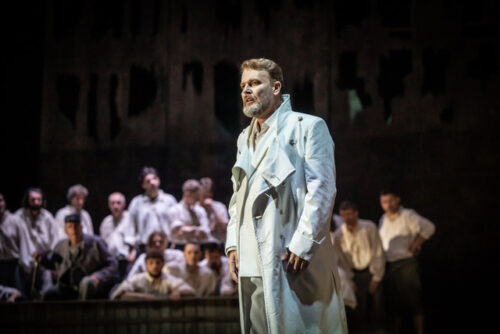
In late March, Tomasz Konieczny was a busy man. The Polish bass-baritone was nearing the end of a run of Tristan und Isolde at the Metropolitan Opera, performing alongside Lise Davidsen and Michael Spyres in a new staging directed by Yuval Sharon. His buoyant, hearty Kurwenal was hailed by all, with The New Yorker deeming him ‘a born Wagner singer’. It was the hottest ticket in town, and the Met responded to the demand by adding a performance.
Konieczny is also a man on a mission, and Met performances were not the only thing on his agenda. On one of the first fine spring days in New York, he took time to discuss the Baltic Opera Festival (BOF) at a busy diner a few blocks from the Met. We met just days before the American Friends of the Baltic Opera Festival (AFBOF) was to be launched at The Kościuszko Foundation.
The launch party turned out to be far from the average charity event but rather a concert featuring some of the greatest singers in the world. Konieczny was joined by Davidsen and Spyres, as well as Ekaterina Gubanova and Ryan Speedo Green, to perform selections from Wagner’s Wesendonck Lieder and his operas. Monika Radecka and Piotr Buszewski sang excerpts from Joseph Beer’s Polish Wedding, which will be performed at the BOF in July 2026, and Aleksandra Kurzak, a surprise guest and clear favorite, sang ‘Vissi d’arte’. At the piano was Konieczny’s longtime musical partner, Lech Napierała.
The Bayreuth of the North
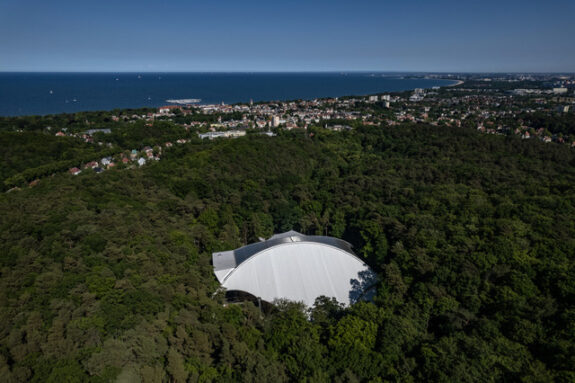
Konieczny is the artistic director of BOF, which he founded to revive a century-old operatic tradition on Poland’s Baltic Coast. Opera Leśna (Forest Opera in English / Waldoper in German) was founded in 1909 in Sopot, some 20 miles from Gdańsk. The spa town was a favorite watering hole for the Polish intellectual elite, as well as Russian and German aristocrats including Kaiser Wilhelm II. Sopot, like Gdańsk, became part of the Kingdom of Prussia in 1772 and, depending on the vagaries of war, was either German or Polish for the first four decades of the last century.
In the late 1920s and 1930s, Wagner became a repertoire staple at Opera Leśna. Productions were staged in Sopot’s amphitheater which seats 5,047 musicians and has an orchestra pit that can hold up to 110 musicians. The high quality and popularity of its Wagner productions led to it being dubbed the ‘Bayreuth of the North’. When the Nazis overran Poland in 1939, the festival continued, taking on an overt German nationalistic flavor.
After World War II, the entire region known as Pomerania, including the so-called ‘tri-cities’ of Gdańsk, Gdynia and Sopot, became part of Poland. Gdańsk was ground zero for the rise of the Solidarity movement in the 1980s that toppled Polish communism, while Sopot became a major seaside resort, with opera sporadically staged at its amphitheater, although Wagner was no longer featured.
A festival inspired by a pandemic, compassion and patriotism
In March 2020 at the onset of the COVID-19 pandemic, Konieczny was in Vienna He was scheduled to sing 18 performances of five different operas, including Wagner’s Ring cycle, at the Vienna State Opera where he was named an Austrian Kammersänger in 2019. None of those performances went forward as Austria immediately went into lockdown. Konieczny says that freelance artists like him and his colleagues were ‘left high and dry’.
The Austrian Heldentenor Peter Svensson, who would die of COVID-19 complications in 2021, responded to the situation. He made his dream of a Wagner festival a reality, with two performances of Wagner’s Der fliegende Holländer and a single Tristan und Isolde at the Weinviertler Festspiele in August 2020. They were staged in an open-air theater in Mikulov in Southern Moravia, a region near the Austrian border known for its wine production.
With casts that featured leading Wagnerians, including Martina Serafin, Günter Groissböck and René Pape as well as Svensson and Konieczny, the festival was an artistic success but a financial failure. Nonetheless, it prompted Konieczny to think, ‘If Peter Svensson could envision his dream in an unsuitable venue, with performances interrupted by rain, why not do this in Sopot?’
Making the dream a reality
In Poland, the chief source of funding for the arts is the government and, since Sopot is located in the province of Pomerania, Konieczny began there. He admits to being very naive about the process and went about the task by just knocking on doors. One that opened for him was that of Jaroslaw Sellin, Poland’s Deputy Minister of Culture, National Heritage and Sport. As Konieczny recalls, Sellin responded, ‘It is as if you fell from the sky. I was born in Gdynia, am a Wagner enthusiast and have long wanted to relaunch Opera Leśna’. At that first meeting, Sellin committed to funding for the BOF and has fulfilled every promise.
Sellin steered Konieczny to the Baltic Opera in Gdańsk, which also received state sponsorship, to become an organizer of the BOF. With a history dating to 1949, the Baltic Opera gained international recognition when the BBC cited it as one of the best opera houses in Europe in 2010. The relationship between BOF and the Baltic Opera has flourished under Romuald Wicza-Pokojski, the company’s General Manager. The first festival in 2023 was organized under the sponsorship of the Baltic Opera in Gdańsk and the National Centre for Culture Poland, with performances in Gdańsk and Sopot.
Konieczny’s vision for BOF was to feature Romantic operas but never to be solely a Wagner Festival. The repertoire has evolved to include works by Polish composers Karol Szymanowski and Krzysztof Penderecki. Konieczny strives to avoid politics, stating that ’it is an artist’s duty to speak politics through his art, and to build bridges and provide a space where politicians can connect’. To that end, Polish President Andrzej Duda and German President Frank-Walter Steinmeier served as honorary sponsors of the 2023 festival.
The BOF – The beginnings 2023-2025
The first festival in 2023 featured Marek Janowski conducting Der fliegende Holländer with Andrej Dobber as the Dutchman, Ricarda Merbeth as Senta and Franz Hawlata as Daland at Opera Leśna. Konieczny couldn’t sing the title role as scheduled due to a last-minute call from Bayreuth. At the Baltic Opera, the BOF staged Karol Szymanowski’s Loteria na mężów, czyli Narzeczony nr 69 (Lottery for Husbands or Fiancé No. 69), an operetta set in America with a lighthearted plot about a lottery designed to arrange marriages. There was also a film marathon featuring opera-related cinema.
From the beginning, Konieczny has had three interrelated goals: to program works sung in Polish, showcase works by forgotten composers and foster the spirit of freedom that prevailed in the early days of Opera Leśna. In 2024, the Ukrainian Freedom Orchestra, a joint initiative of New York’s Metropolitan Opera and Warsaw’s Teatr Wielki under the baton of Keri-Lynn Wilson, performed Beethoven’s Ninth Symphony in a rare Ukrainian language version at the CRIST shipyard in Gdynia. The shipyard granted 3,000 workers three days’ leave so that they could attend the concert. Lech Wałęsa, leader of the Solidarity movement, former President of Poland and Nobel Peace Prize laureate and the Ukrainian Chamber of Commerce were the honorary patrons.
The 2025 festival featured the most adventurous programming to date. Richard Strauss’s Salome with Jennifer Holloway in the title role was the standard fare in Sopot, while Alek Nowak’s Monster’s Voice, a new opera inspired by the film Europa Europa, was staged in Gdańsk. It is based on the story of Solomon Perel, a Jew who hid in the ranks of the Hitlerjugend during the Second World War.
There was also a performance of Łukasz Godyla’s Wòlô Bòskô, which translates as ‘God’s Will’ in Kashubian. Curated by baritone Damian Wilma, the piece blends Pomeranian folklore with contemporary music. The texts and songs were performed in Kashubian, a distinct West Slavic language spoken in the region.
There were two performances in which Konieczny took special interest. The first was a multi-media production of Schubert’s Winterreise, directed and performed by his brother, bass Lukasz Konieczny. In addition to the songs, there were recitations of poems by Krzysztof Kamil Baczyński, who died in the 1944 Warsaw Uprising. They were accompanied by video projections inspired by a notebook kept by Kazimierz Fidler while interred in Buchenwald. Fidler was the great-grandfather of Łukasz and Tomasz Konieczny.
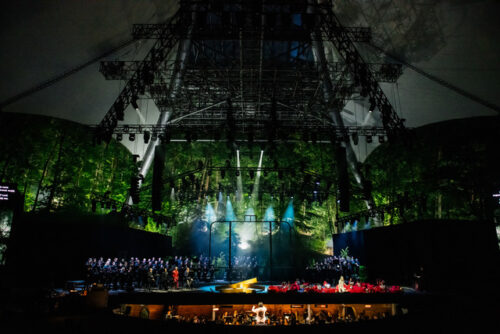
The other was a staged performance of Krzysztof Penderecki’s St Luke’s Passion, a monumental work composed in 1966 to commemorate the millennium of Polish Christianity. Konieczny was advised that there would be no audience for such a challenging work, but he forged ahead and proved the naysayers wrong. More than 4,000 people attended the sole stage performance, proving ‘that there is an audience for such works, through which the BOF can foster pride in Poland and its culture’.
BOF 2026 – Romantic Rituals, Northern Spirits
BOF’s fourth season runs from 2-7 July 2026. The two main-stage productions are Die Walküre at Opera Leśna in Sopot and Beer’s Polish Wedding (Polskie Wesele in Polish / Die Polnische Hochzeit in German) at the Baltic Opera in Gdańsk.
Die Walküre is being presented to commemorate the 150th anniversary of the first performances of the Ring in its entirety at Bayreuth. John Fulljames will direct the production, with conductor Axel Kober leading a cast that includes Konieczny as Wotan, Izabela Matuła as Sieglinde, Stanislas de Barbeyrac as Siegmund, Regine Hangler as Brünnhilde, René Pape as Hunding and Małgorzata Walewska as Fricka.
Joseph Beer was a Polish-born Jewish composer known for his highly successful Viennese-style operettas which combine lush romanticism with modernistic, jazzy elements. His thriving career was halted by the Nazis, forcing him into hiding in France. He survived the war although his parents and sister died in the Holocaust.
Polish Wedding had a successful premiere at the Zurich Opera in 1937 and toured many European cities in various translations from the original German. The Paris premiere starring Jan Kiepura and Marta Eggerth was cancelled due to the deteriorating political climate in Europe. Paweł Miśkiewicz directs the BOF production, with conductor Łukasz Borowicz leading a cast headed by Monika Radecka and Piotr Buszewski.
The Sinfonietta Cracovia will also present The Museum of Man – Penderecki in Memoriam as a tribute to the composer and his wife, Elżbieta Penderecki. They played a pivotal role in establishing the ensemble which became one of the leading interpreters of his works. To close the festival, soprano Anett Fritsch will sing a recital highlighting the poetry of Heinrich Heine and the interaction between art and the sacred.
The American Friends of the Baltic Opera Festival
In Poland, as in most of Europe, the state is the primary source of funding for the arts. The BOF has corporate funding, including its lead sponsor, Orlen S.A., a Polish multinational corporation that is a major energy producer in Central and Eastern Europe. There is, however, no tradition of private support for the arts, as in the US. Konieczny deems private-sector funding essential to ensure the BOF’s future which is why he founded the American Friends of the Baltic Opera Festival (AFBOF).
Apart from financial support from American donors, Konieczny has other goals for the AFBOF. One is to lead by example, with American donors inspiring Polish opera lovers to do likewise. He admits that this goal faces structural challenges – the institutional and governmental framework is not in place in Poland. Beyond financial support, he also hopes to attract more Americans to experience the festival. That is just another step toward achieving the BOF’s aim to build bridges between people from different countries. That goal was there from the beginning, when leaders from Poland and Germany helped turn the page and return opera to the forest in Sopot.
Rick Perdian
Featured Image: Opera Leśna in Sopot, Poland © BOF
For more information on the 2026 Baltic Opera Festival, click here.