
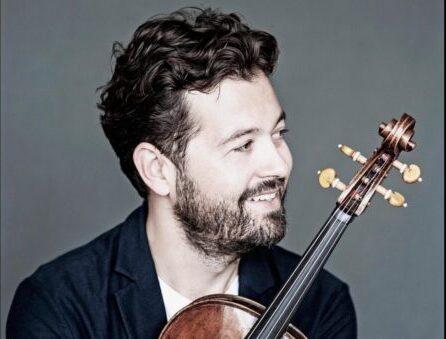
 United Kingdom Various: Scottish Chamber Orchestra / Lawrence Power (director/soloist). City Halls, Glasgow, 24.4.2026. (GT)
Couperin (arr. Adès) – Les baricades mistérieuses
Vaughan Williams – Suite for Viola and Small Orchestra
Tippett – Fantasia Concertante on a Theme of Corelli
Rameau – Les Sauvages
Magnus Lindberg – Viola Concerto (Scottish premiere)
This evening of music for the viola from the Baroque to the 21st century, opened with one of the most puzzling pieces of the period. François Couperin wrote his piece for harpsichord in 1717 as part of a collection Ordre 6ème de clavecin in B-flat major in the style brisé of keyboard music. The piece composed in the rondo manner is thought to hint at the traditional stamping on grapes during harvest or of a machine-like motion; it remains however a riddle regarding the meaning of the original work for harpsichord. This arrangement by Adès is from 1994 and is in the form of a string quintet of double bass, bass clarinet, clarinet, viola and cello. The earthy sounds of the viola, cello, and bass provided a stimulating start to the concert. In giving Couperin’s piece a new life, Adès provides contrasting colours with the viola firmly at the centre of the music making. The Les baricades mistérieuses arrangement was written for the 80th birthday of Wilfrid Mellers.
As Ralph Vaughan Williams played the viola as a student, and throughout his long career, he tried to give more distinction to the instrument, and his 1934 suite, is the second that he wrote for the viola after his Flos campi. Another cause for promoting the viola were the virtuoso violists Lionel Tertis, and William Primrose who inspired his contemporary composers Bax, Bridge, Britten, Holst, and Walton to write for the deep, rich harmonies of the instrument. This performance led by Lawrence Power consisted of five brief pieces from two groups of the music composed by Vaughan Williams. The opening Pastorale was distinguished by an exuberantly soaring melody on Power’s viola and the following Carol was exquisite with the triangle giving a festive tone against a flowing melody on the viola. The Christmas Dance, continued the tradition with beautiful harmony from the bassoon of Cerys Ambrose-Evans, and Marta Gomez’s flute, with hints of folk music, especially eloquent on the oboe of Maria Munoz Zaragoza. The Ballad was poignant on the viola while in the final Moto perpetuo, the fiery rhythmic energy showed off the instrument’s qualities assisted by the buoyant woodwind in an exciting, and upbeat finale.
Commissioned for the 1953 Edinburgh Festival to mark the 300th anniversary of Corelli’s birth, Michael Tippett’s Fantasia Concertante has ensured his place among the finest British composers of the 20th century. One of the achievements is that it contrasts light and darkness with an underlying passion that grips one and ensures the work’s continuing popularity. Based on the Adagio in F major from Corelli’s Concerto Grosso, Op.6 No.2. Here the setting for the orchestra was contrasted by Stephanie Goney on violin, Lawrence Power also now playing the violin and Philip Higham on the cello. Their performance of Tippett’s piece was intense, and often almost hypnotic, and at times, heavenly in the shifting between periods of tension and the search for salvation. The pace of the performance was very quick-moving, evincing impressionistic technique and masterful playing. Alternated spells of intense reflection by the brass and woodwind led to the quiet, subdued close.
Jean-Phillipe Rameau’s 1725 Les Sauvages was so exciting in its theatricality and invention that he included it later in the ballet opera Les indes galantes and here the dramatic piece opened with great strikes from percussionist Louise Lewis Goodwin behind the orchestra giving a wonderful momentum leading to an exquisite idea emerging in the orchestra, in a fascinating performance.
As Magnus Lindberg explains, ‘I wanted to write a big concerto for the instrument, but decided to use a Classical orchestra with double wind instruments and strings only. In this work, even the timpani doesn’t become part of the sound palette. Nor is there any other percussion, harps or keyboard instruments. In this way the Concerto follows the line of my Violin Concerto No.1, which I scored for a “Mozart sized” orchestra. The piece is divided into three movements which are played without pauses in between, thus sharing all the material. I work with a large number of different characters, all identified by different harmonies, tempos and textures, drawing parallels with the course of my Piano Concerto No.3.
This pair of concertos also shares an important harmonic feature – the incorporation of pentatonic harmonies within my language. The majority of my works, ever since the early 1990s, have been based on a hybrid model combining “combinatorial” pitch material with “spectral” harmonies. Spectral harmonies, in my case, have mainly been based on chords respecting the natural overtones, thus creating a clear distinction between the bass line and the high register. SATB (soprano, alto, tenor, bass), the universal basis of the different voices.’
The Lindberg Viola Concerto opened with a brass fanfare which was repeated before an engaging idea from the oboe of Munoz Zaragoza and Martin on clarinet. There was a shimmering in intervals between the brass accords and from the strings, before the viola entered with an eloquent theme and to exchanges of ideas with the oboe creating intense drama and colourful harmony. Power unleashed a period of sublime play switching between intensity, a quiet stillness, and an icy beauty, prior to a great exciting moment in the whole orchestra with the brass chords. The Viola Concerto proved an enjoyable and entertaining work and worthy of wider performance.
This evening was a fascinating survey of music written for the viola over three centuries with Lawrence Power at the core both in his playing but also in his often entertaining words before each work on the programme.
Gregor Tassie