
 United Kingdom Various: Sir Willard White (bass), Brodsky Quartet (Krysia Osostowicz, Ian Belton [violins], Paul Cassidy [viola], Jacqueline Thomas [cello]). Turner Sims Concert Hall, Southampton, 28.4.2026. (CK)
What the list below doesn’t tell you is that every item bar two is an arrangement, made in every instance bar one by a member of the Brodsky Quartet. The two exceptions are Britten’s Poème and Barber’s Dover Beach, to which I shall return.
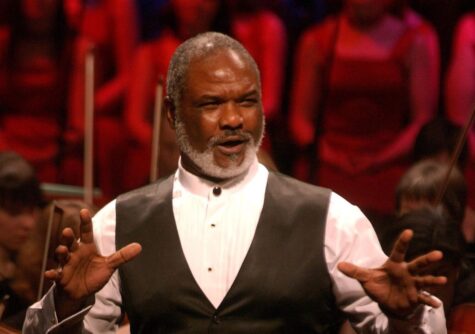
It was a great pleasure to welcome a quartet that has been part of our musical scene for four decades, and a much-loved singer who has been around for five. Sir Willard White will be 80 in October: still charming, spry and relaxed, enjoying some gentle banter with violist Paul Cassidy, though (how could it be otherwise?) with a voice that only intermittently reminded us of what it was.
The idea behind the programme was a laudable one: a homage to the Hollywood Quartet, active after the Second World War, performing the classical quartet repertoire (try their performances – suitably reinforced – of Schoenberg’s Verklärte Nacht and Schubert’s String Quintet, on Testament), premiering the works of film composers in the Golden Age of Hollywood and recording with Frank Sinatra. Thus, a classical first half and a second half devoted to the Great American Songbook.
So much for the concept. Did it work as a concert? Not entirely: it felt like a curious hybrid, with some high spots certainly, but no real sense of direction or cumulative impact. The Brodskys opened each half on their own, Sir Willard entering unobtrusively as they finished: I liked the opening arrangement of Copland’s Hoedown from Rodeo, with the two violins doing their best to sound like folk fiddles. We might have been in a church hall or a haybarn: there was even a polite ‘Yee-hah!’ from one of the players.
White was a wonderful Porgy in Simon Rattle and Trevor Nunn’s Porgy and Bess at Glyndebourne forty years ago (issued on CD and subsequently filmed), and it was pleasing to hear him begin by recalling some of its music – Summertime (it needs a woman’s voice to make it fly), a nod to Catfish Row’s streetsellers the Strawberry Woman and the Honeyman, and I Got Plenty o’Nuttin’, which he built to a terrific climax. Next, a pair of traditional folk songs: The Ash Grove was notable for the simplicity and delicacy of the accompaniment of the Brodskys; White clearly enjoyed himself in a gently suggestive rendering of The Foggy Dew.
We were in deeper waters with Schubert’s Death and the Maiden, with dark, funereal sounds from the players, and White conjuring vividly the girl’s terror and the solemn, consolatory majesty of death’s response. The Trout was no doubt intended as a contrast: but it was less effective, and there was a sense that the two Schubert songs had cancelled each other out. Massenet’s Élégie was an unexpected highlight, with eloquent playing from the Brodskys, and White flowing and mellifluous in French, rising to powerful declamation.
Samuel Barber’s setting of Matthew Arnold’s great poem Dover Beach was the only vocal work of the evening performed by the forces it was written for. White gave an engagingly personal introduction to the poem, not attempting to plumb its depths, underlining its contemporary relevance: but in his performance he unlocked all the poem’s feeling, his voice garlanded with Barber’s beautiful instrumental writing, full-hearted in ‘Ah, love, let us be true to one another!’, hard and grim in the poem’s bleakly nihilistic conclusion. It was a remarkable performance by a great singer.
The second half opened with the Brodskys playing Britten’s Élégie – the slow movement of a string quartet, Paul Cassidy told us, written when Britten was 14. The second violin maintains a quiet, clashing second throughout, against which scraps of melody in the other instruments rise and fall. There is a potent sense of space, an unsettling landscape: original, and individual.
Both singer and players seemed to ease their way into the set of American songs that occupied the rest of the concert, and we in the audience went with them. Sir Willard enjoyed inhabiting each song, strumming his air guitar in Copland’s The Dodger, trying out some dance moves in the instrumental break in Jerome Kern’s They Didn’t Believe Me; he sounded like a man freed up in Cole Porter’s Spiritual-like Blow, Gabriel, Blow. His voice was at its richest and most relaxed in Close to You – the four players cavorting around his head like an aviary – and, more softly, in the gentle calypso Jamaica Farewell (he is Jamaican born). The Brodskys were at their most affecting in the arrangements of P.S. I Love You and They Didn’t Believe Me.
I was sorry that the programme culminated in My Way – a song that I cordially dislike – though I enjoyed the instrumental arrangement which began with a nod to Bach’s (or Procol Harum’s) Air on a G String and was almost gate-crashed towards the end by Zadok the Priest. All was forgiven, though, when we had two encores: an agile and amusing Farmyard Song (I Bought Me a Cat), and Ol’ Man River, which we had probably all been hoping for. Sir Willard had enough voice left to remind us what a great song this is. And what a great singer he is.
Chris Kettle
Copland – Hoedown; Long Time Ago; The Dodger
Gershwin – Excerpts from Porgy and Bess
Trad. – The Ash Grove; The Foggy Dew
Schubert – Death and the Maiden; The Trout
Massenet – Élégie
Barber – Dover Beach
Britten – Poème
Jenkins – P.S. I Love You
Porter – Blow, Gabriel, Blow
Kern – They Didn’t Believe Me
Livingston/Lampi/Hoffman – Close to You
Burgess – Jamaica Farewell
Anka/Revaut/Thibaut – My Way