
 Hungary Let the World Know – Concertos and other violin pieces with orchestra by Robert Schumann, Sibelius, Bartók, Dvořák, Ravel, Bruch, Brahms, Tschaikovsky: Barnabás Kelemen (violin), László Fenyő (violoncello), orchestras and conductors. Great Hall of the Music Academy Budapest, 1 – 3 May 2026, streamed by The Violin Channel. (AK)
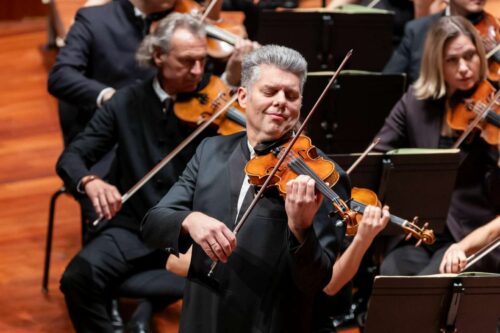
Presented by the Festival Academy Budapest, a mind-blowing yet high-quality series of events took place in Budapest during the period of 1st – 3rd May 2026. Barnabás Kelemen performed nine concertos and three additional pieces for violin and orchestra within nine concerts. His repertoire for these three days consisted of violin concertos by Robert Schumann, Sibelius, Dvořák, Bartók (both concertos), Bruch, Tschaikovsky and Brahms (violin concerto as well as the double concerto for violin and violoncello), furthermore Ravel’s Tzigane and both Bartók rhapsodies.
As if such schedule was not taxing enough, immediately before each of the nine concerts spread over the three days, Kelemen rehearsed up to an hour with whichever of the seven participating orchestras and seven participating conductors accompanied him. Most mortals would have collapsed by even half of such a schedule but Kelemen triumphed both artistically as well as physically,
The publicised premise of the marathon – Let the World Know – was to show how important Hungarian violinists were for the creation of great violin concertos. ‘Nine concertos from eight composers dedicated to seven violinists’ run the marketing slogan and, indeed, seven great Hungarian violinists were instrumental (in all meanings of the world) for compositions featured during the Kelemen marathon. Some of these Hungarian violinists lived abroad where they met the relevant composers but – to quote the brilliant 20th-century author George Mikes from his How to be an Alien – ‘once a Hungarian is always a Hungarian’.
Joseph Joachim (who lived in Berlin) was the dedicatee of the Robert Schumann, Dvořák, Brahms, Bruch concertos as well as the Brahms double concerto. Leopold von Auer, the founder of the so-called Russian violin school was the dedicatee of Tschaikovsky’s concerto. Jelly d’Arányi, for whom Ravel composed his Tzigane lived in London. Zoltán Székely, Joseph Szigeti and Stefi Geyer were friends of the Hungarian Bartók who dedicated his two violin concertos (Geyer, Székely) and two rhapsodies (Szigeti, Székely) to them. However, Sibelius’s dedication of his concerto to Ferenc (Franz) von Vecsey was beyond borders or personal friendships.
I am sceptical about the publicised premise of the marathon but I can only say ‘hats off to Barnabás Kelemen’. He performed each of his pieces with mind-blowing virtuosity and disciplined musicality while seemingly physically at ease. He played the whole repertoire (minus the Brahms Double Concerto) from memory, never forcing the sound thus allowing his beautiful Guarneri violin – once played by the much-missed late János Rolla – to sing beautifully the praises of composers, dedicatees and the long-standing Hungarian violin school.
To my taste, only two of the seven participating conductors were able to give ultimate support to Kelemen, thus producing – at least for me – the two most successful concerto performances: Bartók’s Second Violin Concerto with conductor Andreas Ottensamer and the Tschaikovsky concerto with conductor András Keller. However, the unbelievable musical peak was presented within an encore: Kelemen and cymbalom player Miklós Lukács played Bartók’s Rumanian Dances with such artistry that I thought I just died and reached heaven.
Those who were unable to attend in person had the opportunity to watch all events by courtesy of The Violin Channel. I was one such person, initially with deep sadness owing to not being able to experience the events in person in Budapest. However, it soon transpired that I gained extra dimensions: the team producing the streaming were skilled artists with admirable artistic integrity. Their visual offerings were fully in line with the musical scores – which they clearly knew well – bringing the aural experience to a different level. For me the other hero of the musical events (apart from Kelemen) was the producer and executive director Imre Szabó Stein. However, his concepts needed to be in good hands and fortunately they were in the excellent hands of Katalin Gémes, András Komlós, Gergely Cigány and Gergely Lakatos (Aviso).
I am not sure and puzzled by the last moment of the fully packed three days of concerts. After finishing his last concerto, Kelemen said: ‘now let us honour the greatest’ and proceeded to play Bach’s D minor Sarabande for solo violin. He played beautifully but his sentiment (of honouring the greatest) jarred with all what went before.
Agnes Kory
Orchestras and conductors: Orchestra of the Music Academy Budapest / Michael Stern (conductor), St. Stephen orchestra / Zsolt Hamar (conductor), Pannon Philharmonia / Gábor Káli (conductor), Győr Philharmonia / Andreas Ottensamer (conductor), Debrecen Philharmonia / Gergely Madaras (conductor), National Philharmonia / György Vashegyi (conductor), Concerto Budapest / András Keller (conductor).
1st May 2026
Robert Schumann – Concerto in D minor
Bartók – Rhapsody No.2
Sibelius – Concerto in D minor
Bartók – Rhapsody No.1
Dvořák – Concerto in A minor
2nd May 2026
Bartók – Concerto No.1
Ravel – Tzigane
Bruch – Concerto No.1
Bartók – Concerto No.2
3rd May 2026
Brahms – Concerto for violin and violoncello
Tchaikovsky – Concerto in D major
Brahms – Concerto in D major
That’s quite an achievement! Congratulations!