 United Kingdom Wagner, The Flying Dutchman: Soloists, Welsh National Opera Chorus and Orchestra / Tomáš Hanus (conductor). Hippodrome, Birmingham, 7.5.2026. (CP)
When Thomáš Hanus entered the orchestra pit to conduct to the The Flying Dutchman, it was the prelude to eleven minutes of ecstasy for the audience. This tone poem vividly conjures up the turbulence of the sea and the dangers of the Norwegian reefs, threats to any vessel. Wagner had a very real experience of rough weather when he sailed from Riga to London in a small schooner – a four week journey in heavy seas ending with the boat’s distress. After this experience Wagner was equipped for to retell Heinrich Heine’s use of legend to introduce ironic humour about redemption through a woman’s love. Wagner created a serious Romantic opera focussing on salvation through devotion.
Thrilling and superbly played by the Welsh National Opera Orchestra, the overture expresses the opera’s passion and dramatic tension in a few seconds; eleven minutes, eyes closed, soaking up the atmosphere! However director Jack Furness and designer Elin Steele have quite different plans! Whilst the wonderful music develops, there is feverish action on stage as a 1940s iron bedstead is pushed centre stage on which Senta’s mother writhes in agony as she delivers the baby Senta. Within minutes, the baby is born and in a few more minutes a very young Senta in red dress is running around the vast stage devoid of any stage set and scenery, before a teenage Senta in red dress takes up the running. Finally, the teenage Senta hands over the circuit running to the adult Senta (Rachel Nicholls) still in a red dress which now seems to symbolise the absent red ship sails. This is WNO’s attempt to explain the backstory of the loss of the mother’s influence as Senta grows up and her persistent wish to be the saviour of the Dutchman by lifting a curse. By this time the Overture has ended, but certainly not in the way many in the audience expected it to be. Finally, we meet the chorus dressed as sailors with the Steersman (eloquent Welsh tenor Trystan Llŷr Griffiths) complaining of tiredness when he ought to be keeping watch. By the time he begins verse two of his lyrical song he is falling asleep, allowing the Dutchman’s ship to arrive unnoticed and the Dutchman (Simon Bailey) comes ashore for the first time in seven years in search for the wife who can release him from the curse as the immortal sailor doomed to relentlessly wander the oceans.
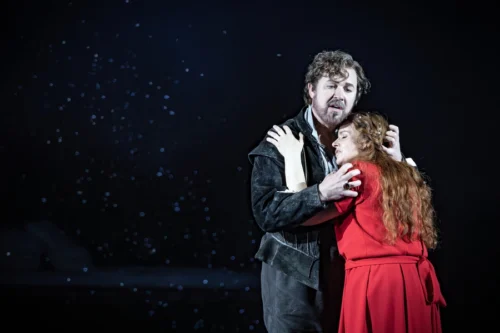
Elin Steele’s costumes are vaguely twentieth-century and there is no set as such from her for lighting designer Lizzie Powell to light. A few large searchlights are located in the wings; just a couple of ropes would help reduce the austerity. Is the absence of clutter on the stage a refreshing change? Yes, the absence did permit the audience to focus on a remarkable duet between Senta’s hunter lover Erik (Leonardo Caimi) and Senta with her realisation she must lose Erik and redeem the sufferings of the Dutchman through self-sacrifice.
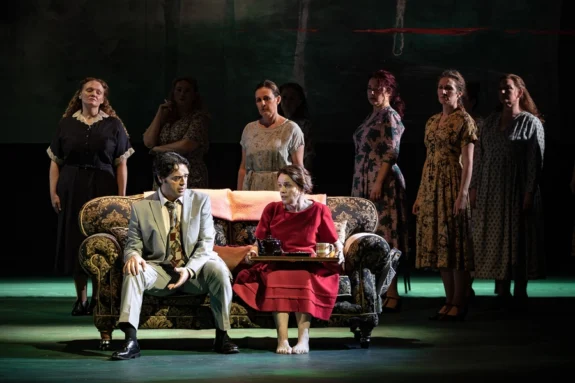
Rachel Nicholls, singing Senta is an experienced Wagnerian singer; her performances at Longborough and Grange Park Opera – where she this year as Freia in Das Rheingold – were extremely well-received. As Act II of this Dutchman opens Mary (Monika Sawa) is supervising the spinning women, without spinning wheels! Senta sits in front of the group, not wishing to become involved, as she is obsessed with the story of an immortal sailor. Unable to spin, the ‘spinning team’ fiddle with various items of clothing; they do sing enthusiastically in this ‘managing more with less’ atmosphere, it does go to show just what can be achieved with very little money but fine voices, thanks to the effort of chorus master Frederick Brown. Throughout this intense scene with Senta deep in her thoughts, the orchestra plays magnificently, Anders Swane playing the tuba with considerable flair and impeccable timing. As a break with the clutter free stage, a 1950s three-seater settee is pushed on the stage on which Erik tries to plead his case for a continuing relationship. Very soon the settee is removed as Daland (James Creswell) arrives with the Dutchman, the relationship with Senta is confirmed, as her father sings ‘May you win this noble man’. Senta responds with, ‘faithful until death’. As for evidence of the wealth of the Dutchman, there is none.
The intelligent playing by the WNO Orchestra continues throughout the developing third-act party with an order for the ‘steersman to leave your post to join us’ in the merrymaking. The WNO Chorus, too, makes the very best of the opportunity to impress in Birmingham with an abundance of energy. Erik makes one final attempt to change Senta’s mind, but only a ‘faithful woman can save the Dutchman from a hideous fate’. This is Senta responsibility. The 1940s iron bedstead on which Senta was born returns; now it serves as her deathbed. Not quite the script many in the audience were expecting. This work was the decisive breakthrough for Wagner’s operatic vision. WNO’s creative team exceeded the established norms of the opera that marked the real beginning of Wagner’s career. Overall, this was superbly sung and acted by the entire ensemble led was Bailey’s tormented Dutchman, Nicholls’s troubled Senta, Creswell’s bluff Daland and Caimi’s ardent Erik.
Sad news reached the audience during the performance that this Dutchman would the last opera conducted by Hanus whose effort has over the decade been distinguished by acclaimed performances of Peter Grimes, The Makropulos Case and Khovanshchina. His tenure as principal guest conductor with Icelandic Symphony Orchestra has begun. He will be a huge loss as will the annual Birmingham visits but the cash strapped WNO and the change in the Welsh Government will almost certainly result in a change of direction, following a ‘brand refresh’ and the use of artwork from Welsh artists for a poster campaign, with smaller initiatives across parts of Wales which have not previously benefited from the Cardiff-based iconic Wales Millennium Centre’s outreach programme. Hopefully, the ‘rebirth’ season next year will be an appropriate celebration in WNO’s 80th year and, with it, the continued success of this excellent orchestra.
Clive Peacock
Featured Image: Leonardo Caimi (Erik) and Rachel Nicholls (Senta) © Craig Fuller
Cast:
The Dutchman – Simon Bailey
Senta – Rachel Nicholls
Erik – Leonardo Caimi
Mary – Monika Sawa
Daland – James Creswell
The Steersman – Trystan Liŷr Griffiths
Senta’s Mother – Rhiannon Llewellyn
Nurse – Stacey Wheeler
Young Senta – Theodora Davies, Phoebe Turner
Production:
Director – Jack Furness
Designer – Elin Steele
Lighting designer – Lizzie Powell
Movement director – Rebecca Meltzer
Chorus master – Frederick Brown