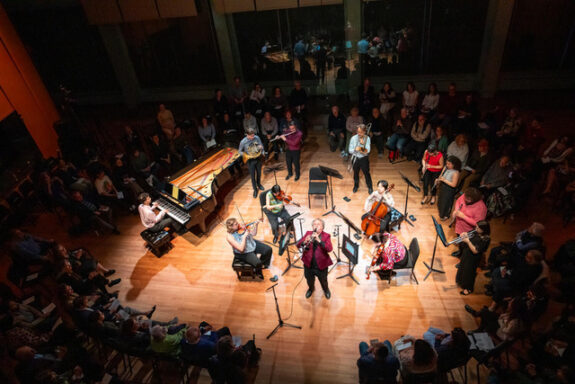
 United States Various, ‘Ensemble Connect Up Close: Songs of Cultural Transition’: David Krakauer (clarinet), Ensemble Connect. Carnegie Hall, New York, 6.5.2026. (RP)

David Krakauer was the guiding force – spirit doesn’t quite capture the clarinetist’s energy and enthusiasm for the music that was being played – behind Ensemble Connect’s exhilarating ‘Up Close’ concert, ‘Songs of Cultural Transition’. It was a deeply personal experience for Krakauer which he described as the musical equivalent of an episode of This is Your Life, featuring works he has loved, resurrected, championed, created and dazzled audiences with for decades.
Krakauer’s style has been described as ‘Klezmer Madness’ for its high-energy, eclectic fusion of traditional Eastern European Klezmer with contemporary rock, funk, jazz and classical influences. His playing lived up to the hype but there is more to the man than that. The concert featured music by Jewish composers who are all but forgotten and whom he has helped to resurrect. Much of that work has been in collaboration with the YIVO Institute for Jewish Research which celebrated its hundredth anniversary last year.
YIVO was founded in 1925 in Vilna (now Vilnius, Lithuania) by leading Jewish intellectuals to preserve Eastern European Jewish history, culture and language. In 1940, when the Soviet Union took full control of the city, YIVO relocated to New York City. Its vast archives preserve a broad spectrum of music including klezmer, Yiddish folk and theater songs, Hasidic tunes, cantorial music and Holocaust-related songs.
The concert opened with Paul Hindemith’s Kleine Kammermusik, a wind quartet that he composed in 1922, years before he was labelled a ‘degenerate’ composer by the Nazis and forced to emigrate to the US. Kleine Kammermusik is typical of Hindemith’s acerbic, avant-garde spin on the Baroque, leavened with a touch of Stravinsky. Flutist Cameron Cullen, oboist JJ Silvey, clarinetist Nicole Martin, bassoonist Marty Tung and hornist Will Sands etched the piece’s dissonances with clarity but impressed more in the solos and especially the witty musical dialogues that lace through it.
Clarinetist Anoush Pogossian was joined by violinists CoCo Mi and Laurel Gagnon, violist Abby Smith and cellist Alena Ariza in the Lento from Alexander Krein’s Jewish Sketches. Krein was a prominent Soviet composer and a leading figure in the Jewish national school of music that took root in Russia during the 1920s and 1930s. Jewish Sketches, composed in 1909 and 1910, blends traditional Jewish klezmer melodies with the harmonic languages of Western modernists like Alexander Scriabin, Claude Debussy and Maurice Ravel.
The Lento is the opening movement of the three-movement work and features the clarinet as soloist. Pogossian played its mournful solos, combining the sensibilities of Jewish liturgical prayer and klezmer sounds with penetrating emotion and mellow tones. The poignant mood was echoed in the strings as they wound their way through Krein’s melodies.
Although born in Argentina to Eastern European Jewish parents, Osvaldo Golijov is cut from much the same musical and cultural cloth as Krakauer but with a Latin American twist. The Dreams and Prayers of Isaac the Blind was inspired by the writings of the Medieval French Kabbalist rabbi who described everything in the universe as products of combinations of the letters of the Hebrew alphabet.
The same quintet, with Pogossian again as soloist, performed K’vakarat, the third movement of The Dreams and Prayers of Isaac the Blind. The solo line was originally written for a cantor to sing, but Golijov rearranged it for Krakauer, noting that the meaning of klezmer is ‘instrument of song’. Pogossian displayed her virtuosity and artistry in exquisite sobs of melody to mournful wails over the continually evolving emotional soundscape created by the other four musicians
Although Bartók was not Jewish, it is often assumed that he is due to his strong defense of Jewish colleagues and open defiance of the Nazis. He composed Contrasts for violin, clarinet and piano in 1938 on a commission by clarinetist Benny Goodman and violinist Szigeti, before emigrating to America.
Clarinetist Nicole Martin, violinist Laurel Gagnon and pianist Joseph Vaz played the last movement of the work, entitled Sebes, which is Hungarian for ‘fast’ (as is the boys’ dance on which it is based). In addition to Gagnon’s brilliant performance of its blazing cadenza, she had to switch between two differently tuned violins, as did Martin with clarinets. They also engage in rapid dialogues which Vaz entered into with equally fiery playing.
Krakauer performed first as a soloist in his ‘Love Song for Lemberg / Lvov’, inspired by a visit to his grandfather’s hometown, which is now Lviv, Ukraine. He described it as a tribute to the city’s Austro-Hungarian beauty and the hardships faced by its Jewish inhabitants. In this chamber music setting of the piece, Krakauer imbued the mournful waltz with richness and continuity of sound, squeezing more emotion out of a trill than imaginable. Violinists Gagnon and Mi also contributed to the piece’s complex emotional mood.
The concert ended with Krakauer as soloist in three works. First was his arrangement of a traditional klezmer tune, ‘Der Gasn Nign’, for clarinet and string quartet. He combined the virtuosity of his wild improvisations with a deeply emotive, more lyrical playing that conjured a long-ago past.
Krakauer, the wizard, was on full display in his improvised solo piece, ‘Synagogue Wall’, a high-energy blend of klezmer and avant-garde techniques. The wild, intense cries, howls and whispers that he made on the clarinet were the equivalent of the abandon with which a jazz singer scats. His connection with the audience was as intense as it was immediate.
Temperatures flamed even higher when Ensemble Connect joined Krakauer in his ‘hot-jazz’ arrangement of ‘Der Heyser Bulgar’. The piece pays homage to a type of Yiddish music that originated in present-day Moldavia and became popular with Jewish immigrants in America in the 1920s. Krakauer mesmerized the audience with the opening mournful solo in another display of amazing virtuosity coupled with profound emotion. He can sustain a high note longer than seems humanly possible. With the entry of the other musicians, they all but blew the roof off the Carnegie Hall.
Rick Perdian
Featured Image: David Krakauer (clarinet) and Ensemble Connect © Stephanie Berger
Ensemble Connect: Laurel Gagnon (violin), CoCo Mi (violin), Abby Smith (viola), Elena Ariza (cello), Camreon Cullen (flute), JJ Silvey (oboe), Nicole Martin (clarinet), Anoush Pogossian (clarinet), Marty Tung (bassoon), Will Sands (horn), Grace O’Connell (trumpet), David Seder (trombone), Joseph Vaz (piano)
Hindemith – Kleine Kammermusik, Op.24, No.2
Alexander Krein – Lento from Jewish Sketches, Op.12
Osvoldo Golijov – K’vakarat from The Dreams and Prayers of Isaac the Blind
David Krakauer – ‘Love Song for Lemberg / Lvov’, ‘Synagogue Wail’
Bartók – Sebes from Contrasts
Traditional – ‘Der Gasn Nign’, ‘Der Heyser Bulgar’ (arr. D. Krakauer)