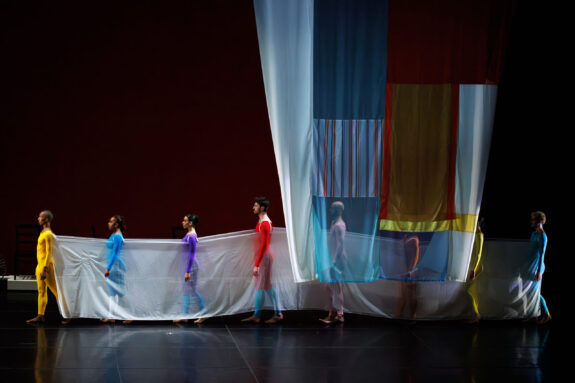
 United States Cage, Anderson – ‘Dancing with Bob: Brown, Rauschenberg & Cunningham Onstage’: Trisha Brown Dance Company. The Wallis Annenberg Center for the Performing Arts, Beverly Hills, 7.5.2025. (JRo)
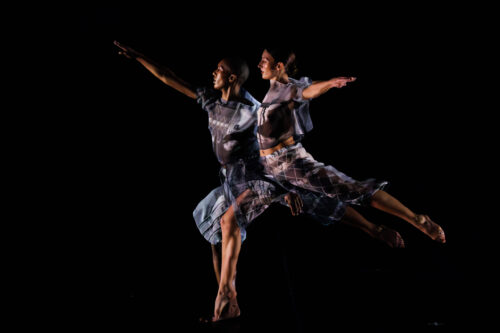
Dancers: Savannah Gaillard, Rochelle Jamila, Burr Johnson, Claude Johnson, Catherine Kirk, Ashley Merker, Patrick Needham, Jennifer Payán, Spencer Weidie
To be in the audience last night and see the Trisha Brown Dance Company performing works by Brown and Cunningham was to travel back to the latter part of the twentieth century and the lofts of Lower Manhattan – to a time when a community of artists was teeming with ideas and optimism. It seemed as if the air in the theater was permeated with the energy of that time and place, yet the dancing, sets and costumes were as timeless as only true art can be.
The common denominator in Brown and Cunningham’s works was Robert Rauschenberg, one of the seminal figures in the mid-twentieth century’s move away from the gestural painting of Abstract Expressionism towards a more conceptual approach to art. Early in his career, Rauschenberg created White Paintings, which echoed the stillness of Kasmir Malevich’s white-on-white Suprematist works and influenced John Cage. With a restless intelligence that touched many art forms, Rauschenberg was noted for his photography, printmaking, sculpture and Combine paintings.
What struck me was the sense one had of Rauschenberg’s hand in every element of the sets and costumes. Neither slick nor facile, the sets and props of both Set and Reset and Travelogue were carefully considered art pieces themselves, and they contributed as much to the realization of the works as the dancers and the music.
In Trisha Brown’s Set and Reset, fluid movement was layered over the geometry of bodies in space. Dancers in constant motion traveled across the floor with ceaseless vitality, but there was a gentleness to their movement like the stealthy grace of cats. Nothing felt forced – all steps grew organically from the torso in a perfect balance of grounding and suspension. The dancers’ limbs exhibited the full range of motion possible for the bodies’ joints: arms swung back and forth like lazy pendulums and legs bent, stretched and leapt. All the while, arms and legs worked equally and in harmony to realize the choreography.
With electronic synthesizer and voice, Laurie Anderson drew a dusting of melody out of the complex patterns of her percussive score. The music and dance blended together so seamlessly that to listen to Long Time No See after seeing Set and Reset is to see in the mind’s eye Brown’s choreography.
Rauschenberg’s tantalizing sculpture of white silk stretched over a rectangular frame and bookended by two silken pyramids presided over the dance. On them were black and white projections of newsreel footage and NASA imagery: ships, skyscrapers, rockets, monkeys and headlines were layered on the surfaces and silkscreened onto the silky white costumes of the dancers. The set and costumes felt ethereal yet grounded, much like the dance itself. The rectangle and pyramids were centered on the stage then gracefully rose into the air to float over the dancers. The lighting by Beverly Emmons beautifully illuminated the art and dance, and the reconstruction of Rauschenberg’s sets and costumes was superb.
To John Cage’s Telephones and Birds, Merce Cunningham and Rauschenberg conjured in Travelogue an absurdist Dada universe where episode upon episode delighted with its boldness and whimsy. To quote from the press release regarding Cage’s score: ‘Three musicians…will take turns playing bird calls and dialing telephone numbers with automated voice messaging systems that yield a variety of responses. What they’ll play (and how loud, how long, etc.) is determined by a random number generator. The randomized, automated responses will overlap at times, creating a unique, improvised, and irreproducible performance over its 33-minute runtime’.
Not an easy score to dance to and yet the dancers’ timing was so masterful that the proceedings felt effortless. Travelogue opened with a dancer dragging a long white platform on stage with a rope. Seven chairs on the platform were each occupied by a dancer and each chair was separated by a bicycle wheel – shades of Marcel Duchamp. The humor was instantaneous as automated voices answered the mobile phones, giving information and directing callers while the dancers posed nonchalantly on the chairs.
Arrayed in brightly colored unitards like a flock of multi-colored birds, the dancers descended the platform and commenced their vaudevillian peregrinations. A translucent banner of colored squares and rectangles was suspended from the ceiling and dominated the stage – Rauschenberg’s use of the delicate fabric having been influenced by a trip to India. There was more in store with the artist’s designs of sails, fans and scarves used as props in the dance.
In one sequence, seven dancers at evenly placed intervals walked on the stage with a translucent, horizontal sail. In a delightful surprise they drew together and the sail folded onto itself. Charismatic dancer Burr Johnson waved two black-and-white racing-style flags or walked an invisible tightrope. There were other nods to circus stunts with imaginary rope climbing and Claude CJ Johnson dancing with tin cans strapped to his hips and legs. There were references galore to birds: attached at the dancers’ waists, color wheel fans of silk skimmed the floor and opened like fluttering bird plumage; a group of eight dancers bent over like shorebirds rooting in the sand; and a single dancer exited the stage like a waddling duck or pelican.
It is easy to imagine the excitement Cage, Cunningham and Rauschenberg shared during the process of creating Travelogue. The piece’s exuberant spirit coupled with the discipline inherent in Cunningham’s technique was evident. Discipline and exuberance also describe Brown, Anderson and Rauschenberg’s collaboration. After all, inspiration and structure are the prerequisites for the creation of art that endures.
Jane Rosenberg
Featured Image: Trisha Brown Dance Company in Merce Cunningham’s Travelogue © Ben McKeown
Set and Reset (1983)
Choreography – Trisha Brown
Music – Laurie Anderson, Long Time No See
Original design and Costumes – Robert Rauschenberg
Lighting – Beverly Emmons
Choreography staged – Carolyn Lucas with Cecily Campbell, Marc Crousillat, Jamie Scott
Design and Production reconstruction consultants – Jessie Ksanznak, Nick Kolin
Scenic reconstruction – Lawrence Voytek, Show Fab
Costume reconstruction – Amanda Kmett’Pendry, Dyenamix Inc., Zarah Green
Travelogue (1977)
Choreography – Merce Cunningham
Music – John Cage, Telephones and Birds
Original design and Costumes – Robert Rauschenberg
Choreography staged – Marcie Munnerlyn, Andrea Weber
Music director and Realization of Telephones and Birds for mobile devices – Adam Tendler
Design and Production consultant – Davison Scandrett
Scenic reconstruction – Mrinali Thanwani, Bland Wade, Kris Julio
Sail reconstruction – Rose Brand
Costume reconstruction – Earlene Munnerlyn, Marissa McCullough
Lighting reconstruction – Davison Scandrett, Joe Levasseur