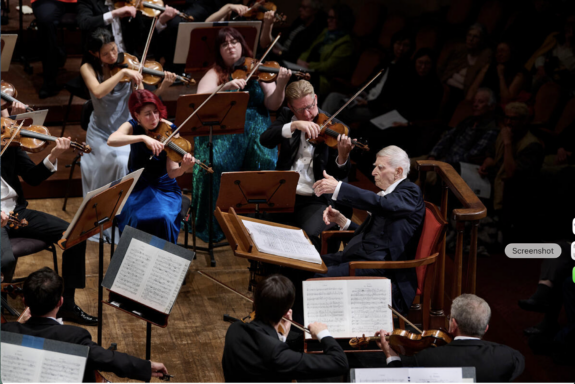
 Mahler: San Francisco Symphony / Herbert Blomstedt (conductor). Davies Symphony Hall, San Francisco, 15.5.2026. (HS)
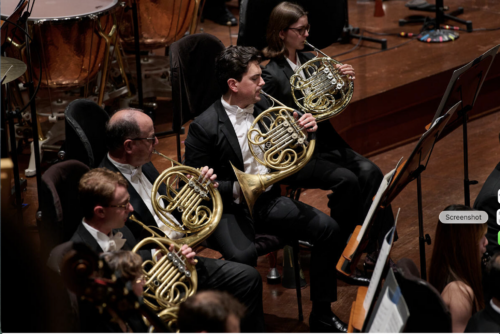
Mahler – Symphony No.9 in D major
Under Herbert Blomstedt’s direction on Friday, Mahler’s Ninth Symphony flowed with serious intent in an extraordinary performance with the San Francisco Symphony in Davies Symphony Hall. It is a place and an orchestra he knows well. He was music director here from 1985 to 1995 and has been conductor laureate ever since, a title he also has with orchestras in Leipzig, Copenhagen, Stockholm and Dresden.
For a while, though, it looked as if Herbert Blomstedt wasn’t going to get through the full 90 minutes of Mahler’s Symphony No.9. It took five minutes for four able-bodied men to get the 98-year-old onto the podium and settled on a piano bench. They came out again to attend to him three-quarters of the way through the energetic third movement. On Saturday, on the advice of his doctors, Blomstedt withdrew from the remaining two performances and David Robertson was announced to conduct.
Blomstedt’s performances in San Francisco have always been serious occasions – this one especially so because it just might be the last. And yet, the music reached the highest level. Conducting without a baton, he seemed totally in command, drawing Mahler’s long lines, complex counterpoint and sonorities of every color from musicians hanging on his gestures.
As music director in San Francisco, he impressed with fully thought-through approaches to the big classics, especially Bruckner and Sibelius. Early in his tenure, a performance of Mahler’s Symphony No.2 was a highlight. The long arc of these pieces always felt natural. Details such as cues and attacks came through in response to precise baton gesture indications.
On Friday evening, from my seat directly behind him, I could not see his hands except when his gestures were at an angle, but the unanimity remained impressive. There was energy and expressiveness. Even better were the clear differentiations between darker and brighter paragraphs in the music. Tempos were on the deliberate side but never flagging.
The opening, with its offbeat rhythms and spare statements of the foundational themes, carried its weight without becoming ponderous. Each statement was separately given breathing space, as they laid out the building blocks of what was to come. As the iterations played out in Mahler’s seeming endless variations, it was like encountering an old friend who looked just enough different to be startling. The result was a sort of intimacy, even in the spacious exclamations from the brass and the busy timpanist, Edward Stephan.
The long first movement revealed its changing character with clarity, without excess emphasis. The more anxious paragraphs made a return to the steady pace, almost comforting, and the final measures evaporated with a soft touch.
The more straightforward music of the second movement changed temperature with carefully delineated tempos, textures and sonic colors. The stomping of the first ländler contrasted with the stateliness of the first movement’s reflectiveness, but the next venture in three-beat time felt almost like a Johann Strauss waltz. The changes were delicious, especially at one point when they seemed to be bumping one another.
The busiest movement, which Mahler titled Rondo-Burleske, relished all the sharp shifts and emphasized the contrapuntal elements as they wove around each other. About halfway through the movement, Blomstedt gradually began to lean to his right, further and further. At one point I feared he might tip over, but his helpers came out with an armchair and prepared to swap it for the piano bench. They tapped him gently on the arm. The music stopped, and much of the audience applauded until the switch was made.
Blomstedt called out a measure number with a strong voice, and the music picked up seamlessly, as smoothly as it happens in a rehearsal. More secure with something to hold himself up, he seemed like a conductor reborn.
As Mahler began work on this symphony, he had been diagnosed with an incurable heart inflammation. His irregular heartbeat reminded him with each breath that he had limited time. His gestures seemed even more emphatic as the Adagio finale unfolded. Mahler fashioned this symphony to reflect his own pending death. Rather than rising to a victorious climax, as had his previous symphonies, this one’s Adagio finale goes out on a reflective note.
No doubt Blomstedt could feel some of the same emotional tugs, his body weakening while his mind and ability to communicate with his musical colleagues remained strong. As the finale unfolded, his gestures seemed even more emphatic. A tender touch to the Bach-like chorale that opens the movement established an atmosphere of peace and acceptance, his hands gently shaping the music. Even as parts of the concluding Adagio rose to richly orchestrated peaks, there was always a sense of resignation with a few moments reflecting annoyance (but never contentiousness). The final minutes were touchingly serene.
With my attention focused on the bond that had clearly been reestablished with this orchestra, much of the all-star work by the individual musicians floated past only briefly noticed. Special kudos to concertmaster Alexander Barantschik for his bittersweet moments in the finale and the chamber-music-like unanimity of the string section. The woodwinds, together with the horns, were arresting throughout, and Katherine Siochi’s harp statements hit just the right notes.
At the end, Blomstedt’s helpers returned to carefully rotate his chair so he could acknowledge a well-deserved raucous ovation. The audience did not let up even as the process to get him into his wheelchair continued. As he was rolled off the stage, Herbert Blomstedt waved cheerily to the audience and to members of the orchestra still familiar to him. His broad smile made for a satisfying, if heart-tugging, moment.
Harvey Steiman
Featured Image: Herbert Blomstedt conducts the San Francisco Symphony in Mahler’s Ninth © Stefan Cohen
I’m grateful for the details description of what made the performance remarkable.
He’s supposed to give the same programme in Stockholm next weekend, May 29-30, and I’m sure hoping he will be able to make it through. A remarkable artist (and a remarkable symphony)!
I was there, Friday night. On Saturday afternoon, I received an email saying Blomstedt would be unable to conduct Saturday night’s performance, for which I also had a ticket. David Robertson, who had been helping conduct rehearsals for the Mahler 9, was being called in to the breach, and he led a truly electrifying performance, with the SF Symphony playing out their hearts for him. So astonishing that afterwards I went to the Symphony website to get a ticket for the Sunday afternoon performance: so heart-stoppingly beautiful. Sadly, apparently no reviewers were on hand to see it.
As it happens at least Joshua Kosman (On a Pacific Aisle) was there to review the Sunday performance. His review agreed with your comments.
This was a profound embarrassment to the once Maestro Herbert Blomstedt. Among other things it was MUCH TOO SLOW. Even the Blomstedt recordings previously came in at a longish 1:23. This one was 1:34 (not counting the pause to re-secure him in the chair)! You can see the musicians struggling with what had become a dirge. Bad decisions all around. The SF Symphony should be ashamed of themselves.